Hoop House Plastic Calculator
Estimate greenhouse film width, roll length, end wall plastic, overlap, shrink allowance, waste, and finished sheet weight from your hoop house dimensions.
Use the measured bow arc if you have it. Otherwise the calculator estimates the arc from width and center height, then adds side overlap, baseboard or wiggle wire allowance, end laps, seams, and waste.
Film Thickness and Approximate Sheet Weight
| Film thickness | Microns | Weight per 1,000 sq ft | Typical use |
|---|---|---|---|
| 3 mil | 76 microns | 14.2 lb | Short season covers and low tunnels |
| 4 mil | 102 microns | 19.0 lb | Temporary tunnels with light handling |
| 6 mil | 152 microns | 28.4 lb | Common greenhouse and hoop house film |
| 8 mil | 203 microns | 37.9 lb | Reinforced or exposed installations |
| 10 mil | 254 microns | 47.4 lb | Heavy duty covers and custom panels |
Roll Width Fit by Common Hoop Arc
| Roll width | Good fit range | Allowance remaining | Planning note |
|---|---|---|---|
| 16 ft | 4-8 ft low tunnels | 1-4 ft | Often enough for bed hoops and side tuck |
| 24 ft | 10-12 ft caterpillar tunnels | 1-3 ft | Check baseboard wrap before ordering |
| 28 ft | 12-16 ft walk-in tunnels | 1-4 ft | Useful when sides roll up |
| 32 ft | 16-20 ft high tunnels | 1-5 ft | Common one-piece cover size |
| 42 ft | 24-30 ft gothic houses | 2-6 ft | Reduces panel seams on wider spans |
| 48 ft | 30-34 ft production bays | 2-5 ft | Best when the measured arc is known |
End Wall Style Film Rules
| End wall style | Calculator approach | Opening treatment | Best use |
|---|---|---|---|
| Open ends | No separate end wall film | No cutout | Low tunnels and vented caterpillars |
| One arched end | One cross-section area | No cutout | One fixed end and one open end |
| Both arched ends | Two cross-section areas | No cutout | Simple plastic end walls |
| Door cutouts | Two areas minus openings | Door area removed from each end | Walk-in doors or roll-up ends |
| Gable style | Width times height times shape factor | Door area removed from each end | Framed flat end walls |
Example Film Totals Before Waste
| House size | Typical cover cut | Main cover area | End wall range |
|---|---|---|---|
| 10x20 ft | 24 ft x 24 ft | 576 sq ft | 0-140 sq ft |
| 14x48 ft | 28 ft x 52 ft | 1,456 sq ft | 0-230 sq ft |
| 20x96 ft | 32 ft x 100 ft | 3,200 sq ft | 0-390 sq ft |
| 30x96 ft | 42 ft x 100 ft | 4,200 sq ft | 0-720 sq ft |
| 34x144 ft | 48 ft x 150 ft | 7,200 sq ft | 0-940 sq ft |
Measure before ordering: A real tape over the bow beats a drawing, especially on gothic or home-bent hoops where the shoulder radius changes the cover width.
Plan the fastening path: Add enough plastic for wiggle wire channels, baseboard wraps, roll-up side pipes, and the final trim before you compare roll widths.
When you prepare to purchase plastic film for your hoop house, you must determine the exact amount of plastic film that is required to build the greenhouse. In order to calculate the necessary amount of plastic film for the greenhouse, you must take into account that the plastic film should reach the ground on both sides of the hoop house, the plastic film should wrap around the baseboards of the greenhouse, and there should be extra film to prevent the wind from damaging the plastic. If the amount of plastic film are calculated incorrectly, you could either end up wasting your money by purchasing too much plastic film, or you could lose time due to purchasing plastic film that is too short to cover the hoops.
In order to calculate the amount of plastic film that you should purchase for your hoop house, you will need to take a few different measurements of your greenhouse prior to ordering the plastic film from your supplier. You should measure the distance of your hoop house over the hoops, not the measurements from the building plans for the greenhouse. The plans may indicate the measurements for the hoops, but the actual distance of the hoops will change after they are installed into the ground.
How to Measure Plastic Film for Your Hoop House
Additionally, you must also determine whether the ends of your hoop house will be open or enclosed, as this will change the amount of plastic film that is required for your greenhouse. Finally, if there is channels for the wiggle wire or wraps for the baseboards of your greenhouse, you will need to determine how much plastic film is required to allow for these features. Many people do not account for the length of plastic film that is required to allow the plastic film to reach past the hoop house, and to provide enough extra plastic film for the plastic to be tucked under the baseboards.
This extra length of plastic film is a significant length of plastic film for long hoop house greenhouses. In addition to accounting for the length of the hoops, plastic film must also be provided for the ends of the hoop house. If you allow for a two-foot lap of plastic film beyond the last hoop of your greenhouse, you will have plastic film that provide enough length for the plastic to be secured against the wind.
However, this length of plastic film is also an additional length of plastic film that you must account for in the total amount of plastic film that you purchase. Another factor that will influence the amount of plastic film that is required for your greenhouse is the thickness of the plastic film. Twenty-five mil plastic film is a common choice for plastic film for hoop house greenhouses, as it balances the cost of the plastic with the durability of the plastic film.
Four mil plastic film is less expensive, but may be insufficient for greenhouses that are to remain intact for multiple growing seasons. Eight mil plastic film is more durable, but comes at a higher cost. The weight of the plastic film will change with the thickness of the plastic film; the thicker the plastic film, the more heavy the plastic film will be for individuals to lift onto the hoops of the greenhouse.
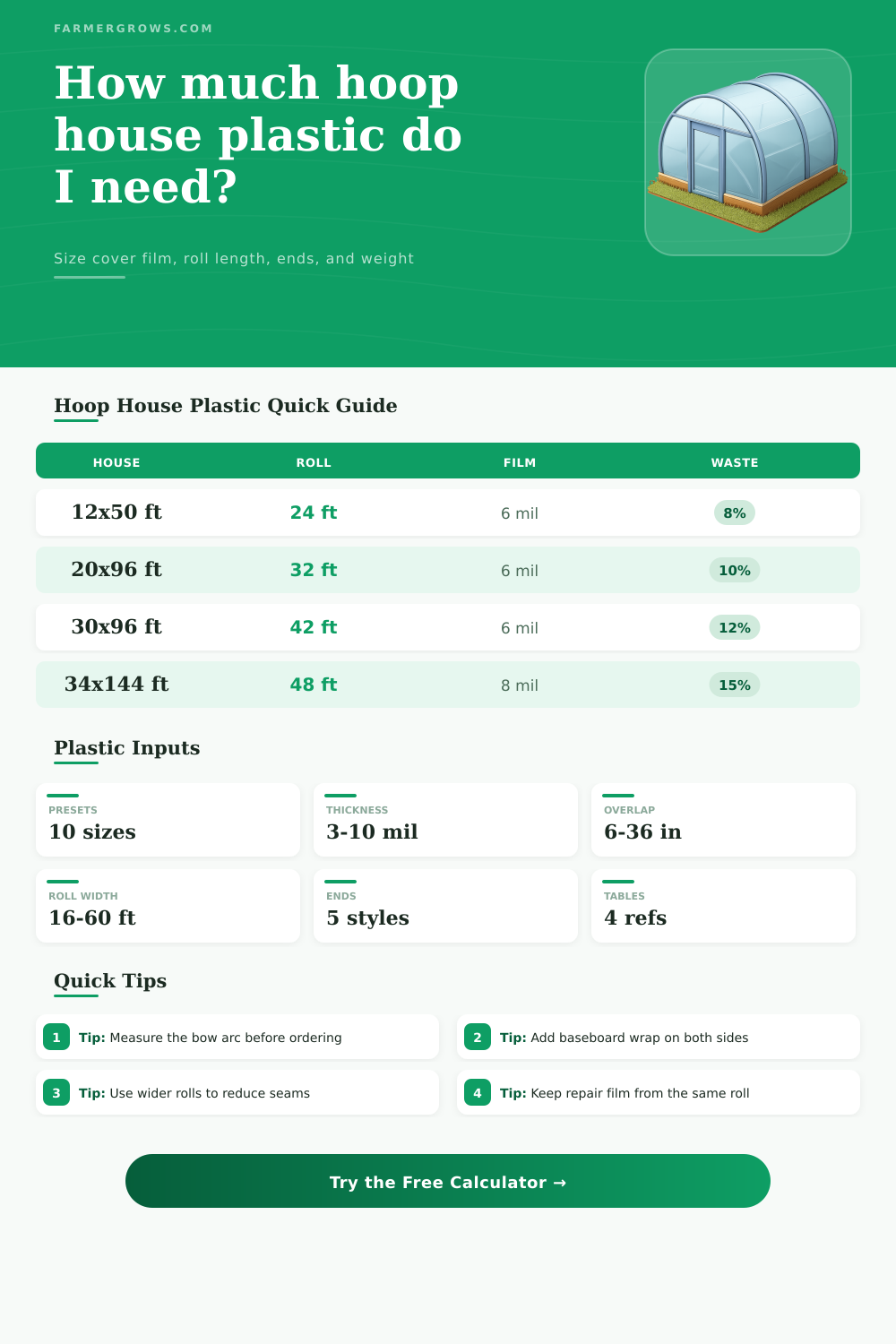
In the tables included in the plastic film calculator, the typical widths of the rolls of plastic film are provided for hoop arcs of common lengths. For instance, a twenty-foot arc hoop house will typically require a roll of plastic film that is thirty-two feet in length, once you include the length of the plastic film that is required to allow the plastic to reach past the hoops in the measurement. A thirty-foot gothic arc hoop house will require a roll of plastic film that is forty-two feet in width or wider if you wish to avoid having a plastic film seam in the center of the greenhouse.
These tables provide starting points for plastic film calculations, but you should measure your own hoops. If your arc is larger than the measurements listed in these tables, the plastic film calculator will indicate that you will have to purchase two panels of plastic film. In addition to the arc of your hoop house, the style of the end walls of your greenhouse will play a major role in the amount of plastic film that is required to cover the hoops.
If the ends of your greenhouse have open ends, you will only need plastic film for the main cover for the greenhouse. However, if the ends of your greenhouse are arched and to be covered in plastic film, you will need additional plastic film to cover those ends. The plastic film for the ends can be reduced if the greenhouse has a door that you will cover in plastic film, but plastic film will still be needed for the door frame such that the plastic film does not have to be torn during placement.
The plastic film calculator will adjust for these factors so that the length of plastic film that is calculated will not include the length of plastic film that will be used for the end walls. Another consideration for plastic film purchase is the allowance for plastic film waste. If you plan to be very careful when placing the plastic film into the hoops of the greenhouse, a five percent waste allowance will be sufficient.
However, if you are placing the greenhouse panels for the first time, or if the location of the greenhouse may introduce wrinkles or other issues with the plastic film, a ten percent waste allowance will provide enough extra plastic film to account for these issues. Fifteen percent waste is sufficient for plastic film that will be placed in a location that experiences strong winds, or if you plan to use the plastic film for any repairs to the greenhouse that may occur in the future. It is generally more cost effective to have too much plastic film for your hoop house greenhouse than to have too little plastic film for the greenhouse.
Twenty feet of plastic film is an easy amount to donate to the plastic film for next growing season’s plastic film needs, but twenty feet of plastic film is not an amount that can be easily accounted for in the plastic film that is purchased for your greenhouse. The best way to determine the amount of plastic film that you will need is to utilize the plastic film calculator that is available for greenhouse farmers. However, you must also use a tape measure to measure the length of your greenhouse.
Measuring the plastic film greenhouse yourself will allow you to note any differences in the arc of the hoops; a higher arc on one end of the greenhouse than on the other end may indicate that you should of purchased plastic film that allows for extra length beyond the hoops.