Poly Pipe Flow Calculator
Estimate water flow through poly pipe from SDR, size, inside diameter, pipe length, pressure drop, slope, inlet pressure, fittings, flow mode, and imperial or metric units.
Pressurized mode solves flow from available pressure drop with Hazen-Williams. Gravity mode estimates full-pipe slope flow with a Manning-style approximation and still checks equivalent friction loss.
Poly Pipe Flow Result
Enter pipe details to estimate flow and pressure loss.
This grid compares nearby IPS poly pipe sizes using the same SDR, pressure drop, length, fittings, slope, C factor, and flow mode.
| Nominal IPS poly | Outside diameter | SDR 11 ID | SDR 17 ID | Common farm use |
|---|---|---|---|---|
| 3/4 in | 1.050 in | 0.859 in | 0.926 in | Small garden, drip, and greenhouse branches |
| 1 in | 1.315 in | 1.076 in | 1.160 in | Zone feeds and stock trough branches |
| 1-1/4 in | 1.660 in | 1.358 in | 1.465 in | Long laterals and modest pump lines |
| 1-1/2 in | 1.900 in | 1.555 in | 1.676 in | Greenhouse headers and nursery supply |
| 2 in | 2.375 in | 1.943 in | 2.096 in | Orchard blocks, transfer, and pond lines |
| 3 in | 3.500 in | 2.864 in | 3.088 in | High flow farm mains and gravity outlets |
| 4 in | 4.500 in | 3.682 in | 3.971 in | Large mains, manifolds, and pond plumbing |
| 6 in | 6.625 in | 5.420 in | 5.846 in | Large transfer, irrigation supply, and drainage |
| Velocity | Result meaning | Typical fit | Field check |
|---|---|---|---|
| Under 2 ft/s | Gentle, low-loss flow | Suction, gravity, and settling-sensitive runs | Large pipe may not self-scour sediment |
| 2 to 5 ft/s | Efficient working range | Most farm mains and irrigation supplies | Check end pressure on long runs |
| 5 to 7 ft/s | High but often usable | Short transfer and washdown lines | Close valves slowly to reduce surge |
| Over 7 ft/s | Review pipe size | Short intermittent flow only | Friction, noise, and water hammer risk rise fast |
| Input | Calculator role | Flow effect | Practical note |
|---|---|---|---|
| Lower SDR | Smaller calculated ID | Less flow for same pressure drop | Often higher pressure rating, but confirm pipe print line |
| Higher SDR | Larger calculated ID | More flow for same pressure drop | May have lower pressure rating than thick-wall pipe |
| 5% fittings | Light equivalent length | Small pressure increase | Few couplers and gentle bends |
| 30% fittings | Heavy equivalent length | Noticeable flow reduction | Manifold with valves, filters, tees, and elbows |
| Slope | Drop per 100 ft | Gravity effect | Common use |
|---|---|---|---|
| 0.25% | 0.25 ft | Low capacity | Carefully graded drains and tank overflows |
| 0.50% | 0.50 ft | Moderate capacity | Pond returns and yard drain lines |
| 1.00% | 1.00 ft | Strong capacity | Farm overflow and short gravity supply runs |
| 2.00% | 2.00 ft | High capacity | Short steep bypass or transfer drains |
These estimates are for clean water in smooth poly pipe. Final designs should also check elevation change, pump curves, surge control, pipe pressure rating, codes, and manufacturer data.
When you install poly pipe for irrigation or for feeding stock troughs, you need to be able to calculate how much water will arrive at the end of that poly pipe. Additionally, you need to make certain that the poly pipe that you select will provide for that demand for water, without wasting any of the water pressure or creating problem along the way to the end of that poly pipe. Calculating the water flow through poly pipe can be difficult due to the numerous factor that affect the flow; the size of the poly pipe, the thickness of the walls of the poly pipe, the length of the poly pipe, the slope of the ground, and the number of valves and elbows along the poly pipe system.
Poly pipe is a material that people often select for projects due to its toughness, flexibility, and low cost. However, the physical qualities of poly pipe can mask problems that may exist within the system. For instance, poly pipe that is large in size externally can have a relatively small diameter that allows for water movement within the system.
How to Calculate Water Flow in Poly Pipe
The SDR (Strength-Diameter) ratio for poly pipe is a value that provides information regarding the relationship between the outside diameter of the poly pipe and the thickness of the walls of the poly pipe, but does not provide information regarding the flow of water through that system. You can use a calculator to calculate many of these factor; the calculator accounts for the flow of water through pressurized poly pipe using the Hazen-Williams equation, as well as the flow of water through gravity-fed poly pipe using a Manning-style approximation equation. The individuals that use the calculator dont need to memorize these equations; rather, the calculator will provide the results of these equations.
By increasing the SDR number for the poly pipe, the walls of the poly pipe will become thinner. As a result, the inside diameter of the poly pipe will increase. An increase in the inside diameter will increase the flow of water through the poly pipe, but will reduce the pressure of the water that exits the end of the poly pipe.
This trade-off is beneficial for short lengths of poly pipe that have low inlet and outlet pressures; however, it is potentially problematic for long lengths of poly pipe or high required outlet pressures. The calculator makes it easy to see how these two factors trade off against one another, so that individuals do not have to manually calculate these value. Additionally, it is also possible to enter the inside diameter of a poly pipe that is of an older manufacture; many manufacturers made older poly pipes with different inside diameters than many of those that are manufactured today.
Both the length of the poly pipe and the number of fittings along the poly pipe can impact the flow of water through that system. Fittings along the poly pipe can create resistance to the movement of water, similar to the effect of increasing the length of the poly pipe. Percentages can be entered into the calculation of the flow of water through the system to account for this resistance.
For instance, if the fitting included a manifold, it may have a certain percentage of resistance in relation to its number of valves; a straight section of poly pipe that includes only a few couplers may have a different percentage of resistance. These percentages impact the velocity of the water through the poly pipe, as well as the outlet pressure of the poly pipe. Both of these factors need to be monitored while the water is flowing through the system.
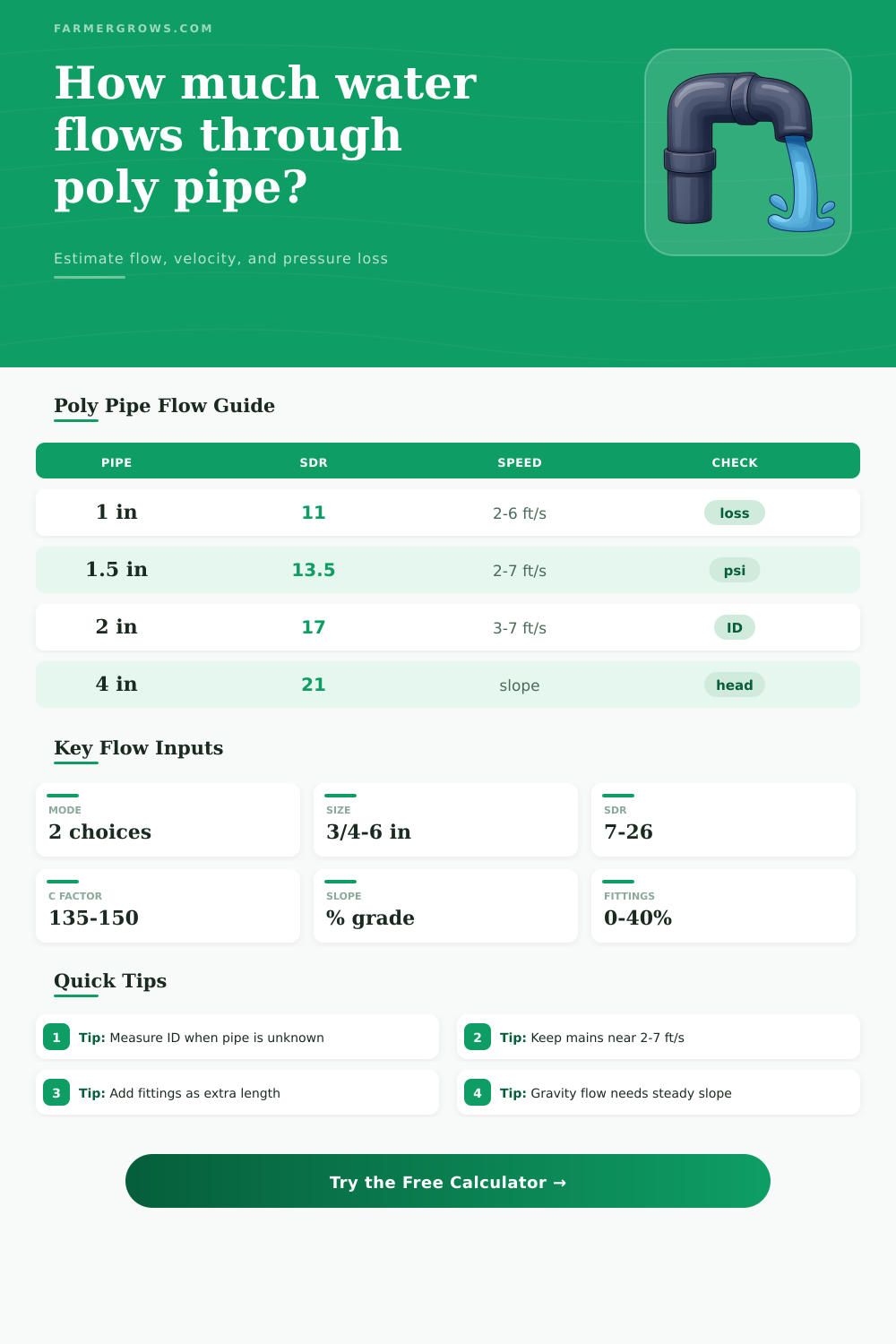
The velocity of the water within the poly pipe can have a great effect upon the system. If the velocity of water through the poly pipe is too low, sediment will begin to settle within the system. If the velocity of the water is too high, it may create noise within the poly pipe system, it can create wear on the poly pipe fittings, and it can create the phenomenon of water hammer within the poly pipe system.
Maintaining the velocity of water within the system within a middle range will ensure that the system efficiently moves water through the poly pipe without damaging that system. The calculator will alert the individuals entering the calculation if the calculated velocity falls outside of the ideal range for that system, allowing individuals to adjust the size of the poly pipe as necessary. Poly pipe systems that rely upon gravity to move the water from one location to another have different dynamics than those that rely upon inlet water pressure to move the water.
With gravity-fed systems, even a small slope to the poly pipe system can allow for the movement of a great deal of water through the system. However, creating steeper slopes increases the capacity of the system for water movement, but also can create a problem in that the system will not be full of water. The calculator system allows for the assumption of a fill level of the poly pipe system so that one can understand the outcome of the system even when it is not filled with the maximum volume of water.
The outcome of a calculation of the water flow through a poly pipe system may approach the ideal calculated outcome, but the outcome in the real world may differ. For instance, the temperature of the water can alter the pressure ratings of the poly pipe, the sediment load in the water changes over time, the amount of water moved by the pumps may not be as indicated on the pump’s label, and the elevation of the water changes. Therefore, the calculator provides an individual with a baseline estimate for how the system will function, but cannot account for all of the potential variable that exist in the real world.
Many individuals choose the size of the poly a system based off the available sizes for that type of poly pipe, or the size that is used by others within their own farms. However, such a selection method may fail if the demand for water within the system increases. For instance, poly pipe that is of a diameter that is sufficient to provide water for twenty stock troughs may not be able to provide water to forty troughs.
Therefore, individuals should of used the poly pipe flow calculator to test a variety of sizes for the poly pipe, prior to purchasing that poly pipe. You can also use the calculator to determine how the same poly pipe system functions in different modes, such as changing from a pressurized mode to a gravity-fed mode. One of the most common mistake that occur in the implementation of poly pipe systems is ignoring the resistance that the fittings along that system can create.
For instance, a header for a poly pipe system that includes numerous outlets and a filter may create as much resistance to the flow of water as a long length of the poly pipe system itself. Thus, ignoring the impact of such resistance will result in an underestimation of the required outlet flow of water, and an underperformance of the system created by the poly pipe. Therefore, the individual should enter the resistance of the systems fittings into the calculator in advance of burying the poly pipe along the predetermined trench.
In addition to avoiding the aforementioned problem related to the fittings along the poly pipe system, it is also necessary to avoid assuming that the inlet pressure will always remain the same. For instance, if a series of pumps that cycle on and off with demand for water on the property supplies the water, the outlet pressure will be different than that which is supplied at the pump. The calculator calculates the outlet pressure after the water flow resistance along the poly pipe system has been removed from the inlet supply pressure.
Thus, if the outlet pressure is relatively low in the calculations, it will be even lower in the real world. By using a calculator to calculate the various aspects of a poly pipe system, it is possible to avoid the high cost of replacing poly pipe that is too small to handle the demands of the water system.