PPFD to Watts Calculator
Estimate grow light PPF, electrical watts, watts per fixture, and daily light integral from your canopy area, target PPFD, fixture efficacy, dimmer setting, and optical loss.
Use the calculator for a planning estimate before hanging fixtures or changing a dimmer map. PPFD is the target photon density at the canopy, while watts depend on fixture efficacy and losses between the LEDs or lamp and the crop surface.
Efficient full-spectrum boards, bars, and commercial grow fixtures.
Strong flowering output, but lower photon efficiency than many LEDs.
Broad spectrum ceramic metal halide for benches and mixed crops.
Common for propagation where lower PPFD targets are acceptable.
Canopy area in m² = square feet × 0.092903, or direct square meters.
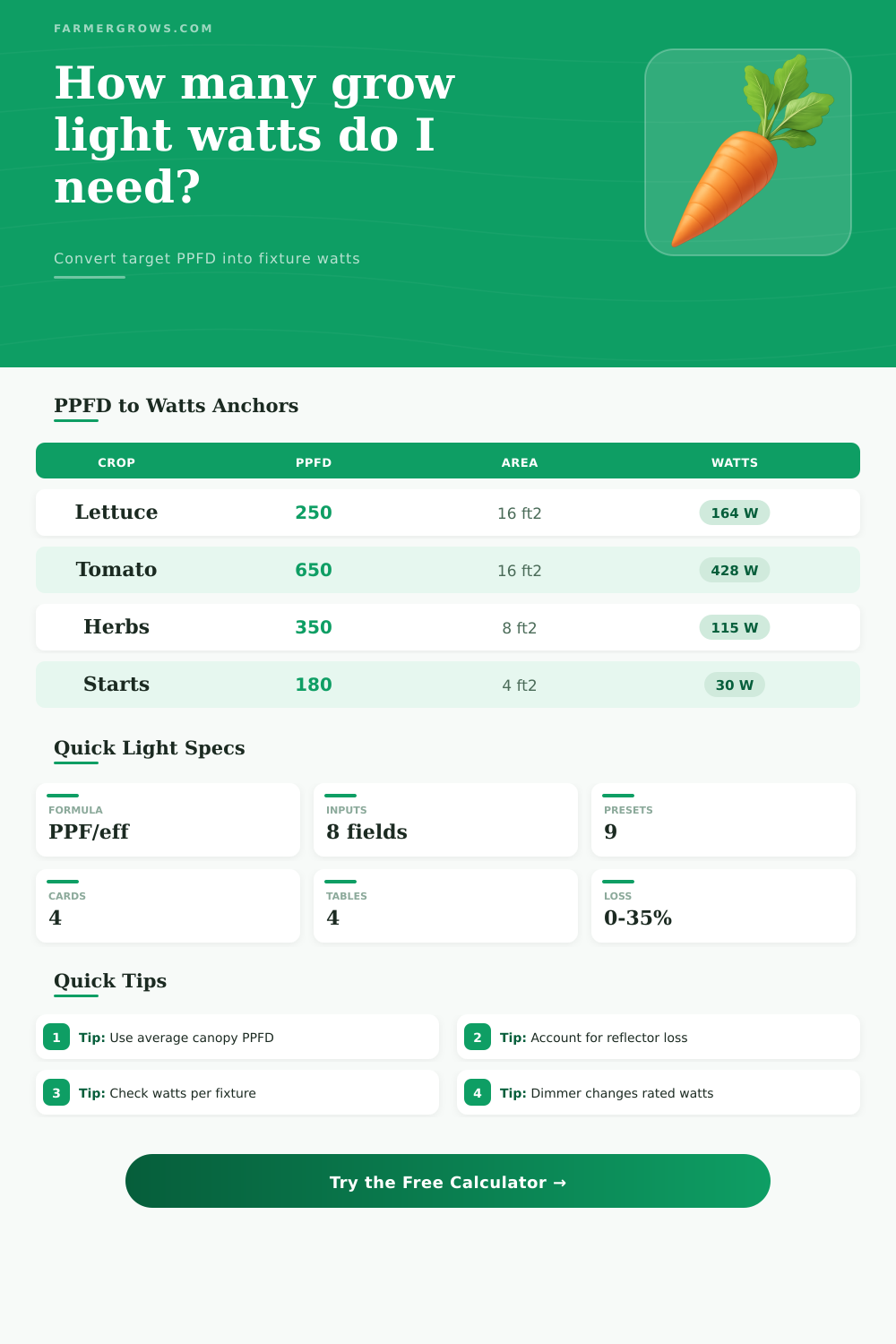
Required PPF = target PPFD × canopy area m² ÷ (1 - optical loss decimal).
Electrical watts at dimmer = required PPF ÷ fixture efficacy. Rated watts at 100% = electrical watts ÷ dimmer fraction.
Lighting Estimate
| Crop or Stage | Common PPFD Range | Typical Photoperiod | Useful DLI Range |
|---|---|---|---|
| Microgreens | 120 to 250 µmol/m²/s | 14 to 18 hours | 6 to 16 mol/m²/day |
| Seedlings and starts | 150 to 300 µmol/m²/s | 14 to 18 hours | 8 to 19 mol/m²/day |
| Lettuce and leafy greens | 200 to 400 µmol/m²/s | 12 to 18 hours | 10 to 24 mol/m²/day |
| Culinary herbs | 250 to 500 µmol/m²/s | 12 to 18 hours | 11 to 32 mol/m²/day |
| Strawberry and compact fruiting crops | 300 to 600 µmol/m²/s | 12 to 16 hours | 13 to 35 mol/m²/day |
| Tomato, pepper, cucumber | 450 to 800 µmol/m²/s | 12 to 18 hours | 19 to 52 mol/m²/day |
| Source Type | Typical Efficacy | Planning Note | Calculator Default |
|---|---|---|---|
| High-output LED bar array | 2.7 to 3.2 µmol/J | Often strong uniformity over benches | 2.85 µmol/J |
| Modern full-spectrum LED | 2.3 to 3.0 µmol/J | Good general default for current fixtures | 2.60 µmol/J |
| Budget LED panel | 1.6 to 2.3 µmol/J | Check fixture-level data, not diode data | 1.95 µmol/J |
| High pressure sodium | 1.5 to 1.9 µmol/J | Reflector and lamp age matter | 1.70 µmol/J |
| Ceramic metal halide | 1.2 to 1.7 µmol/J | Broad spectrum but lower efficiency | 1.50 µmol/J |
| T5 fluorescent | 0.7 to 1.1 µmol/J | Best for low PPFD propagation work | 0.90 µmol/J |
| Common Footprint | Square Feet | Square Meters | Use Case |
|---|---|---|---|
| 2 x 2 ft shelf | 4 sq ft | 0.37 m² | Clones, starts, micro trays |
| 2 x 4 ft shelf | 8 sq ft | 0.74 m² | Microgreens or herbs |
| 3 x 3 ft tent | 9 sq ft | 0.84 m² | Compact flowering canopy |
| 4 x 4 ft tent | 16 sq ft | 1.49 m² | Leafy greens or fruiting plants |
| 4 x 8 ft bench | 32 sq ft | 2.97 m² | Nursery bench or room zone |
| 10 x 10 ft zone | 100 sq ft | 9.29 m² | Small controlled environment bay |
| Setup Condition | Loss Range | What It Means | When to Use |
|---|---|---|---|
| Tight reflective tent | 5% to 12% | Most emitted photons stay near crop area | Low lights, reflective walls, even canopy |
| Open rack or shelf | 12% to 22% | Some light spills past tray edges | Bar lights over narrow trays |
| Greenhouse supplement | 15% to 30% | Mounting height and truss shadows reduce capture | Overhead fixtures above benches |
| High bay room | 20% to 35% | Large distance and aisle spill need more PPF | Tall crops or wide walkways |
For final commissioning, verify with a PAR meter grid at canopy height after fixtures warm up and dimmers stabilize.
Average the canopy, not one hotspot. Take readings across corners, edges, and center, then compare the average to the target PPFD used here.
Use fixture-level efficacy. Diode efficacy is usually higher than delivered fixture efficacy, so it can understate the watts needed.
When you grow plants under artificial light you must determine how much electricity is required to achieve the levels of light that the plants requires. The amount of light that the plants need at the leaf level isnt the same as the amount of watts that the lights uses. Thus, you can use a conversion tool to determine how many watts is required to achieve the light levels that the plants need.
Using this tool will allow you to avoid guesswork and potentially save money. To use the tool you must determine the density of the plant canopy, the amount of light that the plants require, the rate at which light is lost before it reaches the plants, and the efficiency of the light fixture that you will use. PPFD is the measurement of the amount of light that reaches a square meter of the plant canopy.
How to Calculate Watts for Grow Lights
PPFD does not indicate the amount of power that the lights use, nor the amount of that light that reaches the plants. The wattage of the lights is an indication of how much power the lights use. The only way to relate PPFD to watts is to account for efficacy of the lights, the losses of light that does not reach the plants, and the settings of the dimmers that you may use for the lights.
The efficacy of the lights is the relation between PPFD and watts. For instance, moddern LED lights may have an efficacy of 2.6 micromoles per joule while an older high pressure sodium light may only have an efficacy of 1.7 micromoles per joule. Thus, the wattage of the grow lights may need to change by more than thirty percent between these two light type.
The second factor that you must account for is the loss of light that does not reach the plants. Even if you build a reflective tent around the grow lights, some of the light will miss the plants. This loss of light is higher in open rack than in grow tents.
The calculation tool can account for the loss of light in the form of a percentage. The higher the percentage of light that is to be reflected into the plants, the higher the required amount of light output from the lights to reach the plants with the desired PPFD. The third factor that you consider in the calculation of the required wattage of artificial grow lights is the settings of the dimmers.
Most LED lights do not lose efficacy when using a dimmer. However, the LED lights will decrease the draw of electricity if they are using a dimmer. If the intention is for the LED lights to be running at, for example, seventy percent of their output, the rated wattage of the LED lights will need to be higher than the wattage of the lights when they are running at full power.
The calculation tool accounts for this so that the purchase and installation of lights wont be accompanied by a mistake in calculating the wattage requirements of the lights. The next factor to consider is the number of fixtures of light that you will use in the grow area. If you divide the total wattage of light among a larger number of fixtures, each individual fixture will illuminate a smaller area.
The calculation tool can provide the numbers for each individual light fixture to help determine whether an additional number of lights will need to be purchased. The efficacy of the lights can also be determined from the purpose of each area of the grow space. For instance, growers often use high-efficacy bar arrays for areas that contain dense plant canopies because they provide the highest amount of photons per wattage of the lights.
However, because of their high efficacy, they are also often the most expensive lights. Budget lights tend to have lower photon outputs, so more lights may need to be purchased to provide the same amount of light to each plant. However, budget lights tend to produce less heat than high-efficacy lights.
Propagation lights may have lower efficacy because the plants require less light and grow for longer periods of time. Yet for plants that produce fruit the efficacy should be higher because the energy that the plants use during the fruiting periods results in higher costs over time. The Daily Light Integral is another calculation that the tool can perform.
DLI measures the length of time that the lights are on during the grow cycle. For instance, lights with a lower PPFD that cycle for eighteen hours will provide the same amount of light as lights with a higher PPFD that cycle for twelve hours. The DLI allows the grower to determine whether the length of time that the lights will be on is realistic for the grow space and the plants that will be grown in that space.
In some cases, growers will wish to lower the intensity of the lights for which they are growing and instead extend the length of time that they are on. There are many mistakes that you can make with artificial grow lights. One such mistake is to use the efficacy of an individual diode in the lights as the efficacy of the entire light fixture.
The efficacy of the diode does not necessarily reflect the efficacy of the entire light fixture that emits the light. Thus, you should use the efficacy of the entire fixture instead of the efficacy of the individual diode. Another mistake is to measure the PPFD of the lights at only one bright spot within the grow area.
The PPFD should be measured at a series of spots within the area to ensure that the reading is accurate. The tables that the calculation tool provides can assist in the grower in making purchasing and layout decisions. The target PPFD levels for the plants can change based off the variety of plants, the temperature of the growing area, the amount of CO2 in the air, and the nutritional content of the growth media.
For instance, the lights that are required for seedling plants are not the same as those that are required for fruiting plants. These tables provide reference points for establishing the proper amount of light for each type of plant. It is also important for the grower to be able to convert the area units from square feet to square meters.
The target PPFD for lights is provided in measurements of light per square meter of canopy. Thus, if the tent in which you will install the lights is four feet by four feet, the actual area of the canopy that the light will cover may be smaller. The area that you should enter into the calculation tool is the true area that the grow lights will lit to avoid wasting electricity.
The goal of this calculation tool is to create a grow area that is both sufficient for the plants to be grown and affordable to operate. By calculating the amount of watts that are required to provide the levels of light that the plants need, growers can make informed decisions prior to making purchases of artificial grow lights. After installing the grow lights it is also a good idea to measure the light that the lights emit at the canopy height with a handheld PAR meter.
PAR meters are necessary because the variables in grow rooms cannot be precisely accounted for in the calculation tool. By using the calculation tool growers will reduce their mistakes, leaving any remaining adjustments to the lights to be made with ease.