Lumens to PPFD Calculator
Convert fixture lumens into estimated canopy lux, PPFD, DLI, and target coverage while adjusting for spectrum, area, fixture count, light loss, and sensor correction.
Lumens describe visible output from a lamp, while PPFD estimates plant-useful photons at the canopy. This calculator divides delivered lumens by canopy area to estimate lux, then applies a source spectrum factor, sensor correction, and crop target comparison.
Balanced default for broad-spectrum grow lights and white diode fixtures.
Use for efficient full-spectrum fixtures with strong red output.
Best for greenhouse daylight, shade cloth checks, and bright windows.
Yellow-orange lamps can show high lumens with lower plant photon estimates.
Light Conversion Results
| Total delivered lumens | Canopy area | Lux | White LED PPFD |
|---|---|---|---|
| 5,000 lm | 1 m² | 5,000 lux | 75 µmol/m²/s |
| 10,000 lm | 1 m² | 10,000 lux | 150 µmol/m²/s |
| 20,000 lm | 1 m² | 20,000 lux | 300 µmol/m²/s |
| 40,000 lm | 2 m² | 20,000 lux | 300 µmol/m²/s |
| Light source | PPFD per lux factor | 10,000 lux PPFD | Best use |
|---|---|---|---|
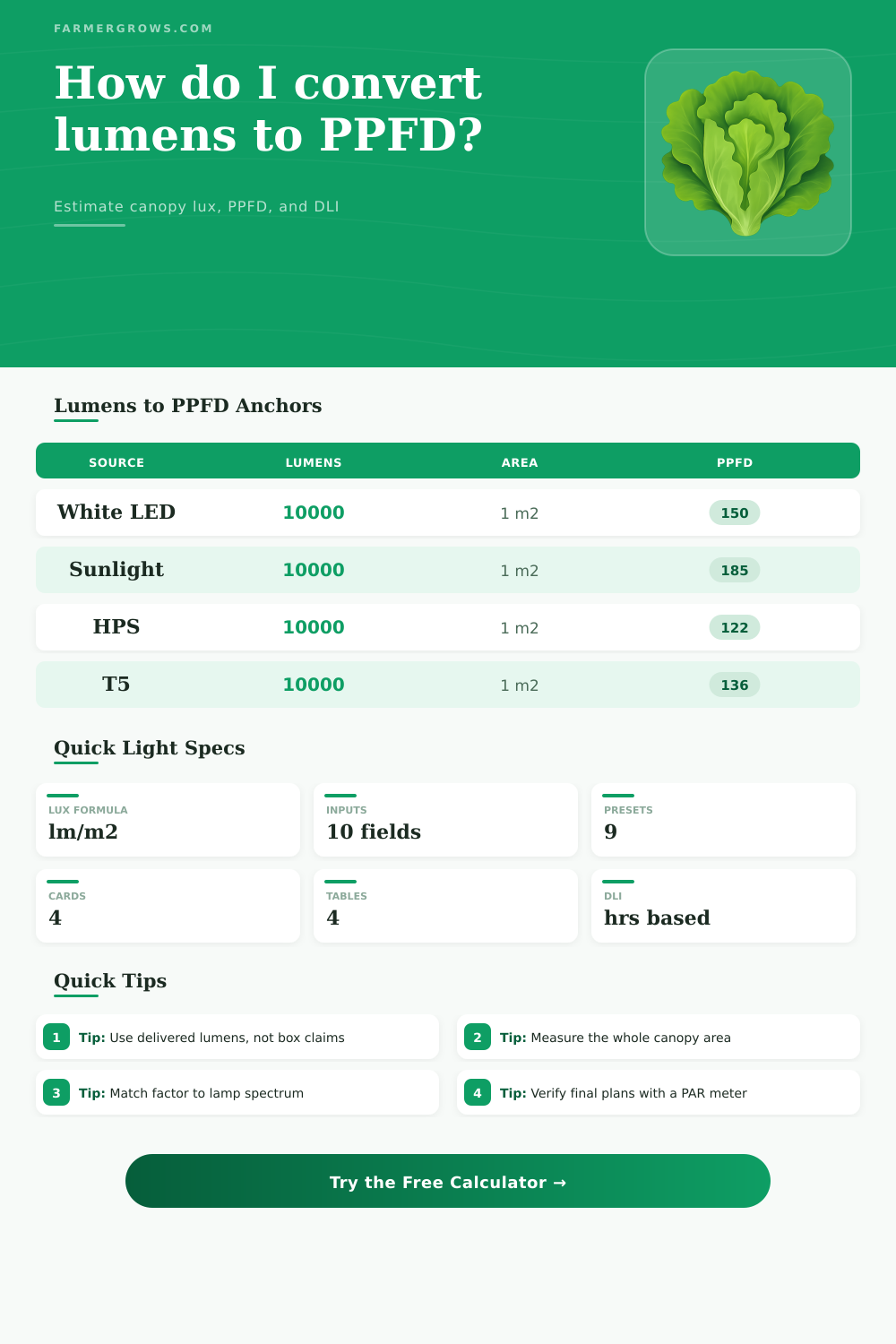
| White LED grow light | 0.0150 | 150 µmol/m²/s | General indoor crop planning. |
| High-output full-spectrum LED | 0.0160 | 160 µmol/m²/s | Modern red-rich grow fixtures. |
| Sunlight or greenhouse daylight | 0.0185 | 185 µmol/m²/s | Greenhouse and shade cloth checks. |
| High pressure sodium | 0.0122 | 122 µmol/m²/s | Older flower rooms and warm lamps. |
| T5 fluorescent | 0.0136 | 136 µmol/m²/s | Propagation shelves and starts. |
| Crop group | Common PPFD range | Default target | Typical photoperiod |
|---|---|---|---|
| Microgreens | 120-180 | 150 | 14-18 hours |
| Seedlings | 150-250 | 200 | 14-18 hours |
| Leafy greens | 200-350 | 280 | 14-18 hours |
| Tomato or pepper | 450-700 | 600 | 12-16 hours |
| PPFD | 12 hours | 16 hours | 18 hours |
|---|---|---|---|
| 150 µmol/m²/s | 6.5 mol/m²/day | 8.6 mol/m²/day | 9.7 mol/m²/day |
| 280 µmol/m²/s | 12.1 mol/m²/day | 16.1 mol/m²/day | 18.1 mol/m²/day |
| 450 µmol/m²/s | 19.4 mol/m²/day | 25.9 mol/m²/day | 29.2 mol/m²/day |
| 600 µmol/m²/s | 25.9 mol/m²/day | 34.6 mol/m²/day | 38.9 mol/m²/day |
Manufacturer lumens are usually measured at the fixture, so include lens, reflector, height, dust, and overlap losses before comparing to crop targets.
Use this calculator for planning and fixture comparisons; confirm final benches with a PAR meter at several canopy points.
Lumens divided by canopy area estimate lux, then spectrum and correction factors convert that brightness into practical PPFD and daily light targets.
When using grow lights for your plants, you must understand the differences between lumens and PPFD. Lumens is used to describe the light that is weighted towards human eyes; PPFD are a measurement of the amount of photons that reaches the plants and make up the light that drives the process of photosynthesis in those plants. Because human eyes and plants does not react to light in the same way, lumen and PPFD are two entirely different measurement.
Many people make mistake with grow lights due to the fact that lumen measurements do not accurately reflect the number of photons that reach the plants; slow growth of plants and stretched stem is the result of these mistakes. In order to estimate the PPFD of a grow light, there is a few different considerations to be made. First, you can divide the number of lumens that the light delivers by the area of the plant canopy to determine the lux that reach the plants.
Lumens and PPFD: How to Measure Light for Your Plants
Secondly, you can multiply that lux value by a spectrum factor in order to provide an estimate of the PPFD of the grow light; this factor will change depending on the spectrum of the grow light and the types of lamp that are used in that grow light. For instance, a spectrum rich in red light will have a different spectrum factor then one with green or yellow light. Thirdly, you must also account for the amount of light that is lost along the way from the grow lights to the leaves of the plants.
Light loss can occur due to factor like the amount of dust on the lenses, the distance between the grow lights and the plants, and the age of the grow lights. If such loss are not accounted for, the estimated PPFD will not accurately reflect the actual PPFD that reach the plants. An allowance for light loss can be applied to the initial calculation of PPFD to ensure accuracy of that estimate.
Different plant require different levels of PPFD to ensure proper growth. For instance, leafy vegetable typicaly require between 200 and 300 micromoles per square meter per second of PPFD, while fruiting crops like tomatoes require around 600 PPFD units. Providing less PPFD than require of the plants will result in slow growth of those plants.
Providing too much PPFD to the plants, however, will waste the electricity that is used to illuminate the plants, and may even lead to stress in the plants. It is also important for growers to consider the daily light integral (DLI) of the plants. The DLI are a measurement of the total amount of light that is provided to the plants within a 24-hour period.
A lower PPFD that is provided for 16 hours each day can provide the same DLI as a more higher PPFD that is provided for 12 hours each day. Because growers have control over the length of the photoperiod, they can adjust the DLI of the plants by adjusting the number of hour that the grow lights are switched on. Therefore, the grow lights should be monitored for both the PPFD and the DLI to ensure that the plants receives the amount of light that they require to meet their requirement for that specific crop.
Many growers make mistake in the planning of their grow lights and grow spaces due to the ignoring of the variables discussed above. One mistake is applying lumen measurement to the grow space and ignoring light loss. Another mistake is assuming that all lumens are created equal.
A third mistake is applying a target PPFD without ensuring that the DLI will be within the requirements of the plants being grown. Avoiding these mistake will allow growers to create a better plan for the grow lights that will be used within the grow space. Such a plan will allow for growers to compare different grow lights, and to determine the number of grow lights that will need to be ordered for the grow space altogether.