🚜 Trailer Load Capacity Calculator
Compare GVWR, empty weight, axle rating, tire rating, hitch rating, load weight, tongue percentage, cargo position, and margin in one loading check.
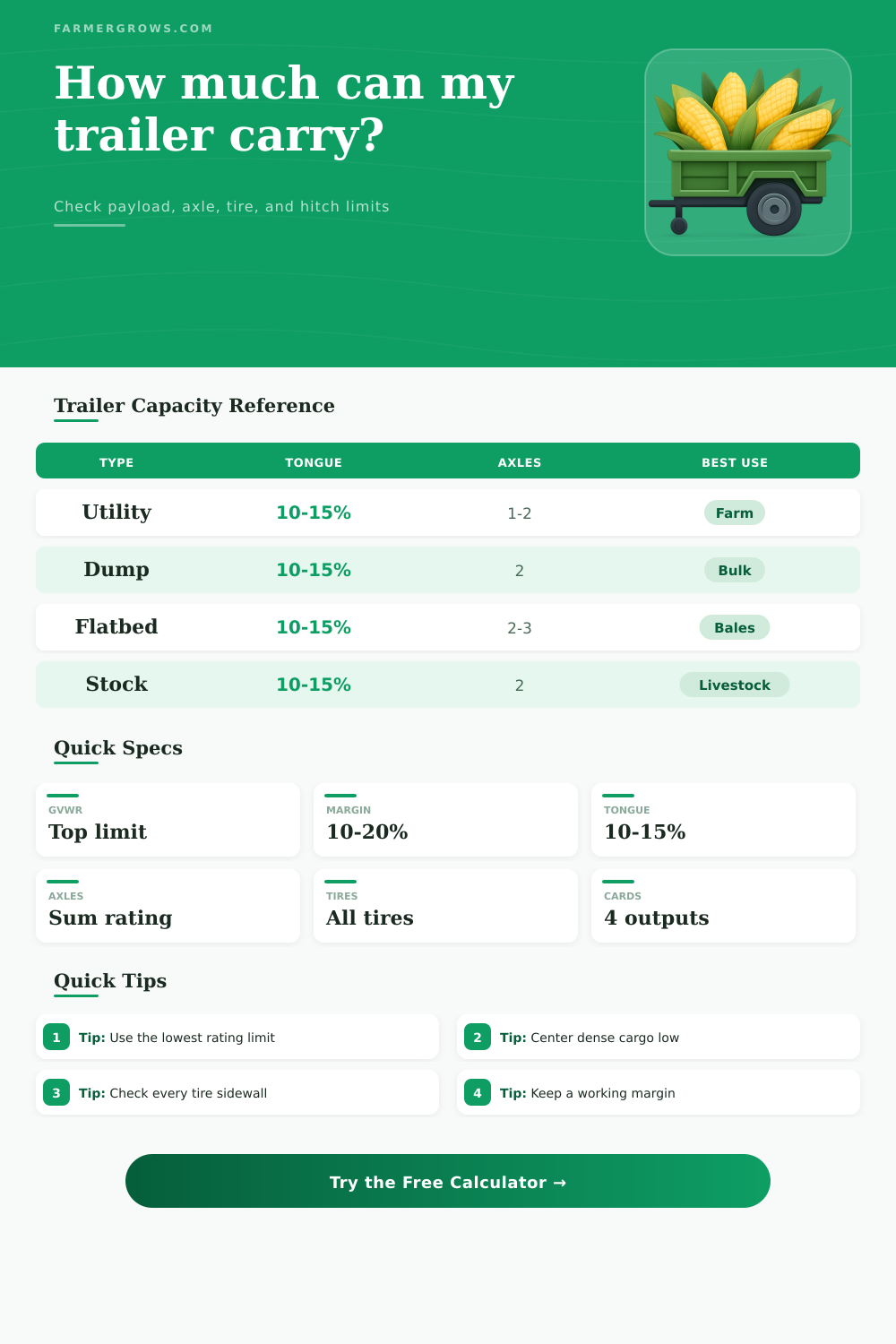
Utility
Best for small equipment, feed bags, fencing, nursery stock, and mixed farm chores with moderate load height.
Flatbed
Best for pallets, hay, bins, and wide cargo that benefits from side loading and even fore-aft placement.
Dump
Best for loose materials where dense cargo can reach weight limits before the box appears full.
Stock
Best for moving live loads or panels where balance can shift and tongue estimate should stay conservative.
| Check | Formula | What It Limits | Calculator Use |
|---|---|---|---|
| Payload | GVWR - empty trailer | Cargo weight | Subtracts selected margin |
| Axle rating | Axles x rating each | Running gear load | Compared after tongue weight |
| Tire rating | Tires x rating each | Tire load capacity | Uses the lower axle/tire value |
| Tongue | Loaded weight x tongue % | Hitch vertical load | Adjusted by cargo position |
| Trailer Setup | Typical Range | Position Clue | Watch Item |
|---|---|---|---|
| Bumper pull utility | 10-15% | Slightly forward | Hitch rating |
| Flatbed with bales | 10-15% | Even tiers | Axle split |
| Dump trailer | 10-15% | Dense load low | Tire rating |
| Gooseneck deck | 15-25% | Forward deck load | Pin rating |
| Position | Calculator Shift | Axle Effect | Tongue Effect |
|---|---|---|---|
| Forward | +2 points | Less axle load | More hitch load |
| Centered | 0 points | Balanced | Target value |
| Rearward | -2 points | More axle load | Less hitch load |
| Mixed | +1 point | Slight relief | Slight increase |
| Load Type | Typical Unit | Planning Note | Balance Focus |
|---|---|---|---|
| Small square hay | 40-75 lbs | Stack evenly | Height and tie-downs |
| Round bale | 800-1,500 lbs | Weight varies by crop | Axle placement |
| Bagged seed | 40-60 lbs | Pallets add density | Tire capacity |
| Bulk compost | 800-1,600 lbs/yd3 | Moisture changes weight | GVWR and tires |
| Compact tractor | 2,000-5,000 lbs | Include attachments | Tongue percentage |
The practical capacity is controlled by the lowest usable limit among GVWR, payload, running gear, tire capacity, and hitch tongue rating.
Soil, compost, seed, and equipment can reach the weight limit quickly, especially when moisture or attachments add hidden pounds.
A trailer has several weight limits. A trailer is often limited by the lowest weight limit of those limits. The lowest weight limit will determine the amount of cargo that can be loaded on the trailer.
The gross vehicle weight rating, the axle rating, the tire ratings and the hitch tongue weight limit must all be considered in the calculation of the load that is to be transported on the trailer. If any of these limits is lower than the others, that limit will be the load limit for the trailer. The trailer load calculator will assist in determining the practical load limit of the trailer by using the ratings of the trailers components.
How to Calculate Trailer Load Limits
You must enter the load limits for the trailer (gross vehicle weight, axle limits, tire limits and hitch limits) and the weight of the cargo to be transported into the load calculator. The load calculator will determine the payload limit of the trailer by subtracting the empty weight of the trailer from the gross vehicle weight rating of the trailer. The calculator will then compare the payload limit to the load limits of the axles, tires and hitch of the trailer to determine the lowest usable number for the trailer load.
This lowest usable number will be the actual limit of the trailer. The weight of the cargo that the trailer is to transport is referred to as the payload of the trailer. However, the payload isnt the only consideration that must be made regarding the weight limits of the trailer.
The trailers axles and its tires must be able to support the weight of the trailer and its payload. Additionally, the hitch of the trailer must be able to support the payload of the trailer and the weight of the trailer itself that is placed on the hitch. Many individuals may believe that the gross vehicle weight of the trailer is the only limit to the trailer.
However, the limits of the trailers axles or the trailers tires may be lower than the gross vehicle weight of the trailer. In these instances, the axles or tires will be the limiting factor for the trailer. The tongue weight of a trailer is the force that the trailer exerts on the hitch of the towing vehicle.
The tongue weight of the trailer can change based off the placement of the trailers cargo. For trailers that a bumper-pull trailer is to pull the tongue weight should be between 10 and 15% of the total loaded weight of that trailer and its cargo. If the trailers cargo is placed towards the front of the trailer the tongue weight will increase.
An increase in the tongue weight can lead to overloading of the trailer hitch. If the trailers cargo is placed towards the rear of the trailer the tongue weight will decrease. A decrease in tongue weight can lead to a decrease of the trailers steering control by the towing vehicle.
The load calculator can adjust the tongue weight based upon the placement of the trailers cargo so that the calculator can appropriately calculate the maximum load of that trailer. It is also common to apply a safety margin to the trailers total capacity. A safety margin is applied for potential errors in the determination of the trailers total capacity and to allow for the potential increase in the total weight of the trailers cargo.
A ten percent safety margin is common for farm trailers that may experience errors in the measuring of the cargo and additional weight from mud or moisture on the cargo. The safety margin will be subtracted from the total load capacity of the trailer. Should the remaining load capacity be low the load calculator will flag this so that the driver can decide whether to redistribute the load or make multiple trips to the trailer.
The different types of trailers may have different load requirements and different limitations. For instance, utility trailers may have limits on the hitch and the load on a single axle. Flatbed trailers may have specific load requirements for hay and wooden bins.
Dump trailers are common with the transport of heavy materials with high loads that can quickly reach the gross vehicle weight of the trailer and its axles. Stock trailers may have the transport of live animals that could shift during transport which indicates the need for a greater safety margin to allow for the weight of the animals to shift during transport. Many individuals may make mistakes in calculating the load of their trailer.
For instance, an individual may only consider the gross vehicle weight of the trailer when calculating the load of the trailer while ignoring the load limits of the trailers axles and tires. Additionally, the load of a tire is often mistaken for the load that can be placed on the entire axle of the trailer. A load calculator avoids these potential mistakes by requiring the individual to enter the load limits of each component of the trailer.
Additionally, the load calculator will select the lowest load limit as the load of the trailer. The actual load of the trailer may be difficult to measure. For instance, hay bales can have varying weights based upon the amount of moisture in the hay.
Additionally, if a trailer is transporting compact tractors the load must also account for the weight of the tractor and the ballast that may be on the tractor. Additionally, cargo that is gaining weight, such as compost or seed may have gained additional weight from rain. Thus, the load calculator cannot determine the moisture in the cargo.
However, the load calculator can provide an indication of the distance that the cargo weight is from the limits of the trailer. The positioning of the cargo can impact the trailers hauling capabilities. For instance, if the load of the trailer is placed high above the ground the trailers center of gravity will shift.
A high center of gravity can cause the trailer to begin to sway. Additionally, if the load is placed too far in either the forward or the rear portion of the trailer the trailer may not sit properly on the ground. The load calculator can adjust for the placement of the load so that it can indicate to the trailer driver the appropriate arrangement of the cargo.
It is recommended that an individual perform a physical check of the trailer after using the load calculator. You should walk around the trailer to ensure that the numbers that are entered into the load calculator match the numbers that are printed on the trailer plates and on the trailers tires. Additionally, the trailer can be loaded and its weight can be determined with a scale.
The load calculator can aid in the reduction of guesswork by the trailer driver but the plates on the trailer and the trailers tires will provide the final information on the limitations of that trailer. You should of checked the weight more than once. It is alot of work but its important.
Actually, most people dont realize how much weight matters. One of the most important part of the process is teh checking of the tires. Youll find that modern trailers is built different than older models.
One of the most important things is that the weight is handled corectly. You wouldnt want to have a accident becuase of a mistake. The weight of the cargo is largly dependent on moisture.
It can be a bit more difficult than most people thinks.