
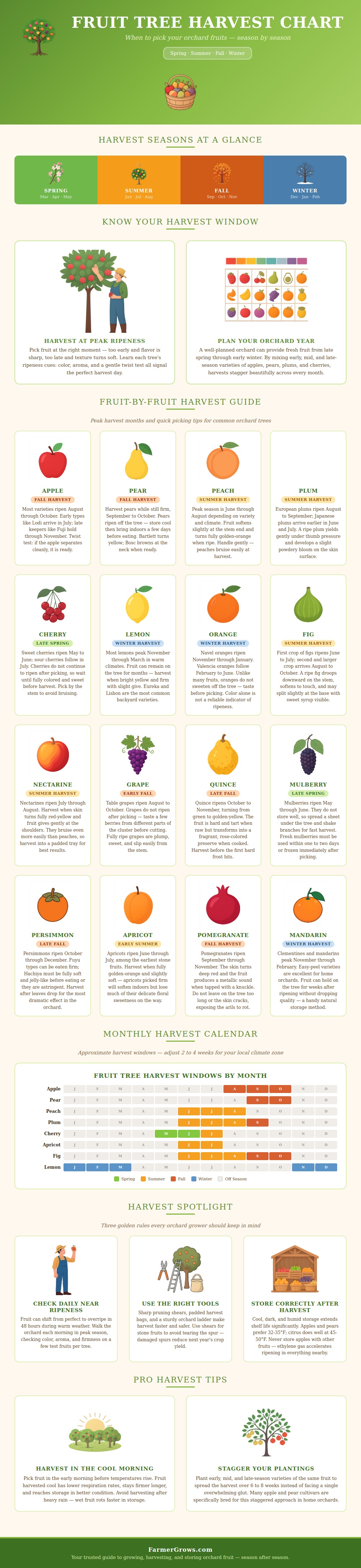
A harvest chart is a visual tool that displays information about when certain fruit will be ready to be picked from the trees. The harvest chart allow a person to create a picking schedule, which avoids the guesswork of when to begin picking the fruit from the trees. Additionally, the harvest chart shows which months will be best for growing which fruits, which allows a gardener to plan their harvest to avoid picking all of the fruit at once.
There is benefits to using a harvest chart because the fruits that are grown in an orchard will have different window of time in which they will be ripe. For instance, early varieties of apples will be ready for picking in the late summer months, but late varieties of apples will remain on the tree well into the November growing season. Other fruits, like cherries and apricots, will be ripe during the spring and summer months when the weather is warming up in the area.
How to Plan Fruit Picking with a Harvest Chart
Citrus fruit, on the other hand, will be ripe during the colder month of the year. Knowing when to pick the fruit from the trees is essential for the health of the tree and the fruit that grow from those trees. If the stone fruits remain on the tree for too long, the fruits can split or attract wasp.
If the apples and pears are picked too early, they will not have developed enough sugar to reach there full flavor. In these instances, a harvest chart will allow a person to determine if the fruit must be picked immediate or if it can be allowed to mature for several days. Fruits signal when they are ready to be picked.
Apples will separate from the spur on the tree after you gently twist them. Pears will remain firm when they are ready to be picked, as they will continue to ripen once they are placed into storage. Figs will droop and the neck of the figs will soften when the fruits are ready to be picked.
Additionally, citrus fruits do not need to be picked as they retain there quality for many week on the tree. The ripeness cues allow a grower to understand that the weather is not the same from year to year or from yard to yard in the same area. Decisions about how to store the picked fruit must be made at the time of harvest.
The harvested fruit picked in the morning will last longer than the same type of fruit picked in the afternoon. Additionally, the storage area for the fruit will contain specific humidity and temperature levels that will determine how many week the fruit can be eaten. Apples and pears will require colder temperature than citrus fruits.
Lastly, different types of fruit should be stored separate, as some types will cause other types to ripen faster. Many mistake are made with fruit picking, but they can be avoided with the assistance of a harvest chart. Some people will allow the fruit to become ripe, whereas the fruit may have begun to soften within the fruit.
Additionally, some people will pick the fruit while the fruit is still green, as they are fearful of the damage that the bird or storms may do to the fruit on the tree. These mistake result in the wasted fruit. By using a harvest chart, however, the person will avoid these mistake.
One way to manage the workload for the fruit is to plant different varieties of the same species of fruit within the orchard. An early variety, a mid-season variety, and a late-season variety will make it easier for the grower to manage the harvest of fruits. This same principle can be applied to pears and plums.
By planting varieties of fruit that ripen at different times of the season, the harvest will be manageable and not an emergency when it arise. By using the appropriate tool when harvesting the fruit, the grower will preserve the flavor of the fruit. By using sharp shears, the fruit will not be injured at the spur of the tree, which allows the tree to preserve its bud for the upcoming growing season.
Using padded bags will allow the stone fruits to not bruise each other as they fall down the tree ladder. Additionally, placing a sheet of paper at the base of a mulberry tree will make it easier to collect all of the mulberries growing on the tree. By using these method with the assistance of a harvest chart, the final result will be a better flavor from the fruit that is eaten.
Fruit harvested at the right time will have the best flavor, whereas the fruit harvested at the wrong time may have a pale flavor. The walk through the orchard to inspect each type of fruit will yield better results than simply leaving all the fruit on the trees. Additionally, each grower will eventually learn which trees will have their fruits ready to be picked first, followed by which trees can be waited upon to produce their fruits.
Through time, each grower will gain the confidence to manage there own orchard.