
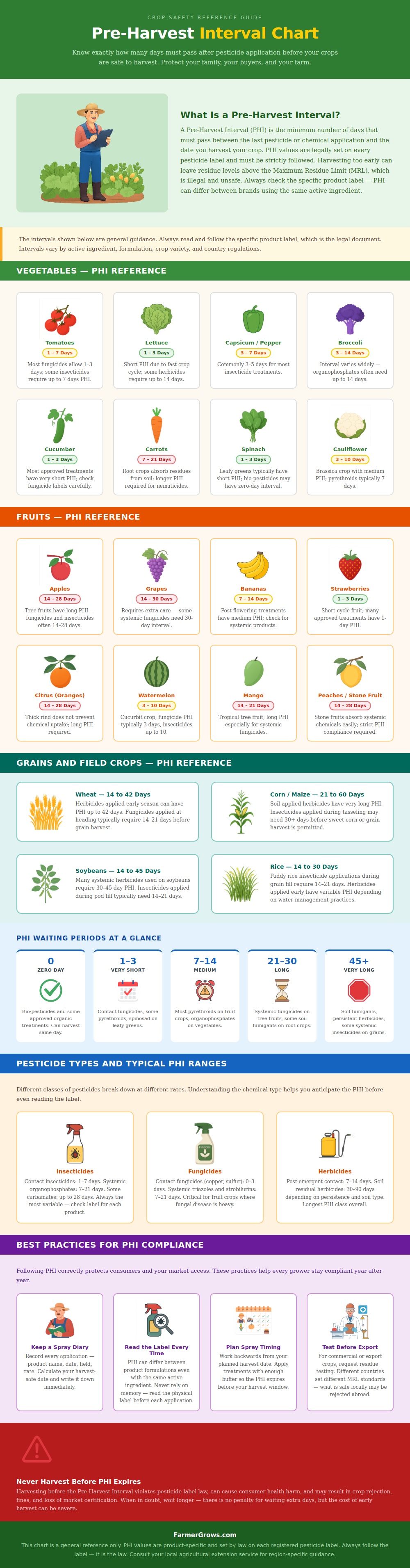
A pre-harvest interval is the minimum numbers of days that must pass between teh last use of a pesticide on a crop and the time that the person will harvest that crop. Pesticide residue dont vanish immediately after the use of a pesticide on a field. Residues can remain on the leaves of a plant, the residues can move through the plant, and the residues can settle into the fruit or root of that plant.
Each type of pesticide will have a different length of pre-harvest interval, as will each type of crop. Vegetables will usually have shorter periods of time than other types of crops. Vegetables typically grow quick, and many types of vegetables is harvested more than once.
What is a pre-harvest interval and why it matters
Leafy vegetables or cucumbers, for instance, have a one- or two-day pre-harvest interval after the application of a contact spray. Root vegetables, however, will have longer periods of time before they can be harvested, because the pesticide will need to wearing off after it has moved into the roots of the vegetable. Fruits will usually require longer periods of time than vegetables.
Pre-harvest intervals for fruits like grapes will be longer than vegetables, because people often use systemic pesticides on the plants to help control disease in the fruits. Grains and field crops will also have a period of time that must pass between the use of the pesticide and the time the crop is to be harvested. Grains like wheat and rice, for example, may be treated with herbicides when they are first planted, and they may also be treated with insecticides after they are germinated.
Because grains are typically harvested only once per growing season, missing the pre-harvest interval for a field crop will result in the loss of that entire batch of grain. The pre-harvest interval for grains will depend upon both the type of pesticide that is used on the crop, and at what point during its growth the treatment occurs. The length of the pre-harvest interval may vary slightly for each type of pesticide.
Contact pesticides will have shorter pre-harvest intervals than systemic pesticides because contact pesticides will break down quick on the leaves of the crops. Systemic pesticides will move through the plants and remain active for longer periods of time. Fungicides work in the same way; those that are used on the surface of the plants will allow for harvesting of the crops within a few days, but those used to control new growth will take longer to break down.
Finally, herbicides will generally have the longest pre-harvest intervals because they are often formulated to remain active in the soil for long periods of time. Pre-harvest intervals must be followed because there are several problems associated with the use of pesticides at levels above the permitted limits. For instance, packing houses may reject crops with excessive amounts of pesticide residues, farmers may lose there export certification for these rejected crops, and the health of the individuals who consume the crops is at risk.
To avoid these problems, grower should create a pre-harvest interval chart. Pre-harvest intervals should not be relied upon with the assumption that every pesticide that contains the same active ingredient will have the same pre-harvest interval. The pre-harvest interval can vary according to the formulation of the pesticide, the variety of the crop, and the amount of that pesticide used.
Thus, it is essential that the grower checks the physical label of the pesticide to ensure that it contains information regarding the pre-harvest interval for that specific product. Additionally, pre-harvest intervals should never be assumed; harvesting the crops before the pre-harvest interval is complete will result in the loss of that crop. Each grower should record the use of pesticides in a spray diary.
Each entry in this spray diary should contain the date of application of the pesticide, and next to each entry should be the calculated date by which the crop should be harvested. After using this spray diary, the grower will be able to adjust the application of pesticides according to the harvest date for that crop. Using a pre-harvest interval chart will allow the grower to accurately plan the harvest dates for each batch of crops.
Furthermore, pre-harvest intervals help to ensure that the crops meets the standards that are required of those crops by buyers of the agricultural products.