
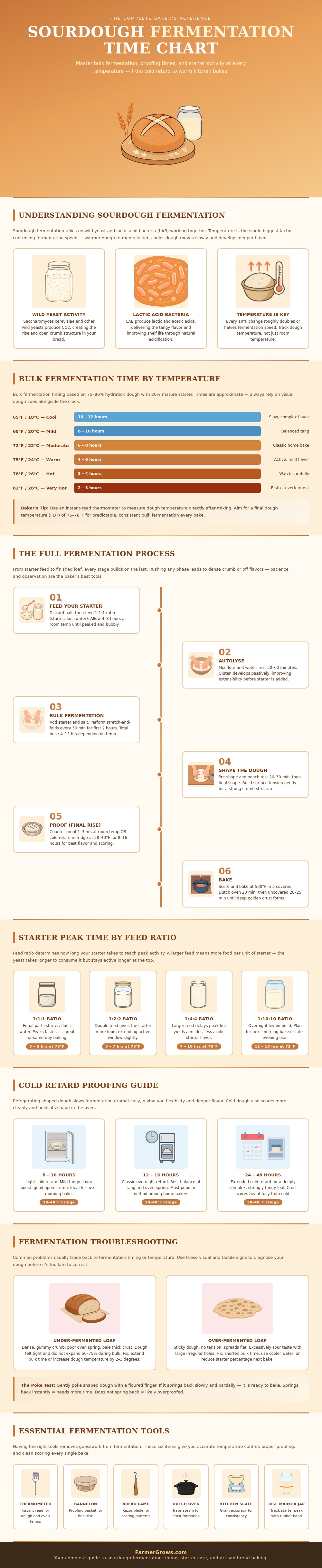
Sourdough baking require you to pay attention to time. However, time alone wont take you from sourdough baking novice to expert if you dont pay attention to how temperature affect the sourdough baking process. If your kitchen is warm, your sourdough dough may rise quick.
However, if your kitchen is much cooler, your sourdough dough may not rise at all. Therefore, you need a fermentation time chart to guide you through sourdough baking. Using this chart, you can determine the best time for different stage of sourdough baking.
Sourdough Time and Temperature Guide
Once you understand how temperature play a role in sourdough baking, you can fine tune your sourdough baking process to achieve the best result. The sourdough baking process start with the sourdough starter. The feeding of the sourdough starter dictate the length of time that it will be active at its peak.
If you use a small feeding of flour and water to feed the sourdough starter, the sourdough starter will reach its peak quickly. This is helpful if you want to bake the sourdough starter that day. If you use a larger feeding of flour and water, the sourdough starter will take longer to reach its peak.
You should learn to read the sourdough starter instead of merely watching the clock. When the sourdough starter are ready to be used, the surface will appear bubbly and its mass will have risen above its normal level. The next stage in sourdough baking are bulk fermentation.
During bulk fermentation, the temperature of the dough have the most influence upon how fast the sourdough bulk ferments. The warmer the dough, the faster bulk fermentation will occur, and the mild the flavor of the sourdough bread. If the dough is cooler, bulk fermentation will be slower, but the sourdough flavor will have a deeper tang.
Using a kitchen thermometer will allow you to take the temperature of the sourdough dough after you mix it together. This will tell you the temperature at which bulk fermentation will occur. You should not merely rely on the temperature of your kitchen.
After bulk fermentation is complete, sourdough bread must be shaped and proofed. Many sourdough baker will let the shaped sourdough bread sit in the refrigerator overnight to cold proof it for improved flavor. Cold proofing improve the sourdough flavor.
Cold dough hold its shape during the scoring of sourdough bread. Cold proofing also add complexity to the sourdough flavor. On a fermentation time chart, you can find the length of time to cold proof sourdough bread to achieve a specific flavor.
The shorter the length of time to cold proof the sourdough bread, the gentler the sourdough flavor will be. However, the longer the cold proofing period, the more strong the acidity of sourdough bread. You can choose the length of time to cold proof sourdough bread according to the amount of acidity you want in the sourdough bread.
The fermentation time chart can also show you if your sourdough starter bulk fermented too long or too short. Under-fermented dough will feel tight and will rise poorly when placed in the sourdough oven. The crumb of sourdough bread will be dense and possibly gummy.
Over-fermented dough lose its structure. It will spread out on the counter when bulk fermented, and the sourdough bread will have a harsh sour flavor. Both under-fermented and over-fermented sourdough bread can be caused by incorrect timing and temperature for bulk fermentation.
By watching your sourdough starter while it bulk ferment, you can avoid making these mistake. Tools can help to eliminate the guesswork in sourdough baking. An instant-read thermometer will allow you to take the temperature of the sourdough dough.
A kitchen scale will help you maintain the proper ratio of flour to water when feeding your sourdough starter. A proofing basket will allow the shaped sourdough loaf to rise on top of the proofing basket instead of the sides of the sourdough loaf. Tools will help you but you must still pay attention to your sourdough starter while it ferment.
The fermentation time chart is a starting point for sourdough baking. In your kitchen, the temperature will not be the same as the chart suggest. The activity of your sourdough starter will also not be the same as the chart suggest.
You can use the chart to understand how long to bulk ferment your sourdough starter. However, you must adjust the process from the chart if you observe your sourdough starter bulk fermenting faster or slower than the chart suggest. If your sourdough starter bulk ferments faster than the time on the chart, shorten the length of the next bulk fermentation.
If your sourdough starter bulk ferments slower than the time on the chart, add more time to the bulk fermentation process or move the sourdough starter to a warmer location. After repeated sourdough baking, the fermentation time chart will become a memory aid for you. You will be able to recognize the look and feel of sourdough starter during bulk fermentation without having to refer to the chart.
By knowing how sourdough starter bulk ferments, you can control the sourdough baking process to achieve the best sourdough bread. The fermentation time chart will remain a helpful tool for you and your sourdough starter but your sourdough baking experience and judgment will take over as you gain experience.