PPFD to DLI Calculator
Convert canopy PPFD into daily light integral using photoperiod, fixture schedule, crop stage, light loss, target DLI, supplemental light, sun contribution, and dimmer percentage.
Daily Light Integral Results
Enter values and calculate to see your DLI.
Calculation Breakdown
| Average PPFD | 10 hr DLI | 12 hr DLI | 14 hr DLI | 16 hr DLI | 18 hr DLI |
|---|---|---|---|---|---|
| 100 µmol/m²/s | 3.6 | 4.3 | 5.0 | 5.8 | 6.5 |
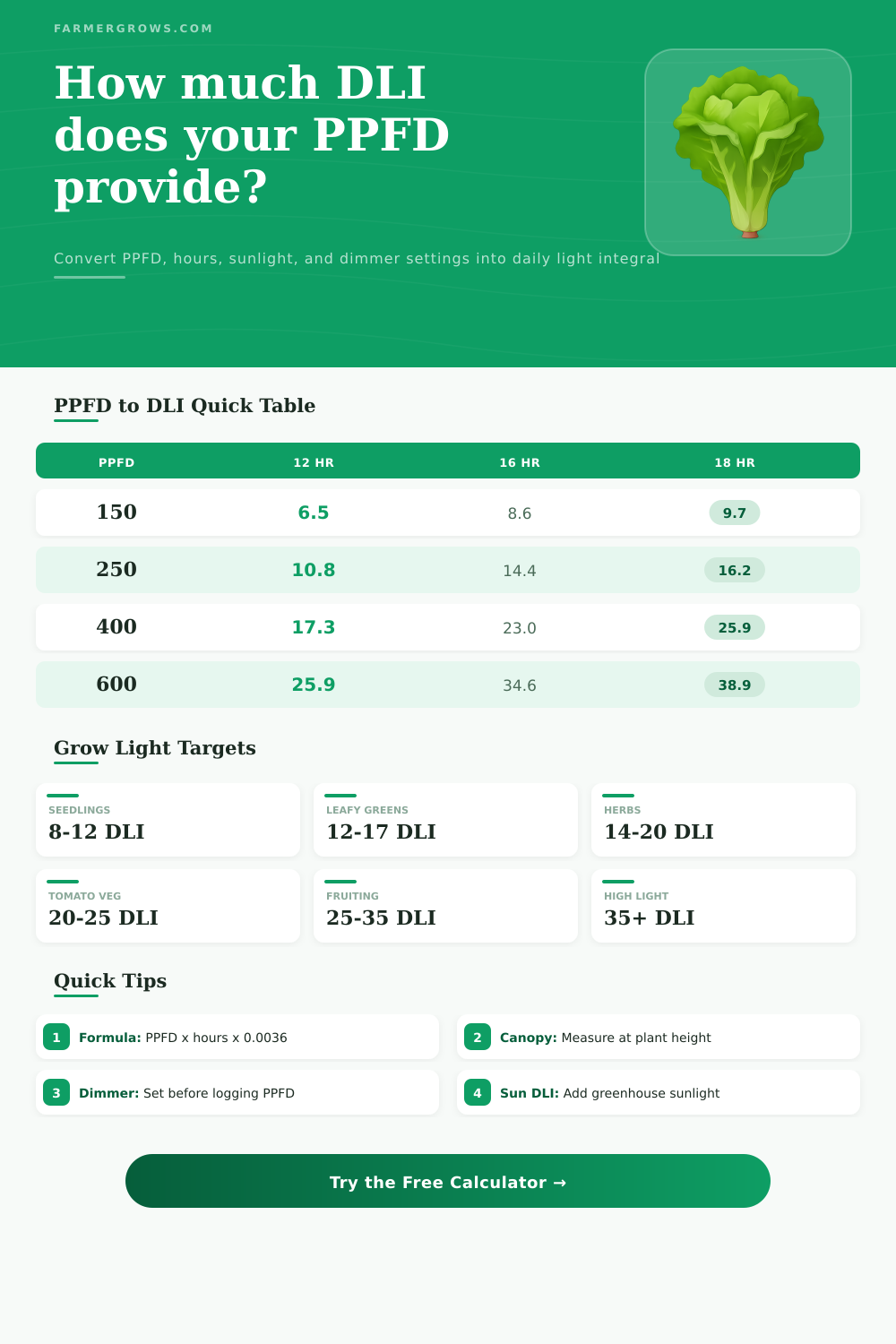
| 150 µmol/m²/s | 5.4 | 6.5 | 7.6 | 8.6 | 9.7 |
| 250 µmol/m²/s | 9.0 | 10.8 | 12.6 | 14.4 | 16.2 |
| 400 µmol/m²/s | 14.4 | 17.3 | 20.2 | 23.0 | 25.9 |
| 600 µmol/m²/s | 21.6 | 25.9 | 30.2 | 34.6 | 38.9 |
| 800 µmol/m²/s | 28.8 | 34.6 | 40.3 | 46.1 | 51.8 |
| Target DLI | 12 hr PPFD | 14 hr PPFD | 16 hr PPFD | 18 hr PPFD | Typical Crop Use |
|---|---|---|---|---|---|
| 10 mol/m²/day | 231 | 198 | 174 | 154 | Seedlings |
| 15 mol/m²/day | 347 | 298 | 260 | 231 | Leafy greens |
| 20 mol/m²/day | 463 | 397 | 347 | 309 | Herbs / veg |
| 25 mol/m²/day | 579 | 496 | 434 | 386 | Tomato veg |
| 30 mol/m²/day | 694 | 595 | 521 | 463 | Fruiting |
| 35 mol/m²/day | 810 | 694 | 608 | 540 | High light |
| DLI Gap | 200 PPFD | 300 PPFD | 400 PPFD | 500 PPFD | 600 PPFD |
|---|---|---|---|---|---|
| 2 mol gap | 2.8 hr | 1.9 hr | 1.4 hr | 1.1 hr | 0.9 hr |
| 4 mol gap | 5.6 hr | 3.7 hr | 2.8 hr | 2.2 hr | 1.9 hr |
| 6 mol gap | 8.3 hr | 5.6 hr | 4.2 hr | 3.3 hr | 2.8 hr |
| 8 mol gap | 11.1 hr | 7.4 hr | 5.6 hr | 4.4 hr | 3.7 hr |
| 10 mol gap | 13.9 hr | 9.3 hr | 6.9 hr | 5.6 hr | 4.6 hr |
| Fixture Schedule | Typical Hours | Best Use | DLI Note |
|---|---|---|---|
| Continuous photoperiod | 12-18 hr | Indoor racks | Simple PPFD x hours |
| Split schedule | 2 blocks | Heat management | Add both light blocks |
| Supplemental greenhouse | 2-8 hr | Winter DLI gap | Add sun DLI separately |
| Short day 12/12 | 12 hr | Photoperiod crops | Raise PPFD if target is high |
| Long day 18/6 | 18 hr | Vegetative growth | Lower PPFD may still hit DLI |
When you look at the plant in your grow space, they may look healthy. However, the growth of the plants may be incorrect. If the growth of the plants within your grow space is incorrect, the most likely issue isnt related to the quality of the light that the plants are emitting, but instead the quantity of that light.
The quantity of light that fall on the plants each day will determine the growth rate of the plants, the compaction of the plants, and when they will begin to flower or produce fruit. The total amount of light that the plants receive each day is referred to as the daily light integral, or the DLI. In order to determine the DLI for each plant within the grow space, the plant grower must calculate the value of the light intensity from the grow lights (also known as PPFD) and convert that value to a value for the total light received by the plants during that day.
How to Calculate Daily Light (DLI) for Your Plants
Such a calculation is relatively easy to perform in theory, but it is easy to perform the calculation incorrectly when considering the way in which the light may diminish during the grow cycle due to various factor. PPFD is a measurement of the number of micoles of light that land on a square meter of the plants each second. The PPFD reading alone, however, does not indicate the total amount of light that is deliver to the plants during the day.
For instance, it is possible for the plants to only be lit for 14 hours during those calculation, or the dimmer that control the lights may be set to 70% of the lights output. The calculator performs the calculation of the DLI of the light that is provide to the plants by multiplying the PPFD by the number of hours that the lights are on during the day, and then multiplying that result by a constant to change the units from seconds to days. The calculator performs this mathematical calculation for the grower after they enter the various parameter related to the light intensity that is provided to the plants.
The first of the parameter that must be entered into the calculation for DLI is the PPFD value. A light meter can read the PPFD value. However, the spot that is measured will not reflect the amount of light that is received by the plants that are located along the edge of the growing bench, for example.
Therefore, it is necessary to take several measurement of PPFD along the area of the grow space that is to be evaluated, and calculate the average of those different values. In addition to this average value, it is also necessary to take into account the setting of the dimmer that control the intensity of the lights for the grow space. Many growers utilize dimmers to reduce the amount of light that the grow lights emit by a certain percentage in order to reduce the amount of heat that is emitted from those lights, or to reduce the amount of electricity that is used to power the grow lights.
The dimmer percentage can be entered into the DLI calculation so that the calculator can determine the DLI of the grow space with that percentage of light being emit by the grow lights. In addition to the PPFD average and the percentage of the light output that is emitted by the grow lights, the number of hours of light that is provided to the plants must be entered into the calculator. Different type of plants prefer to be exposed to either long periods of light, or short periods of light with flowering occurring only with short periods of light.
As such, the hours of light can be entered into the calculation so that the DLI calculation for that plant reflect the amount of light that will be provided during the growing cycle. For example, growers may wish to split the hours of light during certain seasons, or provide supplemental light to green house plants when the lights are off. In addition to the hours of light, the amount of light that may be lost by the grow lights during the growing cycle must also be entered into the calculator.
The light that is reflected off of the grow lights may diminish over time as the diodes of the grow lights wear with use. Additionally, the grow lights may be positioned higher above the plants as the plants grow, which will cause that light to be distributed over a greater area. Other factors that may contribute to the loss of light to the plants include dirty lens, ducting that is placed between the grow lights and the plants, and the amount of light that is blocked by the leaves of the plants themselves.
Each of these factor will reduce the amount of light that reaches the plants, and each factor can be entered into the calculator as a percentage of the total light output of the grow lights. For instance, if only 80% of the light is delivered to the plants due to dirty lenses, the percentage of the loss of light can be entered into the calculator as 20%. Greenhouse growers may have to account for an additional parameter: sunlight.
Sunlight enters the greenhouse even if the grow lights are off. The amount of light that can pass through the greenhouse glazing (or shade cloth) can be entered into the DLI calculation. During the winter months, the amount of sunlight that passes through the greenhouse glazing is relatively low.
However, sunlight during these winter months will still reduce the number of hours that the grow lights must be on to provide the amount of light that is required by the plants. During the summer months, the amount of sunlight entering the greenhouse will prevent the DLI calculation from recommending the addition of excessive supplemental light to the greenhouse plants. After the DLI is calculated for the growing space, that DLI can be compared to the target DLI for the plants of that type.
For instance, plants that are in the seedling or cutting stage will require less DLI than plants that are in the fruiting period. Additionally, different type of plants may have different requirements for DLI. As such, the grower can use the calculated DLI to determine if any adjustment need to be made to the light parameters for the growing space in order to provide the amount of light that is required by those plants.
The DLI calculation will also show the required PPFD for that grow space or the required percentage of the dimmer setting for the grow lights. These two values will allow the grower to decide whether adjustments to the hours that the lights are on is more appropriate than adjustments to the setting of the existing grow lights. The tables provided on the webpage list the DLI values that are created by various PPFD measurements of light.
These tables allow the grower to ensure that the proposed light settings will provide the amount of light that is required by the plants before the grow lights are set up. Additionally, the tables list the hours of supplemental lighting that may be required for various DLI gaps at various intensities of grow lights. The grower can use this information to manage the electrical budget of the grow space.
One of the most common error with the DLI calculation is not accounting for the fact that the output of the grow lights may diminish over time. Additionally, other factors that may contribute to the difference between the calculated PPFD and the amount of light that is provided to the plants include the height of the plants’ canopy, and the amount of sunlight that reach the grow space during the different seasons of the year. It is recommended that the average PPFD value be calculated every few week and entered into the DLI calculation so that the grower is able to ensure that the grow space is still providing the amount of light that is required by the plants.
Another common error is to not account for the fact that extending the hours that the lights are on the plants with a lower PPFD intensity will have the same impact on the DLI as increasing the PPFD of the grow lights while maintaining the same hours that the lights are on. The DLI calculation is able to determine both the number of hours of light that are required and the percentage of the dimmer setting of the grow lights that are required. Thus, the grower can decide which of these option is the most appropriate for there setup.
The formula for calculating the daily light integral is relatively simple. However, each of the input into that formula are important to determining the light strategy that will be used within the grow space. The PPFD readings should be taken at the height of the plants, several different spot within the grow space should be evaluated, the position of the dimmer should be taken into account, and the amount of sunlight that passes through the greenhouse should be updated according to the changing season.
By performing these step, the grower will know both how to manage the light within the grow space, and how to ensure that the determined DLI of the grow space is able to provide the amount of light that is required by the plants.