PVC Pipe Weight Calculator
Estimate dry PVC pipe weight, water fill weight, and total installed run weight from real nominal pipe dimensions, schedule, density, pipe count, and fitting allowance.
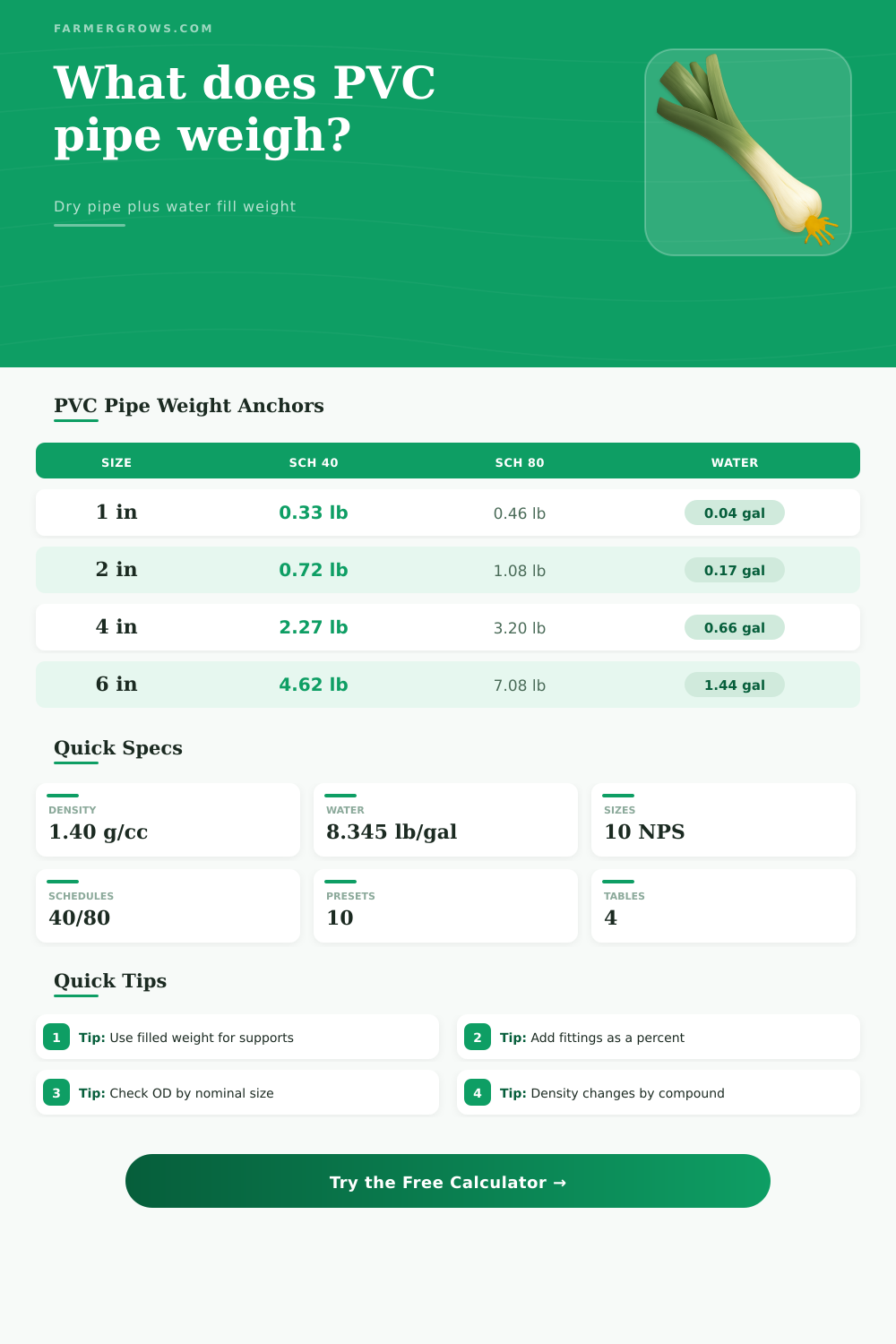
The calculator uses common ASTM D1785 dimensional values for PVC schedule pipe. Dry pipe weight is calculated from pipe wall volume and PVC compound density; filled weight uses water volume and 8.345 lb per US gallon.
Pipe Weight Results
| Nominal size | Outside diameter | Sch 40 wall / ID | Sch 80 wall / ID |
|---|---|---|---|
| 1/2 in | 0.840 in | 0.109 in / 0.622 in | 0.147 in / 0.546 in |
| 3/4 in | 1.050 in | 0.113 in / 0.824 in | 0.154 in / 0.742 in |
| 1 in | 1.315 in | 0.133 in / 1.049 in | 0.179 in / 0.957 in |
| 1-1/4 in | 1.660 in | 0.140 in / 1.380 in | 0.191 in / 1.278 in |
| 1-1/2 in | 1.900 in | 0.145 in / 1.610 in | 0.200 in / 1.500 in |
| 2 in | 2.375 in | 0.154 in / 2.067 in | 0.218 in / 1.939 in |
| 3 in | 3.500 in | 0.216 in / 3.068 in | 0.300 in / 2.900 in |
| 4 in | 4.500 in | 0.237 in / 4.026 in | 0.337 in / 3.826 in |
| 6 in | 6.625 in | 0.280 in / 6.065 in | 0.432 in / 5.761 in |
| 8 in | 8.625 in | 0.322 in / 7.981 in | 0.500 in / 7.625 in |
| Pipe and schedule | Gallons per ft | Water weight per ft | Water weight per 100 ft |
|---|---|---|---|
| 1 in Sch 40 | 0.0428 gal | 0.357 lb | 35.7 lb |
| 2 in Sch 40 | 0.1745 gal | 1.456 lb | 145.6 lb |
| 4 in Sch 40 | 0.6618 gal | 5.522 lb | 552.2 lb |
| 6 in Sch 40 | 1.443 gal | 12.04 lb | 1204 lb |
| 2 in Sch 80 | 0.1535 gal | 1.281 lb | 128.1 lb |
| 4 in Sch 80 | 0.5960 gal | 4.974 lb | 497.4 lb |
| Pipe and schedule | Dry lb/ft at 1.40 g/cm³ | Dry lb/100 ft | Loaded lb/100 ft when full |
|---|---|---|---|
| 1 in Sch 40 | 0.333 | 33.3 | 69.0 |
| 1 in Sch 80 | 0.456 | 45.6 | 76.0 |
| 2 in Sch 40 | 0.722 | 72.2 | 217.8 |
| 2 in Sch 80 | 1.081 | 108.1 | 236.2 |
| 4 in Sch 40 | 2.272 | 227.2 | 779.4 |
| 4 in Sch 80 | 3.203 | 320.3 | 817.7 |
| Input | Typical value | Use in calculator | Field note |
|---|---|---|---|
| Rigid PVC density | 1.38-1.45 g/cm³ | Pipe wall weight | Use manufacturer density if available. |
| Water density | 8.345 lb/gal | Filled pipe weight | Temperature changes are usually minor for planning. |
| Light fittings | 5% | Couplers and few elbows | Good for simple straight irrigation runs. |
| Manifold fittings | 15-20% | Valves and tees | Use more allowance where hardware is concentrated. |
| Scenario | Pipe choice | Length and count | What to check |
|---|---|---|---|
| Greenhouse header | 1 in Sch 40 | 120 ft x 1 | Hanger load when the line stays full. |
| High tunnel main | 2 in Sch 40 | 180 ft x 1 | Loaded weight plus valve cluster allowance. |
| Wash pack drain | 4 in Sch 40 | 60 ft x 1 | Support blocking and slope under wet load. |
| Bench loops | 3/4 in Sch 40 | 48 ft x 6 | Bundle weight before attaching to benches. |
For hanging or raised pipe, size supports from filled weight plus the fittings allowance, not the dry pipe number.
For pump carts, trailers, or removable manifolds, calculate each repeated run separately before adding valves.
This calculator separates the pipe wall, water inside the bore, pipe count, and fittings allowance so support and handling loads are easier to compare.
When you install a PVC line in a greenhouse or a high tunnel, you have to consider the weight of that PVC line. The weight of the PVC line include the weight of the water that is within the line as well as the weight of the fittings. Many people dont consider the weight of the water and the fittings when they calculate the total weight of a greenhouse or high tunnel.
If you dont consider the weight of the water and the fittings, it is possible that the PVC line will sag between the supports, or that the supports may become unstable due to the increased weight of the PVC line with the water and fittings. The weight of the PVC line is one of the most importent measurements to consider in relation to installing the PVC line into the greenhouse or high tunnel; the weight of the PVC line determine the amount of space that must be left between the hangers, as well as the weight that the supports will have to support. The thickness of the pipe wall will play a major role in the weight of the PVC line.
Calculate PVC Pipe Weight with Water and Fittings
Both schedule 40 and schedule 80 PVC lines has the same thickness of the pipe, but the schedule 80 has a thicker wall and more mass. The thicker wall of the schedule 80 PVC line means that the inside diameter of the pipe is smaller. Thus, there is less room for water to exist within the schedule 80 PVC line.
However, the extra mass of the schedule 80 PVC line may help to offset the weight of the water within the line. In addition to the weight of the PVC itself, the amount of water that the line may contain will play a role in the total weight of that line. For instance, a drain line may not contain as much water as a supply header line for the greenhouse, so the supply header will be heavier.
Thus, you have to calculate the weight of the PVC line based off the amount of water that is contained within the line. The length of the PVC line and the number of lines that are to be installed will impact the total weight of the project. For instance, using a single long PVC line may require different support considerations then using a group of shorter lines.
A calculator can help determine the weight of the PVC line in pounds; the calculator can help to convert the gallons of water to pounds, as well as the thickness of the walls of the PVC line to the weight of the line. In addition to the weight of the line itself, you also have to account for the weight of the fittings. A simple line may only use couplers to join the PVC lines, while a manifold may contain various valves and other types of fittings.
The more numerous the fittings are along the PVC line, the more the total weight will increase; with very long lines of PVC, the fittings may add fifteen or twenty percent to the total weight. Thus, you must account for the weight of the fittings when calculating the total weight of the line. The weight of the PVC line will influence the spacing of the supports.
The less frequently that the hangers or other supports are placed along the PVC line, the less weight that each individual support has to hold. However, you will have to install fewer supports along the line if they are placed further apart from one another. The filled weight of the PVC line should be used to determine where the supports should be placed, as opposed to the dry weight of the PVC line.
The filled weight of the line will be much heavier than the dry weight. Thus, the filled weight will help to determine the strength of the posts or frames. In addition to the weight calculations, there are additional factors that should be considered.
For instance, changes in the temperature within the greenhouse may make the PVC line softer, which could lead to sagging of the line due to its weight. Additionally, exposure to sunlight may lead to brittleness of the PVC line over time. The same is true of movement of the line in relation to the soil within the greenhouse.
These factors may not be able to be accounted for in the PVC line weight calculator; however, it is still important to perform an inspection of the greenhouse prior to installing the PVC line to account for these additional factors. In addition to the supports for the PVC line, the weight of the line may impact how it is moved. For instance, many PVC line bundles include a measurement of the weight of the line; however, that weight is only for the dry weight of the empty PVC line.
Thus, if your going to move the PVC line with a cart or trailer, that dry weight is not the weight that must be considered. Instead, you must consider the weight of the empty PVC line plus the weight of the water within the line and the fittings; otherwise, the cart and trailer may not be able to handle that much weight. One additional factor that should be considered in the installation of a PVC line is the diameter of the line.
If the diameter of the line is increased, more water can move through the line, which may lead to the use of smaller pumps to circulate that water. However, the increased diameter will increase the weight of the PVC line with the water within the line. For lines that are turn on and off, the weight will range between the dry weight of the PVC line and its filled weight.
Thus, you can adjust the fill percentage within the calculator to reflect the actual weight of the line when it is in operation. Each of the calculations that are performed for the weight of the PVC line should be performed twice. The first calculation may use the length of the line as well as the specific schedule of the PVC line that is to be used.
Additionally, you can use a second calculation with a larger size of PVC line. This second calculation can help to determine if a different size of line may be better for the greenhouse in question. Thus, determining the weight of the PVC line will help to determine the type of frames, pumps, and valves that will be used in relation to the PVC line.