
When you plant a young tree, the decision you must make regarding the graft union is critical to the success that the tree will have over time. The rootstock will determine the size of the tree, the disease resistance of that tree, and the ability of that tree to handle the soil in which it is planted and the climate in which it grow. The scion will determine the type of fruit that the tree will produce.
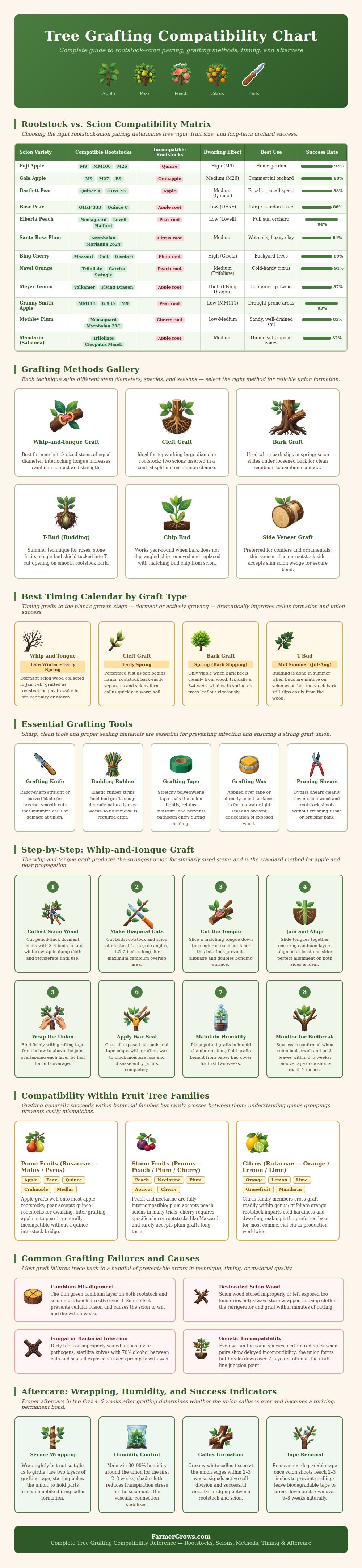
If the two dont match, the tree will struggle and potentially fail to produce its scion fruit. However, if you choose correctly, the tree will produce the fruits and will not require as much intervention to assist in the growing process of the tree. The provided chart demonstrate which combinations of scions and rootstocks will work for the tree and which will not work for the tree.
Choosing the Right Rootstock and Scion
For instance, Fuji and Gala apples will work if the rootstocks are dwarfing or semi-dwarfing but will not work if the rootstocks are quince. The Bartlett pear will work with quince rootstocks but will not work with apple rootstocks. The various peach varieties will work with Nemaguard and Lovell rootstocks but will not work with pear rootstock.
Each of these examples, as well as the others in the chart, have to do with the way that the vascular tissues from each of these different species create callus and exchange nutrient with one another. The chart is based upon biological compatibility, so the chart does not reflect the preference of the various fruits and growers. For instance, there is a great deal of biological compatibility between the apple and pear families.
However, the compatibility is not as great from apples to pears than it would be from apples to other apples or pears to other pears. However, the stone fruits has different rules. For instance, the peach and the nectarine are compatible with one another, but plums are only compatible with peach rootstock.
Additionally, cherries are only compatible with rootstocks within the cherry family. Citrus fruit are compatible within their own family, such as trifoliate orange rootstocks, which are used for oranges, lemons, and mandarins in less desirable climates. Thus, the compatibility of scion and rootstock will succeed more often within the same botanical family but will occur less often outside of those botanical families.
In addition to the compatibility of the scion and the rootstock, the timing of the grafting process is also important. Whip and tongue grafts only work during the dormant season of the tree or during the cool seasons of spring. Bark grafts will only succeed if performed when the bark of the rootstock begins to slip, which usually occurs within a few week of springtime.
Lastly, T-budding only works in the middle of summer when the buds are mature and the tree is still experiencing its growing season. Thus, the timing of the grafting is critical to the survival of the rootstock and the scion. Another factor that will influence the grafting of the scion to the rootstock is the tools that are used.
For instance, using a sharp grafting knife will produce smoother incisions in the bark and tissues than a dull knife. Additionally, the sharp knife will not crush the tissues as much as a dull knife will. The tape and wax that is used will keep the scion and rootstock in place, as well as keep moisture in the joint and keep the pathogens out of the newly joined tree.
During the first ten days of the grafting process, when the calluses are forming, you must protect the graft union from the outside world. There are various reasons that the graft may fail despite the use of proper technique. One of the most common causes of graft failure is the misalignment of the cambium layers of the rootstock and the scion.
Another reason for graft failure is the use of desiccated scion wood. If the scion wood dries out, the cells die out before the grafting process occur. Additionally, if there is an infection at the cut of the scion or the rootstock, the bacteria and fungi will destroy the callus forming at the joint of the two grafts.
Another reason for the failure of the graft is delayed incompatibility, where the grafts appear to succeed for two or three year but eventually break at the graft union. Once you graft the scion onto the rootstock, you must keep the newly formed graft in stable conditions. High humidity around the graft will keep the cut stem from drying out.
Additionally, the use of shade cloth will reduce the amount of water that the scion needs. Once the tree begins to develop creamy callus tissue, indicating that the bridge between the scion and the rootstock is being formed, the graft can be allowed to grow. However, care must be taken not to remove the tape too soon.
However, the tape should also not be left on the scion for too long. Once the graft has developed two to three inches of new shoot growth, the wrap can be removed. By understanding the compatibility of the species, there is no guesswork involved in the process of grafting.
The grower can choose a rootstock that will result in a young tree for the garden. The rootstock will contain the necessary disease resistance for the soil in which the tree is to be planted. The compatibility knowledge allows the grower to plant the scion in the rootstock that will produce the desired fruit.
Thus, understanding compatibility allows the grower to graft the scion onto the rootstock in such a way that ensures that the right tree is in the right place in the garden.