Soaker Hose Flow Rate Calculator
Estimate soaker hose gallons per hour, inches applied, pressure loss, and watering time from hose length, diameter, pressure, soil, slope, zones, and run time.
Use the rated weeping rate from the hose label when you have it. If the label lists output at 10 PSI, keep the rating pressure at 10 PSI and use the regulator input to model the pressure actually feeding the hose.
Shorter, more frequent runs help keep shallow roots from drying between irrigations.
Usually match soaker hoses well because intake and storage are both moderate.
Use lower output or cycle soaking to prevent water from pooling along the hose.
Short zones and pressure regulation keep the uphill end from running too dry.
Soaker Hose Watering Results
Your flow, applied depth, pressure, and timing estimate will appear here.
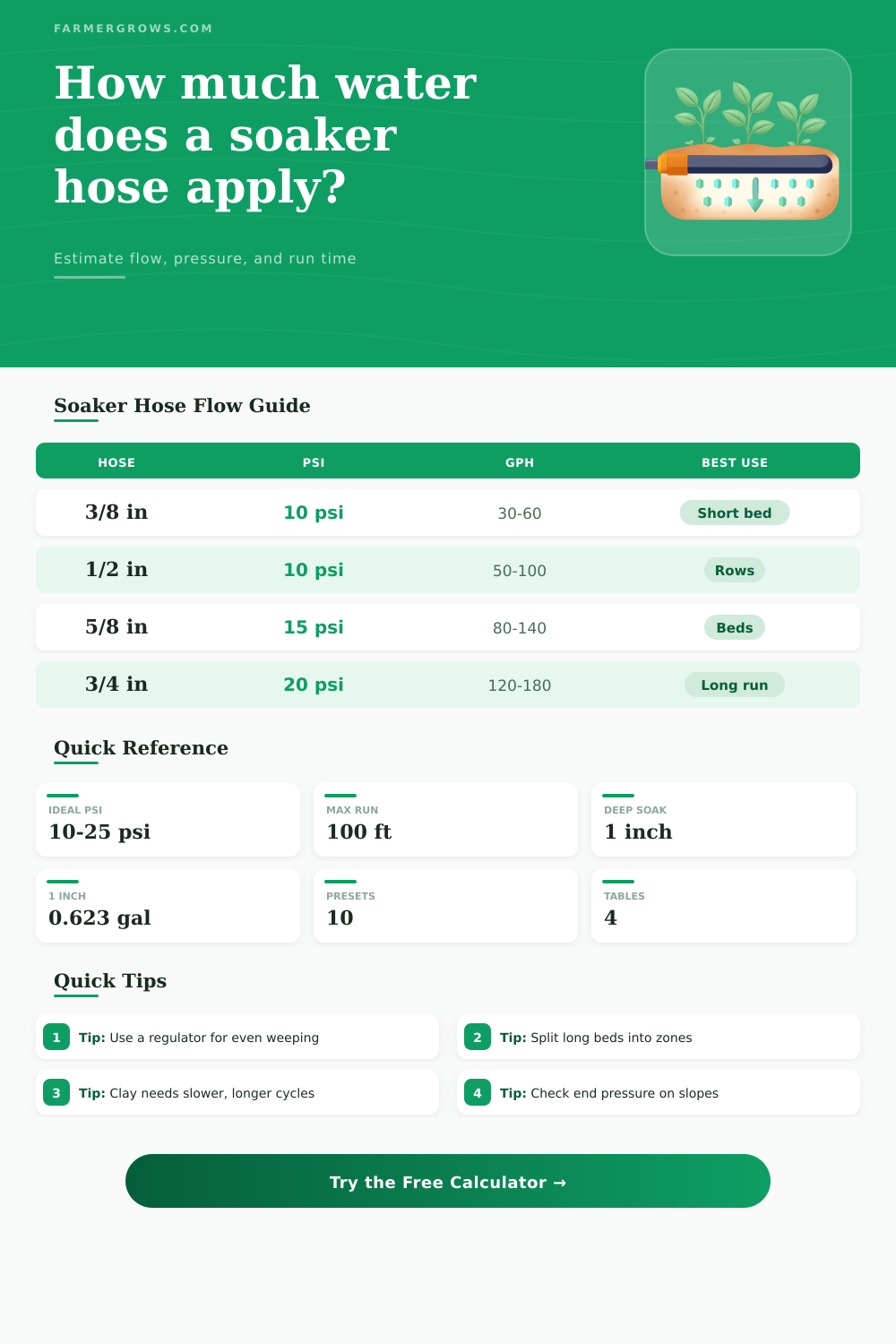
| Inside Diameter | Typical Flow Per 100 ft | Best Run Length | Pressure Note |
|---|---|---|---|
| 3/8 in compact hose | 30 to 60 GPH | 25 to 50 ft | Best for small beds and containers. |
| 1/2 in standard hose | 50 to 100 GPH | 50 to 100 ft | Common choice for vegetable beds. |
| 5/8 in garden soaker | 80 to 140 GPH | 75 to 125 ft | Handles moderate flow with less loss. |
| 3/4 in long-run hose | 120 to 180 GPH | 100 to 200 ft | Use for larger blocks or split zones. |
| Soil Type | Approx Intake Limit | Moisture Behavior | Soaker Hose Strategy |
|---|---|---|---|
| Sandy soil | 0.60 in/hr | Drains quickly and stores less water. | Shorter cycles, often 2 to 3 times weekly. |
| Loam / raised mix | 0.40 in/hr | Balanced intake and storage. | Deep soak to target, then adjust by crop. |
| Silty soil | 0.30 in/hr | Can seal at the surface when saturated. | Moderate flow with a rest cycle if needed. |
| Clay soil | 0.20 in/hr | Slow intake, high storage once wetted. | Low pressure and cycle-soak scheduling. |
| Container bed | 0.75 in/hr | Fast drainage, limited root volume. | Frequent short runs with close monitoring. |
The calculator compares your application rate against these intake limits to flag runoff risk.
| Bed Layout | Typical Hose Spacing | Good Target Depth | Layout Note |
|---|---|---|---|
| Narrow herb strip | One line down center | 0.4 to 0.7 in | Keep output low near shallow roots. |
| Raised vegetable bed | 12 to 18 in apart | 0.75 to 1.0 in | Two lines often cover a 4 ft bed well. |
| Wide market bed | 10 to 15 in apart | 0.8 to 1.2 in | Split long beds into matched zones. |
| Fruit hedge or row | One or two lines at drip zone | 1.0 to 1.5 in | Water slowly enough to move deeper. |
| Result | Formula | Unit | Notes |
|---|---|---|---|
| Adjusted GPH | Rated GPH x length / 100 x sqrt(effective PSI / rating PSI) | gal/hr | Models pressure-sensitive weeping output. |
| Inches applied | Gallons applied / (bed sq ft x 0.623) | inches | One inch over 1 sq ft equals 0.623 gal. |
| Pressure loss | Hazen-Williams friction plus slope head | PSI | Uses hose diameter, per-zone flow, and slope. |
| Watering time | Target inches / application rate x 60 | minutes | Per zone; multiply by zones for sequential runs. |
Pressure tip: Put the regulator and filter before the hose zone, then check whether the far end still weeps after the line has filled.
Scheduling tip: When the application rate is faster than soil intake, split one long run into two shorter cycles with a rest period between them.
Soaker hoses is irrigation tools that release water into the soil slow. The benefit of using a soaker hose is that the water go directly into the soil rather than spraying the leaves or evaporating into air. A soaker hose only works correct if it releases the right amount of water for the garden over the right length of time.
If the soaker hose release too little water, the garden will dry out between watering sessions. If the soaker hose releases too much water, the water will pool up along the hose or run off the soil. There are many variable that affect soaker hoses, including the length of the hose, the diameter, the water pressure, the soil intake rate, and the slope of the land.
How to Set a Soaker Hose for Your Garden
Many gardeners will guess at the proper run times for the soaker hose. Some will adjust the run times after laying out the garden beds and watering too much or too little in certain spot. Guessing at proper setting for a soaker hose is difficult because the variables interact with each other.
For example, if the soaker hose is too long or has a small diameter, the water pressure will lose strength as the water travels through the hose. Additionally, the steeper the slope of the garden beds, the less water pressure that will reach the far end of the soaker hose. Another problem for soaker hose is the type of soil in the garden.
Clay soils absorb water slowly. Water that quickly soak into a raised bed may sit on the surface of clay soil and run off into the lowest point in the garden. A calculator that estimate the proper run times for a soaker hose can account for all these variables if you provide it with the correct information about your soaker hose and vegetable bed.
Many people will underestimate the impact of water pressure on a soaker hose. A soaker hose rated for 90 gallon per hour per 100 feet may not come close to dispensing that number of gallons per hour if the water pressure at the inlet to the garden beds is only half the rated pressure. The relationship between water pressure and flow isnt linear.
A calculator will include the square root factor in calculating the proper run times for your soaker hose. The square root factor determine how much water output you will gain or lose when you add or remove a regulator to the soaker hose. Additionally, city water pressure can be as high as 60 PSI.
The regulator will protect your soaker hose from splitting due to this high water pressure. Another variable to consider is the intake rate of the soil. This is the rate at which soil can absorb water.
Sandy soil will accept water at a much faster rate than most soaker hoses can dispense water. This means shorter watering cycle are appropriate for sandy vegetable beds. Clay soils absorb water slowly.
Soaker hoses will likely create puddle in clay soils. One way to manage water output in clay soils is to cycle the soaker hose on and off to allow the clay soil time to absorb the water. A soaker hose calculator will alert you if your plan to run the soaker hose for a specific length of time may result in the soil intake rate being exceed.
This alert will alert you to monitor your soil during the first few watering cycles so that plant roots dont become over-watered. The slope of the land is another variable. Water will naturally flow to the lower areas of the slope.
This means that the far end of a soaker hose may dry out unless the gardening zone is relatively small. The calculator will account for the effect of friction in the hose and the slope of the land on the water pressure at the far end of the soaker hose. If the pressure at the far end of the hose is too low to effectively water the plants in that zone, the calculator will show you option to fix the problem.
The area that the soaker hose will water is a further variable to consider. Calculating the flow rate of a soaker hose allows you to determine how many inch of water will fall on the vegetable beds. One inch of water spread over one square foot of vegetable bed is equal to 0.623 gallon of water.
In calculating the flow rate, the calculator will also ask for the area of the vegetable beds that will be covered by the soaker hose. A 45-minute run of a soaker hose might deliver half an inch of water to a strip of herbs but only a quarter inch to a wide market vegetable bed. This difference in water application is due to the varying size of vegetable beds.
The number of zones that the soaker hose will water is one more variable to consider. Soaker hoses come in various length but might be divided into zones to water different areas of the vegetable garden. When calculating the flow rate of the soaker hose, the user treats each zone separately.
Dividing a long bed into two or three zones might offer better result for watering vegetable beds than increasing the water pressure on a long soaker hose that water one long strip of vegetable beds. A soaker hose calculation will provide you with the flow rate and total time needed to water each zone if you plan to water each zone one after another. Beyond the variables that a soaker hose calculator can account for are some other issue in real vegetable gardens.
The roots of trees might lift section of the soaker hose, creating pooling areas for water in some spot and dry spots in others. Mulch can hide puddles of water that form along the surface of vegetable beds. The sunlight exposure to the soaker hose might degrade the material of the hose over time.
These issues will not eliminate the need for the calculation of run times but are additional factor that must be considered when watering vegetable gardens with a soaker hose. These issues will alert you to monitor the vegetables during the first few growing season with the new soaker hose. The most useful habit is to calculate the proper run times for your soaker hose before you install the hose in your vegetable garden.
You will all determine the measurements of your vegetable beds, the water pressure in your zone, and the setting of the regulator before you lay out the soaker hose. With these variable set, you can determine the length of each zone of soaker hose and the length of time to run each zone of the soaker hose. Install the soaker hose with these targets for the zones in mind.
Only adjust the soaker hose if the plants or the soil indicate incorrect watering. The calculator will remove the math from your mind so you can focus on the need of your plants and vegetable beds.