Garden Hose Flow Rate Calculator
Estimate hose GPM or LPM from diameter, length, pressure, nozzle size, elevation, fittings, extra loss, and a real bucket fill test.
This calculator uses Hazen-Williams hose friction, orifice flow through the nozzle opening, elevation head, fitting equivalent length, and the classic bucket test formula: volume divided by fill time.
Garden Hose Flow Results
Modeled hose flow, measured fill-test flow, velocity, and pressure losses will appear here.
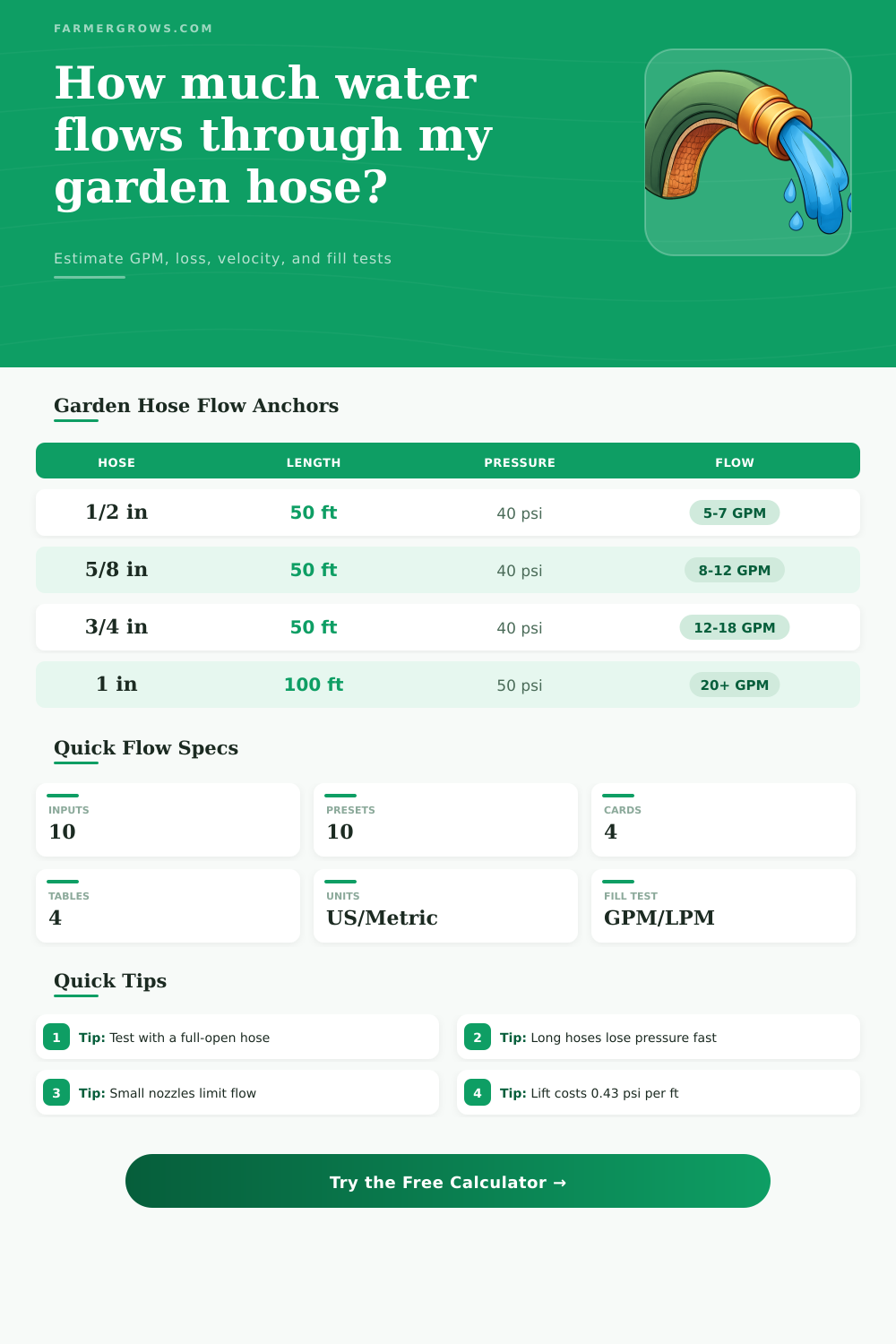
These tables provide practical starting points. Actual flow depends on supply plumbing, hose condition, valves, nozzle geometry, and pressure under flow.
| Hose ID | Area | Typical Use | Good Velocity Range |
|---|---|---|---|
| 1/2 in (12.7 mm) | 0.196 sq in | Containers, short beds | 3-7 ft/s (0.9-2.1 m/s) |
| 5/8 in (15.9 mm) | 0.307 sq in | General garden hose | 4-8 ft/s (1.2-2.4 m/s) |
| 3/4 in (19.1 mm) | 0.442 sq in | Sprinklers, tank fill | 4-9 ft/s (1.2-2.7 m/s) |
| 1 in (25.4 mm) | 0.785 sq in | Long farm or pond runs | 5-10 ft/s (1.5-3.0 m/s) |
| Pressure or Lift | US Rule | Metric Rule | Garden Meaning |
|---|---|---|---|
| Elevation gain | 0.433 psi per ft | 9.81 kPa per m | Watering uphill reduces nozzle pressure. |
| Elevation drop | Adds 0.433 psi per ft | Adds 9.81 kPa per m | Downhill hoses may flow more than expected. |
| Low house pressure | 30-40 psi | 207-276 kPa | Use larger hose or shorter runs. |
| Strong hose bib | 50-70 psi | 345-483 kPa | Can support more flow if plumbing allows. |
| Nozzle Opening | Equivalent Diameter | Flow Behavior | Best Use |
|---|---|---|---|
| Fine spray | 0.08-0.16 in | Low flow, high restriction | Seedlings and delicate transplants. |
| Watering wand | 0.18-0.30 in | Moderate controlled flow | Raised beds and pots. |
| Open nozzle | 0.35-0.55 in | High flow if hose supports it | Tank filling and fast soaking. |
| Open hose end | Near hose ID | Hose friction controls flow | Bucket tests and maximum flow checks. |
| Fitting Type | Equivalent Length | Restriction Level | Planning Note |
|---|---|---|---|
| Straight coupler | 1-2 ft (0.3-0.6 m) | Low | Usually minor unless many are chained. |
| Quick connect | 2-5 ft (0.6-1.5 m) | Medium | Small internal bores can matter. |
| Y splitter or valve | 4-10 ft (1.2-3.0 m) | Medium-high | Check with the bucket test after installing. |
| Filter/backflow device | 8-25 ft (2.4-7.6 m) | High | Use extra loss factor when specs are unknown. |
Bucket test first: For irrigation scheduling, the fill-test result is usually the most reliable number because it includes your real tap, hose, fittings, and nozzle.
Upsize long runs: If the calculator shows high friction loss or velocity above the comfort range, a larger hose often works better than adding pressure.
Flow rate is the amount of waters that passes through a hose in a specific length of time. The flow rate of a hose is not solely determine by the water pressure at the tap because there is several factors that contribute to the movement of water through the hose. These factor include the length of the hose, the diameter of the hose, the elevation of the hose, the fittings on the hose, and the size of a nozzle on the end of the hose.
Any restriction in the hose will reduce the flow of water through the hose. There are a couple different ways to calculate the flow of a hose. One method is with a mathematical calculation.
How to Measure and Test Hose Flow Rate
This calculation takes into account the friction in the hose, the elevation of the hose, and the size of the nozzle at the end of the hose. This calculation will model the flow of water through the hose. The other method of calculating flow rate is by performing a bucket test.
The modeled flow rate can be compared to the fill test that is performed on the hose. Any difference between these two flow rates can indicate restriction within the hose that are not immediately visible. In order to accurately enter the variables into the calculator to model the flow of water through the hose, there are several different measurement that must be provided.
The first variable is the diameter of the hose. You can measure the diameter by inspecting the hose jacket. The length of the hose is another variable.
The length of each section of hose must be accounted for. The third variable is the supply pressure. This measurement is taken when no other water is being drawn from the water supply.
This ensures the static pressure is provide. The fourth variable is the elevation. If the hose is positioned higher above the water supply, there will be a loss of pressure at the nozzle of the hose.
For every few feet that the hose rises in elevation, there will be a loss of approximately half a pound per square inch of pressure. The fifth variable include the number of fittings on the hose. Each fitting will reduce the pressure within the hose.
The size of the nozzle that water exit the hose can also impact the flow rate. It is important to note that a smaller size of the nozzle will not necessarily reduce the flow rate of the hose. However, it will change the location at which the pressure drop occur.
The discharge coefficient is another variable that is enter into the calculator. For nozzles that have a rounded opening, more water will exit the nozzle than if the nozzle had a sharp-edged opening. The hose will lose less pressure to the rounded edge of the nozzle than if it exited through a sharp-edged hole.
There are two different flow rate that can be displayed from the calculator. The first is the modeled flow that the calculator calculates using the variables that were entered. The other is the fill test flow of the hose which can be calculated through a simple bucket test on the hose.
If the fill test flow is lower then the modeled flow, there may be kinks in the hose or a backflow preventer that is too restrictive. If the fill test flow is higher than the modeled flow, the flowing pressure at the end of the hose is likely higher than the static pressure that was entered into the calculator, or the nozzle is larger than the diameter that was measure on the hose. The velocity is the speed of the water as it pass through the hose.
The velocity can be too low or too high for the hose and its diameter. Tables can be used to determine if the velocity of the water within the hose is within the normal range of flow for that size of hose. External environmental factor can also impact the flow of water through the hose.
The temperature of the water can change the viscosity of the water as it passes through the hose. Water that is heated by the sun will behave differently through the hose than water that is kept in the shade. The soil in which the hose is located can also impact the flow of water.
If the soil is dry, it will absorb the water faster than the hose can supply the amount of water. This can impact the actual flow rate of the hose. Soaker hose and drip headers have their own restriction to the flow of water.
Therefore, the most accurate way to calculate the flow rate of these type of hoses is to use the fill test. Many people make the mistake of assuming that the diameter of the hose is the only factor that impact the flow rate. However, the length of the hose and the number of fittings on the hose will also impact the flow rate of water through the hose.
For instance, a 50-foot hose with a 5/8 inch diameter will have a different flow rate than a 150-foot hose of the same diameter with the same number of fitting. The static pressure in the water supply is also not the same as the pressure that is delivered to the end of the hose. Each foot of hose and each fitting will reduce the pressure of the water before it reaches the nozzle at the end of the hose.
Elevation impact the pressure at the nozzle in both directions. If the hose is positioned on a hill so that the water runs downhill, the nozzle will have more pressure to propel the water forward. This allows for the use of smaller nozzle on the end of the hose.
For instance, if a hose is positioned on a hill so that it will run uphill, the nozzle will have less pressure to propel the water forward. The higher the rise of the hose, the more linear the loss of water pressure at the nozzle. Finally, using the bucket test as a means of determining the flow rate of the hose is a good way to verify the result of the flow rate calculator.
In order to perform a bucket test, simply fill a container of a marked volume of water for a certain length of time. Divide the volume of the container by the length of time to determine the flow rate of the hose. This flow rate includes all restriction on the hose.
The calculator allows individuals to determine how different equipment will impact the flow rate of water through the hose.