Pressure Loss in Pipe Calculator
Estimate pipe friction loss, elevation pressure change, required inlet pressure, and water velocity for irrigation mains, laterals, greenhouse lines, and farm water runs.
Hazen-Williams is commonly used for turbulent water flow in irrigation pipe. Enter the actual inside diameter and add valves, elbows, tees, and filters as equivalent straight-pipe length.
Pipe Pressure Results
Losses are calculated with Hazen-Williams for the full effective pipe length, then converted to pressure using water density at the entered temperature.
Smooth new plastic pipe for mains and manifolds.
Common for buried irrigation supply runs.
Flexible laterals and low-pressure field lines.
Smooth small-diameter water service pipe.
Portable irrigation pipe in good condition.
Newer steel pipe before major scale buildup.
Aged pipe with rougher interior surface.
Conservative value for rough or restricted runs.
| Velocity range | Farm use | What it suggests | Typical action |
|---|---|---|---|
| Under 2 ft/s | Drip headers, quiet supply | Low friction, possible settling in dirty water | Usually acceptable for filtered irrigation |
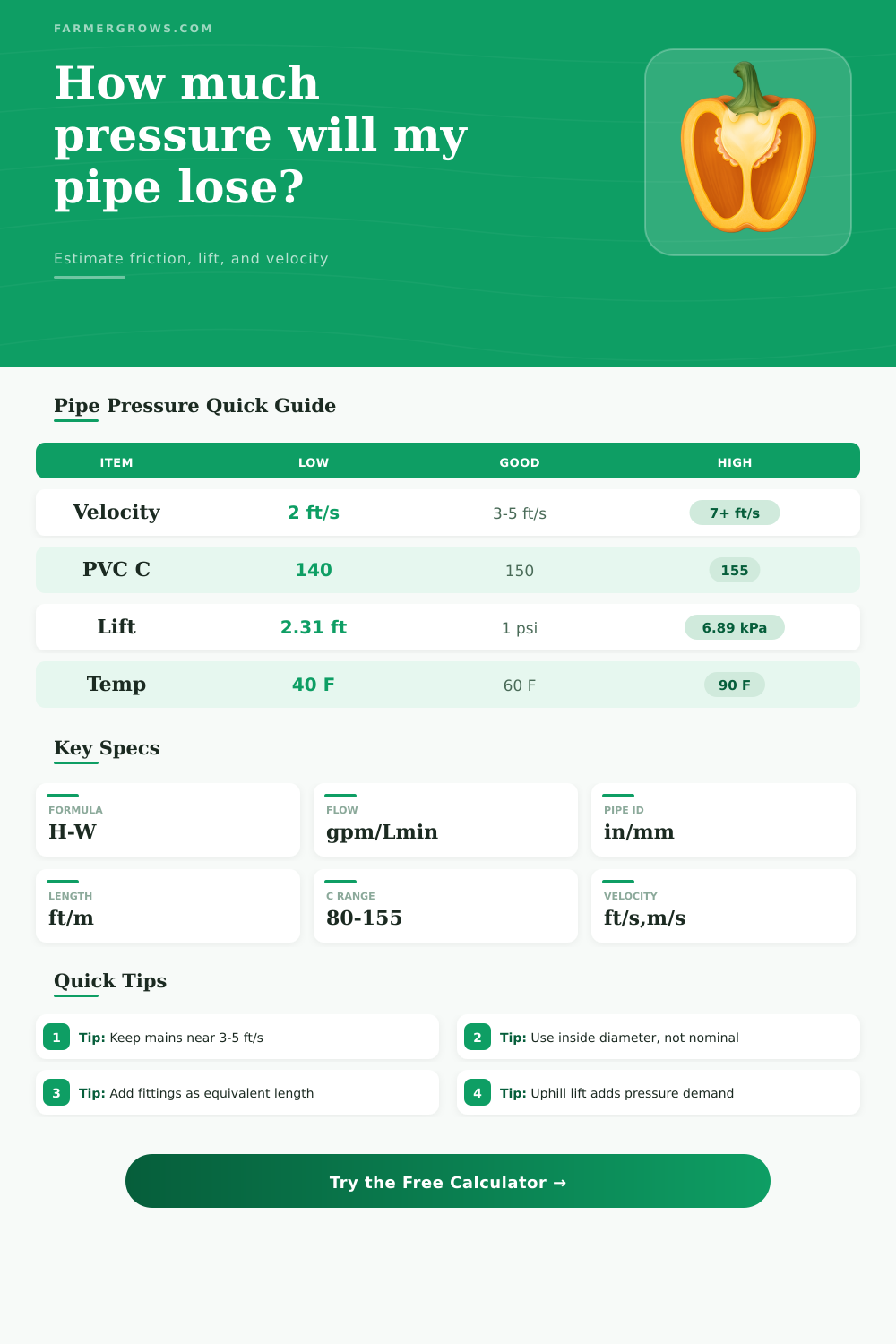
| 2 to 5 ft/s | Mainlines and laterals | Efficient range for many irrigation systems | Good target for routine sizing |
| 5 to 7 ft/s | Short sprinkler feeds | Higher friction and surge risk | Check pump pressure and valve closure speed |
| Above 7 ft/s | Occasional short sections | Large friction losses can appear quickly | Consider larger pipe or split zones |
| Material | Common C | Smoothness | Field note |
|---|---|---|---|
| PVC / CPVC | 150 | Very smooth | Often the lowest loss choice for fixed mains |
| HDPE | 140 | Smooth | Good buried supply pipe with flexible joints |
| Poly tubing | 135 | Smooth | Use actual ID because wall thickness varies |
| Aged steel | 80 to 120 | Rougher | Scale and corrosion can sharply raise losses |
| Conversion | Imperial value | Metric value | Use in calculator |
|---|---|---|---|
| Flow | 1 gpm | 3.78541 L/min | Metric flow is converted before Hazen-Williams |
| Length | 1 ft | 0.3048 m | Pipe and fitting lengths use exact conversion |
| Diameter | 1 in | 25.4 mm | Inside diameter controls friction strongly |
| Pressure | 1 psi | 6.89476 kPa | Results switch with the unit system |
| Fitting type | Low allowance | Higher allowance | When to adjust |
|---|---|---|---|
| Long sweep elbow | 2 to 6 pipe diameters | 8 to 12 diameters | Use higher values for sharp turns |
| Standard 90 elbow | 20 to 30 diameters | 35 to 50 diameters | Add more for compact molded elbows |
| Tee through run | 10 to 20 diameters | 25 to 40 diameters | Branch flow is usually more restrictive |
| Valve or filter body | Manufacturer data | Field estimate | Use pressure test data when available |
The factor of pressure losses in the irrigation system will determine whether the irrigation system has an even or uneven flow of water to the various outlet. Friction in the system, the elevation change within the system, and the resistance that the irrigation system’s pipe create for the moving water causes pressure loss. If the factor of pressure loss isnt considered in the design or installation of the system, the system may provide too much water to the outlets near the irrigation system’s pumps or valves, yet provide too little water to the outlets that are positioned further from those pumps and valves.
An understanding of the factor of pressure loss are required to ensure that the irrigation system provide an even distribution of water to every outlet in the system. Several factor will influence the loss of pressure within an irrigation system. One of the factors is the flow rate of the system; the flow rate will determine the rate at which water pass through the irrigation system.
What Causes Pressure Loss in an Irrigation System
Additionally, the inside diameter of the system will have an influence upon the system’s pressure loss; smaller diameters create more friction within the system than larger diameters. The length of the irrigation system is another of the factor that will influence the loss of pressure; longer lengths will lead to increased friction within the system. Finally, factors like elbows, valves and other plumbing fittings will contribute to the pressure loss within the system; these components act as resistance to the flow of water within the system.
Other factors that contribute to pressure loss include the elevation changes along the system’s route and the water temperature within the system. Lastly, the C factor within the Hazen-Williams equation will have an influence upon the pressure loss within the system. The factor of the inside diameter of the irrigation system’s pipe should be considered rather than the nominal size of the pipe.
Smaller inside diameters will create increased friction within the system; this friction will contribute to the factor of pressure loss within the system. Additionally, the length of the irrigation system’s pipe should be considered; longer length of pipe will create more friction than shorter lengths. Any fittings for the system, such as valves and elbows, will increase the resistance to the water within the system; they should be considered in the calculations for the system as lengths of pipe that is longer than those that are accounted for by the length of the irrigation system itself.
Calculations that do not account for these additional lengths created by the fittings will not accurately calculate the expected pressure loss within the system. The elevation change within the system is one of the major factor that will contribute to the pressure loss within the system. When the irrigation system’s pipe moves uphill, the elevation change will reduce the pressure within the system.
When the system’s pipe moves downhill, however, the elevation change will increase the pressure within that pipe. The factor of elevation change within the system must be calculated to determine whether the system will provide even water to all of the outlets of the irrigation system. Pressure and head are directly related; every 2.31 feet of change in elevation will create a loss or gain of one pound per square inch of pressure.
The materials that are used to construct the irrigation system will impact the Hazen-Williams C factor, which will impact the factor of pressure loss within that system. Pipes with smoother materials will exhibit higher C factors; this factor will result in less pressure loss within the system. Pipes that contain rougher materials will have lower C factors within the Hazen-Williams equation, contributing to the increased pressure loss along the length of those irrigation system components.
Therefore, using smoother materials for the irrigation system will help to reduce the factor of pressure loss within the system; this will allow for the use of smaller diameter irrigation pipes. The velocity at which water move through the irrigation system is another of the factors that will impact the performance of the irrigation system. If the velocities within the system are too slow, sediment will settle within the system’s water.
Additionally, velocities that are too fast within the system will lead to increased friction within the system; fast-moving water with the irrigation system will create issues with rapid valve closures. The velocity should be even; neither too slow nor too fast. Many factor within an irrigation system will change over time.
For instance, the system may experience the clogging of its filters, the age of its emitters, or the scaling of its pipes. Each of these factor will contribute to the loss of pressure within the system. It is important to account for these changes; adding an allowance of ten to fifteen percent to the calculations for pressure will ensure that the irrigation system will continue to function properly within the areas that is supplied with water from the system, even when those filters is dirty or those pipes are of an aged structure.
It is important to measure the pressure within the outlet of the irrigation system after it is installed. By measuring the pressure at the outlet of the system, it is possible to determine whether the system is providing the amount of pressure to the outlets that was calculated for the system. If the pressure at the outlet is less than that which was calculated for the system, there are a variety of possibilities as to the cause of the issue; the system may have features more fittings than were planned for the system, or the filter may be blocked.
By measuring the pressure at the outlet, it is possible to determine the relationship between the flow rate of the system, the length of the system and the loss of pressure within that system.