Mushroom Yield Calculator
Estimate wet substrate, dry matter, biological efficiency, flush-by-flush production, contamination loss, and harvest timing for common cultivated mushrooms.
Use a named preset to seed the calculator with a realistic species, substrate moisture, BE, block count, contamination allowance, and harvest spacing.
dry substrate = wet substrate × (1 - moisture %), wet substrate = dry substrate / (1 - moisture %), and fresh yield = dry substrate × BE %. Contamination loss is applied after potential fresh yield.Estimated Mushroom Yield
Results use dry substrate as the biological efficiency basis, then account for block count, contamination or cull loss, and flush timing.
| Species | Common substrate | Typical BE range | Moisture range | Flush pattern |
|---|---|---|---|---|
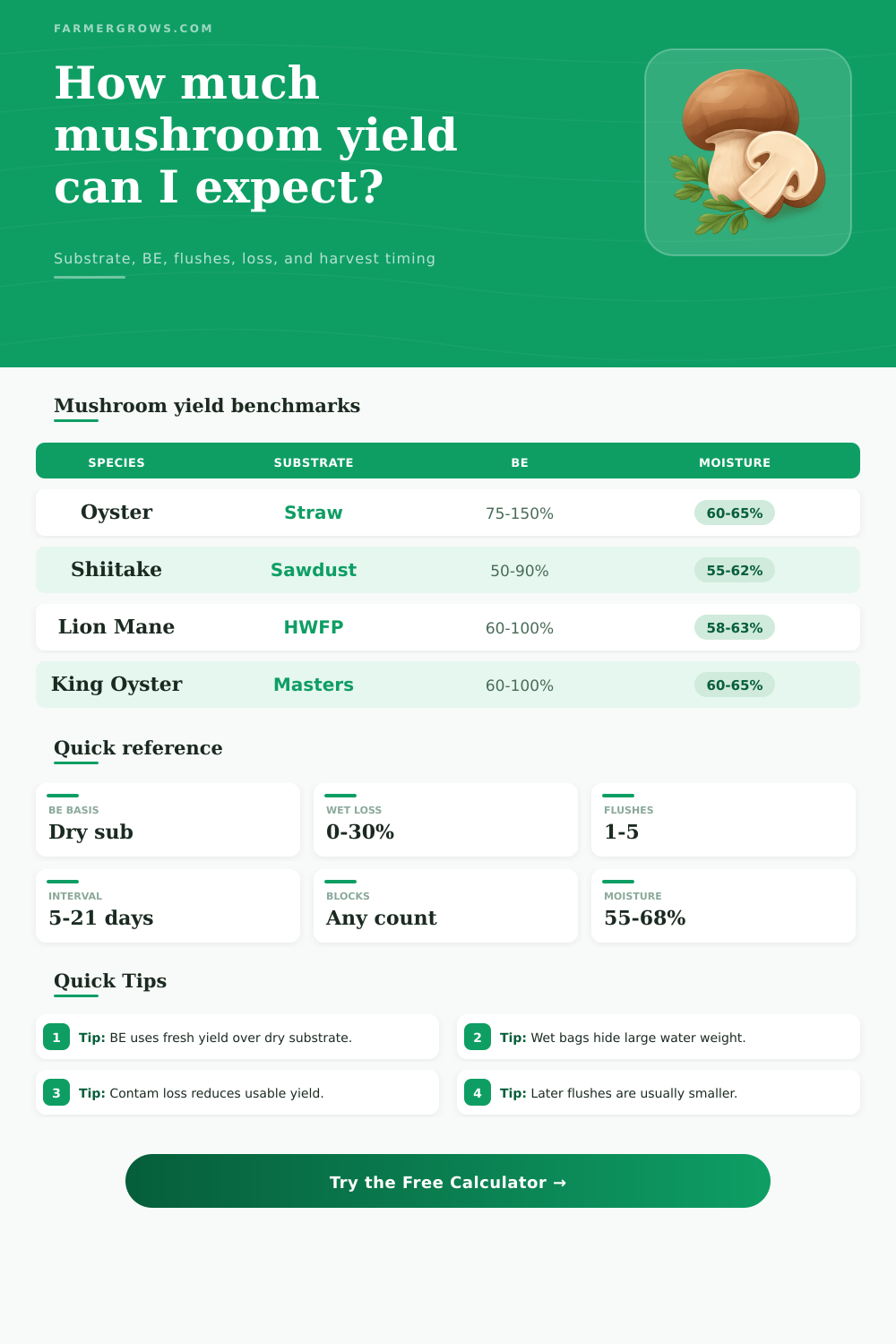
| Blue oyster | Pasteurized straw or HWFP | 75-150% | 60-65% | Heavy first flush, 2-3 flushes |
| Pink oyster | Straw or hardwood blends | 70-130% | 60-65% | Fast warm-weather flushes |
| Shiitake | Supplemented hardwood sawdust | 50-90% | 55-62% | Moderate first flush, slower rest |
| Lion's mane | Hardwood fuel pellets with supplement | 60-100% | 58-63% | Strong first two flushes |
| King oyster | Master mix or sawdust supplement | 60-100% | 60-65% | Few flushes, large individual fruits |
| Chestnut | Hardwood sawdust block | 50-90% | 58-64% | Three smaller flushes |
| Reishi | Hardwood sawdust block | 35-75% | 58-63% | Long single or two-stage harvest |
| Wine cap | Straw and wood chips | 40-80% | 60-68% | Outdoor seasonal waves |
| Wet substrate | Moisture | Dry matter | Water in block | Formula note |
|---|---|---|---|---|
| 5 lb block | 55% | 2.25 lb dry | 2.75 lb water | 5 × 0.45 |
| 5 lb block | 60% | 2.00 lb dry | 3.00 lb water | 5 × 0.40 |
| 5 lb block | 62% | 1.90 lb dry | 3.10 lb water | 5 × 0.38 |
| 5 lb block | 65% | 1.75 lb dry | 3.25 lb water | 5 × 0.35 |
| 5 lb block | 68% | 1.60 lb dry | 3.40 lb water | 5 × 0.32 |
| Species style | Flush 1 | Flush 2 | Flush 3 | Later flushes |
|---|---|---|---|---|
| Oyster-heavy first flush | 55-65% | 22-30% | 8-15% | Low unless blocks stay clean |
| Shiitake balanced blocks | 45-55% | 25-35% | 12-20% | Small with rest periods |
| Lion's mane two-flush crop | 58-68% | 24-34% | 4-10% | Often not worth holding long |
| Reishi long-cycle crop | 70-85% | 15-30% | 0-8% | Usually quality declines |
| Outdoor wine cap | 40-55% | 25-35% | 12-25% | Weather dependent |
| Loss rate | Clean blocks from 100 | Usable share | When it fits | Planning note |
|---|---|---|---|---|
| 0-3% | 97-100 | 97-100% | Tight sterile workflow | Useful for proven strains |
| 5-8% | 92-95 | 92-95% | Good small farm target | Common planning allowance |
| 10-15% | 85-90 | 85-90% | New spawn, substrate, or room | Add buffer before sales promises |
| 20-30% | 70-80 | 70-80% | Problem batch or heat stress | Review sterilization and incubation |
Ranges are planning benchmarks. Actual yield depends on spawn rate, strain genetics, substrate preparation, sterilization or pasteurization quality, incubation, humidity, fresh air exchange, and harvest standards.
Given the difficulty of predicting a mushroom harvest, a mushroom harvest depend on several different variable. The type of mushroom that you are growing, the moisture content of the substrate, and the number of flushes that you plan to grow from that substrate are just three of the variable that must be understood in order to accurately predict the final weight of mushrooms that will be harvested from your grow. Biological efficiency compares the weight of the mushrooms that is harvested with the dry weight of the substrate.
The biological efficiency of the growing process dont necessarily indicate that the weight of the mushrooms will equal the weight of the starting substrate. Instead, biological efficiency of 100% means that the weight of the mushrooms will equal the weight of the dry substrate; the weight of the mushrooms will be sold minus the dry substrate weight. You can calculate the dry substrate weight using a mushroom calculator that accounts for the moisture content of the substrate; the more water that is contained within the substrate, the less dry substrate the mushrooms will have to work with to grow.
Things That Affect How Many Mushrooms You Harvest
Thus, an understanding of the moisture content of the substrate is required to calculate the amount of dry substrate. The number of flushes that the mushrooms will produce and the time between each flush is another variable that should be considered in the calculation of the yield of mushrooms from your substrate. The weight of the mushrooms will be distributed between each flush; some mushroom species contain the majority of their weight in the first two flushes, while other species contain most of their weight in three or four flushes.
The later flushes will weigh less than the initial flushes of mushrooms; additionally, the length of time between each flush will determine how long the mushrooms will occupy your fruiting area. The number of each flush can be calculated using a mushroom calculator; the species of mushroom that is being grown can determine the weight of the mushrooms from each flush. The loss of mushrooms to contamination will reduce the final weight of mushrooms that are sold.
Some mushrooms may be contaminated with mold or bacteria, and it is impossible to provide for perfect conditions when growing mushrooms. The weight of mushrooms that are lost to contamination will reduce the amount of mushrooms that is available for sale; thus, you will need to subtract a percentage for the loss of mushrooms to contamination from the total weight of mushrooms that are calculated for sale. Even a small percentage of mushrooms lost to contamination can significanly reduce the total weight of mushrooms that can be sold.
Aside from the variables described above, additional variable that will impact the weight of mushrooms that are sold include the environmental conditions in which the mushrooms are grown. Factors like the spawn rate of the mushrooms, the temperature at which they are incubated, and the amount of fresh air that is exchanged in the growing area will impact the final weight of mushrooms that are grown. Additionally, the time at which the mushrooms are harvested will also impact the final weight of mushrooms that are sold.
For instance, although a mushroom strain may be expected to weigh the maximum amount of weight at five days after inoculation, if the mushrooms are harvested at three days the weight will be less; likewise, if the mushrooms are allowed to remain in the growing area past five days, the weight may be the same, but the quality of the mushrooms may be reduced. Another variable that can impact the weight of mushrooms that are sold is the substrate itself. For instance, while straw is a substrate that is commonly used for growing oyster mushrooms, and straw breaks down quick; thus, it may not be able to support the fourth flush of mushrooms.
Hardwood sawdust, on the other hand, mushrooms may break down more slowly, but it can support multiple flushes of mushrooms over time. Each of these substrates can be selected in a mushroom calculator to determine how much weight each substrate will produce. The time at which mushrooms are harvested will impact both the weight of the mushrooms and the quality of the mushrooms.
If the mushrooms are harvested prior to the peak growth time for that strain, the total weight of the mushrooms will be less then if they were allowed to grow to their peak. Additionally, if the mushrooms are allowed to grow beyond the time at which they should of been harvested, the mushrooms may grow in weight, but the quality of the mushrooms may decline. Thus, a mushroom calculator can establish the length of time between the initial flush and the final flush of mushrooms.
An additional factor that will impact the total weight of mushrooms that are sold is the factor of consistency of the growing process. Even small changes in process will impact the total weight of mushrooms that are sold. For instance, if the mushrooms are pasteurized for shorter lengths of time each time, or if the bags of mushrooms are packed differently from one batch of mushrooms to the next, the total weight of mushrooms that are sold will change.
Additionally, although a mushroom calculator cannot measure the consistency of your growing process, you will have to state your assumptions about consistency when you utilize a mushroom calculator. Overall, each of these variables can be considered individually, but the main goal is to understand how each of these variables interacts with each other. By understanding how each of the variables interact with each other, each of the variables can be considered a “lever” that can be adjusted in the growing process.
Thus, understanding each of these variables will allow the grower to create an effective and workable plan to grow mushrooms rather than guessing at the outcome of the growing process.