Pump Pressure Calculator
Estimate pump discharge pressure for irrigation and farm transfer lines by combining static lift, target outlet pressure, pipe friction, fittings, filter loss, and safety margin.
Pick a realistic farm or yard case to seed the calculator. Each preset loads a flow rate, source lift, outlet rise, pressure target, pipe, fittings, and efficiency.
Best when you want low drift, steady wetting, and small headroom above the farthest outlet.
Good for trees, nursery benches, and light spray where pressure stays even at the end of the line.
Use this band when the zone needs wider throw, longer radius, and more pressure at the nozzle.
Useful for utility hoses, tank fill, and cleanup lines where flow is high and pressure matters less.
Imperial mode uses gpm, ft, in, and psi.
Method: Hazen-Williams pipe loss plus velocity-head fitting losses, with 1 psi equal to 2.31 ft of water head.
Pump pressure snapshot
Enter values to calculate pump discharge pressure and head.
| Pressure | Head ft | Head m | Note |
|---|---|---|---|
| 5 psi | 11.6 ft | 3.5 m | Low lift |
| 10 psi | 23.1 ft | 7.0 m | Common |
| 20 psi | 46.2 ft | 14.1 m | Spray |
| 40 psi | 92.4 ft | 28.1 m | Higher band |
| Use | Pressure | Head | Note |
|---|---|---|---|
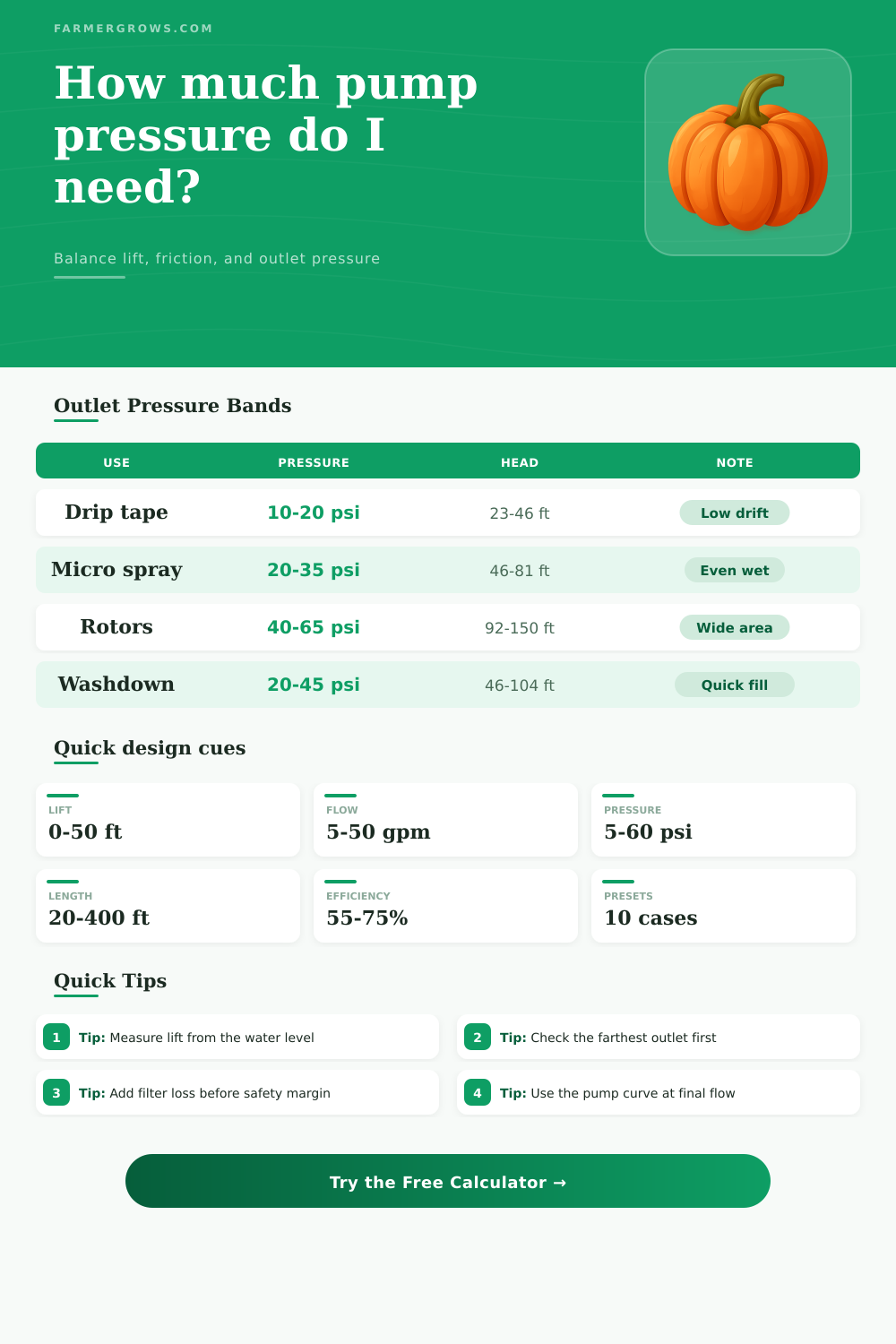
| Drip tape | 10-20 psi | 23-46 ft | Low drift |
| Micro spray | 20-35 psi | 46-81 ft | Even wet |
| Rotors | 40-65 psi | 92-150 ft | Wide area |
| Washdown | 20-45 psi | 46-104 ft | Quick fill |
| Pipe size | Head / 100 ft | Pressure / 100 ft | Use |
|---|---|---|---|
| 3/4 in | 12.24 ft | 5.30 psi | Very high |
| 1 in | 3.02 ft | 1.31 psi | Common |
| 1-1/4 in | 1.02 ft | 0.44 psi | Gentler |
| 1-1/2 in | 0.42 ft | 0.18 psi | Best |
| Material | C value | Behavior | Note |
|---|---|---|---|
| PVC / CPVC | 150 | Smooth | Best pick |
| HDPE | 140 | Smooth | Flex lines |
| Poly tubing | 140 | Flexible | Drip loops |
| Galvanized steel | 120 | Rougher | Older lines |
Combine static lift, emitter pressure, pipe friction, and fitting losses in one place. This calculator helps you choose a pump that holds steady pressure at the farthest outlet with confidence.
When you are creating an irrigation system, it is important for you to understand how the water will behave as it move through the pipe that distribute the water to the various areas that require water to be add to the environment. Many individual may believe that the pressure of the pump is a single number, but the pressure budget of that pump must overcome the various element within the system that reduce that pressure. Each number that is placed within the irrigation system create a loss of the pressure that the water pump creates.
The water will be lost as a result of each elevation change and each joint within the system. Therefore, each emitter within the system will require that the water pump is able to provide enough pressure to overcome each of these losses that occur along the path from the pump to the emitters. The total amount of pressure that is required to overcome these elements of the system are referred to as the Total Dynamic Head (TDH) of the system.
How Pump Pressure Works in an Irrigation System
The TDH is the measurement of the amount of pressure that the pump will need in order to overcome both the force of gravity and friction within the system. If the irrigation system is moving the water from a pond to a hill, then the system will need to overcome the force of gravity. The force of gravity is referred to as the static cost of the system.
These costs represent the amount of pressure that the system will require in order to move the water to higher elevation. The static costs within the system will not change with the different speeds at which the water is moved within the system. In addition to the static cost of the system, there are also the loss of the water that are created due to friction.
As the water moves through the system, the water will create friction against the interior of the pipe that move the water. The materials of that pipe will impact the amount of friction that is created within the system. For instance, if very smooth materials are used to create the pipe, there will be less friction within the system then if old metallic pipes are used.
Therefore, each different material will change the friction losses within the system. Another factor that can be manipulated within the system is the diameter of the pipe. By increasing the diameter of the pipe, the friction loss will decrease.
This is due to the fact that if the volume of the water is high, using a narrow diameter for the pipe will create higher friction losses then a large diameter pipe. Therefore, using a one and a half-inch diameter pipe will allow for less loss of pressure than a three-quarter inch pipe of the same length. In addition to the size of the pipe, each fitting within the system will also contribute to the friction loss of the system.
Any number of ninety degree elbows or T junctions will contribute to the friction loss of the system. Systems with numerous valve and turns within the system will exhibit significant resistance to the movement of the water. Because of the inefficiency of any given system, a safety margin is establish to account for these resistance element.
A ten percent safety margin is often applied to account for factor like potential clogging of a filter. Filters are another essential component for any irrigation system. However, these filter will reduce the amount of pressure within the system.
If the pressure loss of the filter are not accounted for within the system design, the pump will appear to be underpowered once the filter is installed into the system. It is essential to calculate the amount of pressure losses for each portion of the system, including the filter. The various irrigation tool will require different amounts of outlet pressure from the system.
Drip tape will require very little pressure to function normal, while tools like rotors will require high amount of pressure. If the pressure is too low for the rotor tools, the system may not be able to effectively direct the water to the desired area. Conversely, if the pressure is too high, the system may blow a fitting on the sprinkler head or create misting within the irrigation system.
Another calculation that is made within the irrigation system is the calculation of the brake horsepower that is required for the pump. The brake horsepower is the amount of motor that is required for purchase to provide the various amount of energy to the system. The hydraulic horsepower is the amount of energy that the water receives from the pump, but more energy is required by the motor to account for the heat created in the system.
To ensure that the pump can handle the various demand of the system, it is best to round to the next available size for the motor. If the motor is too small, it may not be able to handle the various demand of the system. An oversized motor, however, can be throttled to the necessary speed to reduce its output.
Therefore, when all of the component of the system are accounted for, including the lift of the water, the friction losses, and the outlet pressure for each irrigation tool, an effective irrigation system can be create.