Aquaponics Flow Rate Calculator
Balance tank turnover, hydraulic retention, and pump sizing with one clean aquaponics check for fish tanks, grow loops, settlers, and biofilters.
The calculator uses field-friendly reference anchors from OSU Extension, Texas A&M AgriLife, FAO aquaponics guidance, and Kentucky State University so your flow target stays practical.
Flow Estimate
The final pump target respects the turnover target and the retention limits from your biofilter and solids settler.
| Source | Anchor | Use | Note |
|---|---|---|---|
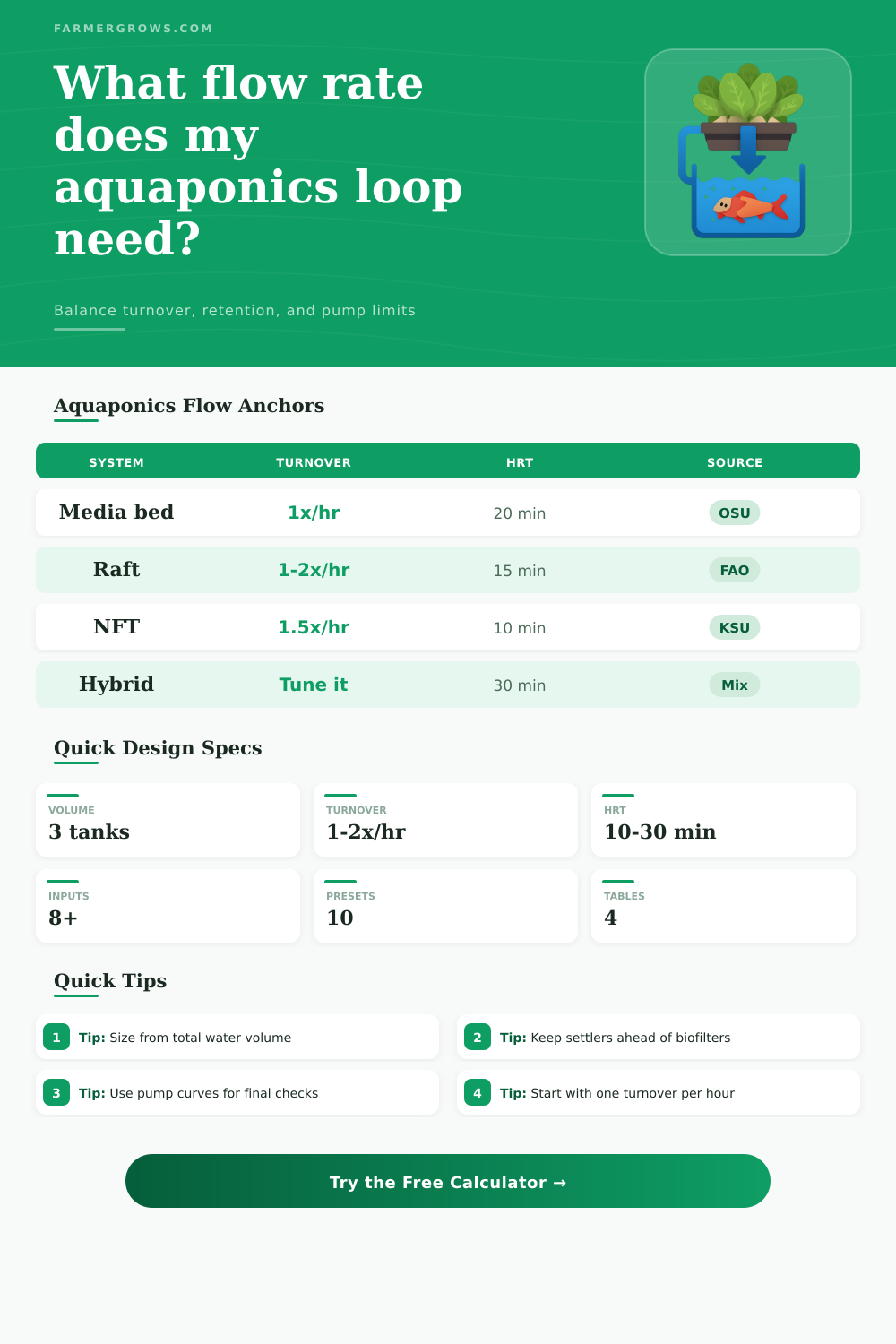
| OSU Extension | Cycle about 1 hour | Default turnover | Good starting point for small systems. |
| OSU Extension | Fish water twice/hour | Fish-heavy loops | Useful when the fish tank needs extra circulation. |
| Texas A&M | 3 turnovers/day | Minimum floor | Use as a lower bound when checking pump head. |
| FAO / Billund | Fish tank ~35 min | Retention cue | Shows the fish side can move fast in recirculation. |
| Component | Typical HRT | Reference | Why it matters |
|---|---|---|---|
| Fish tank | ~35 min | Billund Aquaculture | Keeps the fish side moving and oxygenated. |
| Biofilter | 10-20 min | Billund Aquaculture | Enough contact time for nitrification. |
| Clarifier | 30 min | Kentucky State | Lets settleable solids drop out before fine filtration. |
| Whole loop | 60 min | OSU / FAO | A practical baseline for a clean recirculating loop. |
| Total volume | 1x/hr | 1.5x/hr | 2x/hr |
|---|---|---|---|
| 250 gal | 250 gph | 375 gph | 500 gph |
| 500 gal | 500 gph | 750 gph | 1000 gph |
| 1000 gal | 1000 gph | 1500 gph | 2000 gph |
| 1500 gal | 1500 gph | 2250 gph | 3000 gph |
| Scenario | Volume | Flow | Check |
|---|---|---|---|
| Media bed starter | 430 gal | 430 gph | About 1 cycle per hour |
| Raft module | 800 gal | 1000 gph | Strong circulation for leafy greens |
| NFT rack | 600 gal | 900 gph | Steady film with clean upstream water |
| Hybrid greenhouse | 1200 gal | 1500 gph | Matches a mixed loop with a modest buffer |
Size the pump from total recirculating volume, not only the fish tank.
Let the solids settler take the first hit before water reaches the biofilter.
Reference anchors from aquaponics guidance keep the calculator practical, while the limit check shows whether turnover, biofilter contact, or solids settling controls the final pump target.
Aquaponics systems require a specific water flow rate to ensure that the system function correctly. The water flow rate must be balanced to accomodate the requirements of the fishes, plants, and bacteria in the system. Many individuals selects a water pump based on the volume of the system listed on the packaging.
However, the volume of the pump dont account for the water flow requirements of the system as a whole. If the flow rate of the water in the system is too low, the water will sit in certain area of the system. This leads to low level of dissolved oxygen in these areas, leading to waste accumulation.
How to Set the Right Water Flow for Your Aquaponics System
If the flow rate is too high, the water will create stress for the fish and may wash the beneficial bacteria out of the system. A person must balance three requirement with the water flow rate in the aquaponics system. The first is the turnover rate.
This rate is the frequency with which the volume of the system pass through the water pump. If the turnover rate is too low, the water does not move enough within the system to provide adequate levels of dissolved oxygen for the water. If the turnover rate is too high, the water may develop currents that are more strong for the fish in the system.
The second requirement is the hydraulic retention time, which is related to the biofilter and the solids settler. The biofilter requires water to remain in contact with the filter media for a certain length of time for the bacteria to remove ammonia from the water. If the flow rate is too high for a certain length of time, the water will not remain in contact with the media for long enough for the bacteria to perform there tasks.
Thus, using a high volume pump may result in the system failing to perform it’s tasks. The third component to consider is the requirements of the solids settler. The solids settler allows the water to slow down in order for the heavy waste from the fish to sink to the bottom of the settler.
If the flow rate of the water is too fast, the waste will remain suspended in the water and move into the grow beds. This can lead to clogging of the grow beds. Therefore, the flow rate should be set to the slowest speed for the components of the system to determine an appropriate size of the water pump.
The specific flow rate requirements for aquaponics systems can vary depending on the system that is established. For instance, media bed systems have more forgiving flow rates than systems that use rafts or nutrient film technique systems. Media bed systems require the water to perform various task in the system, so the water does not need to move as quickly as in other systems.
For systems that use rafts and nutrient film techniques, a higher flow rate is better because it prevents nutrient gradients from forming that allow the plants at the end of the system to provide less nutrients for the plants then those at the beginning of the system. Additionally, some water flow rate may need to be accounted for when purchasing a water pump. Water pumps are measured by the flow rate of the water at the maximum output when the height of the water is zero.
If a person were to add pipes to the system, the flow rate will even out when moving through the pipes. To accommodate this, a design buffer should be incorporated into the water flow rate of the system. Additionally, over time, biofilm will form in the system that may lead to the formation of clogs in the filter.
Thus, a person should start with a sensible flow rate and slowly adjust it according to the systems condition. If the turnover rate and retention times are set up appropriately for the system, the water will move fast enough to remain fresh and the filters will clean it slow enough.