
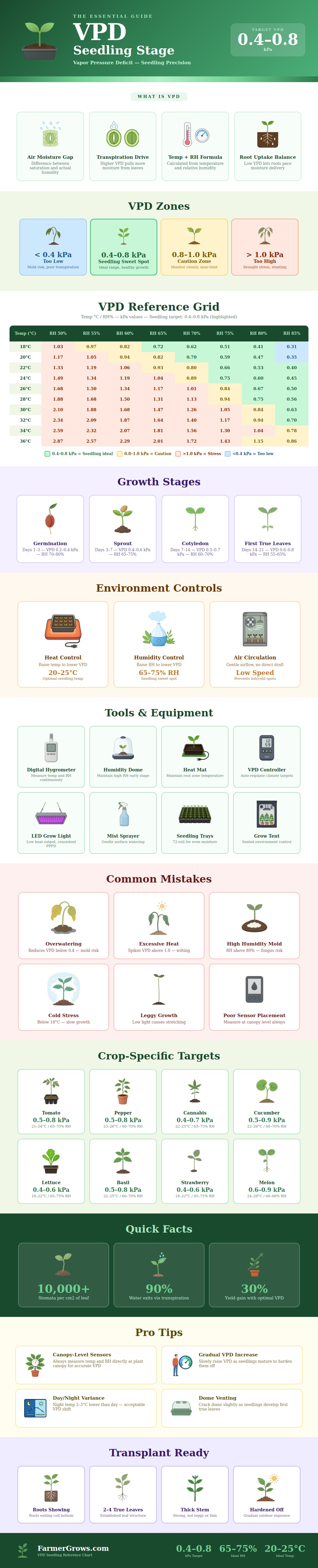
Vapor Pressure Deficit or VPD is an measurement of the relationship between the air temperature and the relative humidity. The Vapor Pressure Deficit are important in relation to the growth of plants because the Vapor Pressure Deficit determines how many water is pulled from the leaves of that plant. If the Vapor Pressure Deficit is high, the air is dry and pull water from the plant quick.
If the air pulls too much water from the plant faster then the roots are able to pull water from the soil, the plant will wilt and become stressed. If the Vapor Pressure Deficit is low due to too many moisture in the air, the plant cannot exhale moisture. If the plant is unable to exhale moisture, it is unable to take up the nutrients that it need from the soil, and mold can develop on the plant.
How Vapor Pressure Deficit Affects Seedlings
While you can measure the relative humidity of an environment, relative humidity do not provide a complete description of that environment due to its disregard of the temperature of the environment. At the same relative humidity, the outcome of that humidity will differ with different temperatures in the environment. The Vapor Pressure Deficit is more useful in that it incorporates both the humidity and the temperature in its description of the environment.
Plants like seedling require specific levels of Vapor Pressure Deficit. The reason for this requirement is due to the small leaves that the plants possess and there fragile root systems. Therefore, seedlings is sensitive to high levels of Vapor Pressure Deficit.
By monitoring the Vapor Pressure Deficit of an environment in which seedlings are growing, growers can ensure that the plant remain in an ideal zone for their growth. If the Vapor Pressure Deficit is too high for the plant that the grower is growing, the plant will experience stress, indicated by curled leaf and brown leaf tips. If a wilting plant is seen, the grower may add more water to the soil.
However, if the wilt is the result of more higher of a Vapor Pressure Deficit, adding more water to the soil may cause the roots of the plant to rot. By using a humidity dome, growers can manage the Vapor Pressure Deficit of the environment in which the seedlings are growing. A humidity dome traps the moisture around the seedling and create a microclimate around the seedling that maintains a low Vapor Pressure Deficit.
As the seedling develops true leaf, the humidity dome can be slowly opened to allow the plant to become accustomed to higher Vapor Pressure Deficit levels. This process is referred to as hardening off the plant, and allow the plant to survive the move into its larger environment. Additionally, growers must remember that the plants that they are growing may require different levels of Vapor Pressure Deficit in their growing environments.
For instance, lettuce seedlings may require lower levels of Vapor Pressure Deficit than pepper seedlings, as the lettuce plants prefers cooler and more moist environments than the peppers. Accuracy in measuring the Vapor Pressure Deficit is necessary to ensure that the plants grow well. However, many people make the mistake of placing the sensor that measure the Vapor Pressure Deficit of the environment away from the plants that they are to be grown.
If the sensor is placed too far away from the plants, the sensor will measure the Vapor Pressure Deficit of the entire room, rather than the actual Vapor Pressure Deficit of the environment in which the plants leaves will be drying out. The sensor should be placed at the canopy level of the plants. Once the seedling has developed a sturdy stem and roots that reach the bottom of the container, the seedling is ready to be transplanted into a larger pot.
By maintaining the correct Vapor Pressure Deficit levels, the seedling will exhibit increased growth.