Greenhouse Heat Sink Calculator
Estimate how much usable heat a greenhouse thermal mass can store, how much night heat load it offsets, and the equivalent water barrel or stone mass needed.
Use a named setup to seed the calculator with realistic dimensions, cover type, night conditions, thermal mass material, and storage temperature swing.
Heat Sink Estimate
Your greenhouse heat sink estimate will appear here.
| Cover assembly | U factor, Btu/hr sq ft °F | Typical use | Heat sink note |
|---|---|---|---|
| Single poly film | 1.20 | Season extension tunnels | Mass helps, but losses are fast |
| Inflated double poly | 0.70 | Market hoop houses | Good balance for barrels |
| Twinwall polycarbonate | 0.58 | Backyard and school houses | Mass offset improves noticeably |
| Single glass | 1.10 | Older lean-to houses | Seal leaks before adding mass |
| Double glass | 0.55 | Permanent greenhouse | Water or masonry performs well |
| Insulated north wall | 0.45 | Passive solar greenhouse | High value from exposed mass |
| Container | Water weight | Gross heat at 15°F swing | Best greenhouse placement |
|---|---|---|---|
| 5 gal pail | 42 lb | 625 Btu | Under benches for small starts |
| 30 gal drum | 250 lb | 3,750 Btu | South edge of seedling tables |
| 55 gal barrel | 459 lb | 6,880 Btu | North wall facing winter sun |
| 110 gal pair | 917 lb | 13,760 Btu | End wall or center aisle |
| 275 gal tote | 2,293 lb | 34,390 Btu | Only on strong, level support |
| Day-to-night swing | Water, per 55 gal barrel | Concrete, per cu ft | Dense stone, per cu ft |
|---|---|---|---|
| 8°F | 3,670 Btu gross | 244 Btu gross | 251 Btu gross |
| 12°F | 5,500 Btu gross | 365 Btu gross | 376 Btu gross |
| 18°F | 8,260 Btu gross | 548 Btu gross | 564 Btu gross |
| 24°F | 11,000 Btu gross | 731 Btu gross | 752 Btu gross |
| 30°F | 13,760 Btu gross | 914 Btu gross | 941 Btu gross |
| Greenhouse | Floor area | 12 hr load, 20°F gap | Water barrels for 50% |
|---|---|---|---|
| Small backyard 8x12 double poly | 96 sq ft | 25,800 Btu | 4 barrels |
| Seedling room 12x18 twinwall | 216 sq ft | 50,100 Btu | 8 barrels |
| Lean-to glass 10x16 | 160 sq ft | 49,600 Btu | 8 barrels |
| Market tunnel 14x48 double poly | 672 sq ft | 180,600 Btu | 27 barrels |
| Passive solar 20x30 insulated wall | 600 sq ft | 111,500 Btu | 17 barrels |
Thermal mass are another method that can be used to regulate a temperature within the greenhouse. Greenhouses often experience dramatic swing in there internal temperature. Due to the nature of greenhouses to lose heat at a rapid rate when the sun is not shining on the greenhouse, the greenhouse can experience a rapid drop in greenhouse temperatures.
During the daytime, solar radiation that enters the greenhouse can heat the greenhouse to excess high temperatures. However, after the sun sets and the greenhouse lose heat, the greenhouse can drop to to lower of a temperature for the plants that are grow within the greenhouse. Using a thermal mass within the greenhouse can counteract these temperature swing.
Using Thermal Mass to Control Greenhouse Temperature
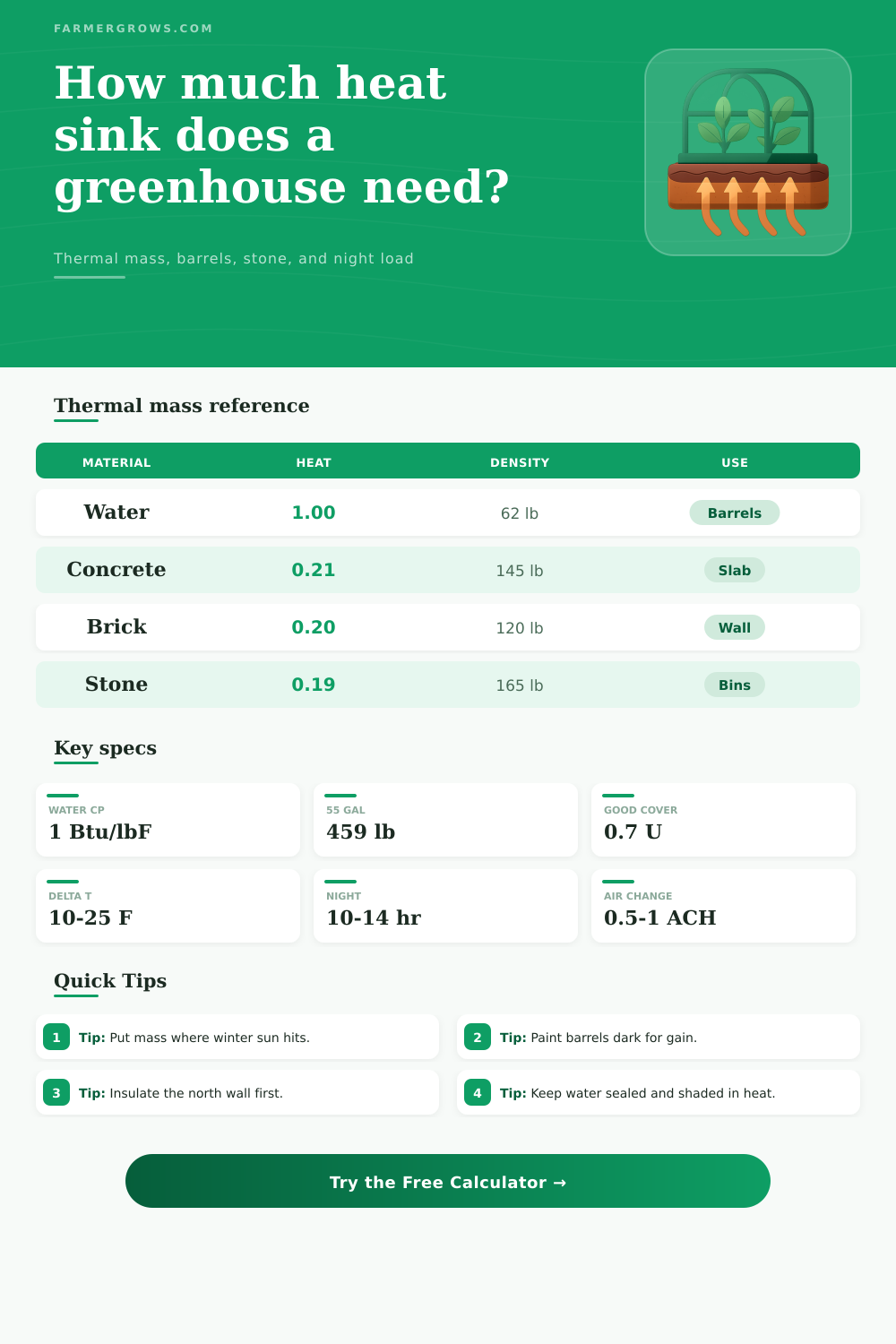
Water are one of the most commonly used materials for the thermal mass within the greenhouse. Water have a high capacity to hold heat. Using black barrels containing water help to absorb the solar radiation that enters the greenhouse.
Alternatively, you can use other materials with high masonry value. Thermal mass made of stone or gravel can be placed under benches within the greenhouse. The air can circulate around these stone to allow for even heat distribution.
In order to calculate the effectiveness of the thermal mass within the greenhouse, it is first important to understand the temperature swing within the greenhouse. The temperature swing is the difference in the greenhouse’s highest temperature during the afternoon and the lowest temperature during the early morning hour. In order for the thermal mass to reach high temperatures during the daytime, the thermal mass will store enough heat to release that heat during the nighttime hour.
To increase the amount of heat that the thermal mass can absorb, you can paint the thermal mass black. Black absorbs the most solar radiation. The efficiency of the thermal mass is also dependent upon the greenhouse envelope.
The greenhouse envelope is the structure of the greenhouse that contain the air within the greenhouse. Excessive leak in the greenhouse envelope will allow for the heat within the greenhouse to escape at a rapid rate. Any greenhouse with high rate of heat loss will require a greater amount of thermal mass to maintain the desired greenhouse temperature.
In this case, it is crucial first to address the leaks within the greenhouse before adding any amount of thermal mass to the greenhouse structure. The placement of the thermal mass is also important to ensure even distribution of heat within the greenhouse. Placing the thermal mass against the north wall of the greenhouse will allow for the thermal mass to capture some of the weak winter sun against the north wall.
Additionally, the north wall can prevent cold air from entering the greenhouse from the rest of the structure. If you dont place the thermal mass in a location that is exposed to the sun, the thermal mass will not absorb enough solar radiation. Additionally, you should not hide the thermal mass behind other object within the greenhouse, such as plant pot.
If heat cannot escape the thermal mass, the thermal mass will retain the heat. Fans can be placed within the greenhouse to allow the heat from the thermal mass to distribute to the remaining area of the greenhouse. Finally, another factor to consider with the thermal mass is the load that it can offset at night.
Due to the nature of thermal mass to release heat, the thermal mass will rarely offset 100% of the heat loss that occur within the greenhouse during a cold night. However, the thermal mass will offset some of the heat loss, which will reduce the amount of supplemental heat that must be provided to the greenhouse to maintain the desired greenhouse temperature. Using the thermal mass will reduce the amount of heat from the backup heater that are provided to the greenhouse.