🌱 Greenhouse Cooling Calculator
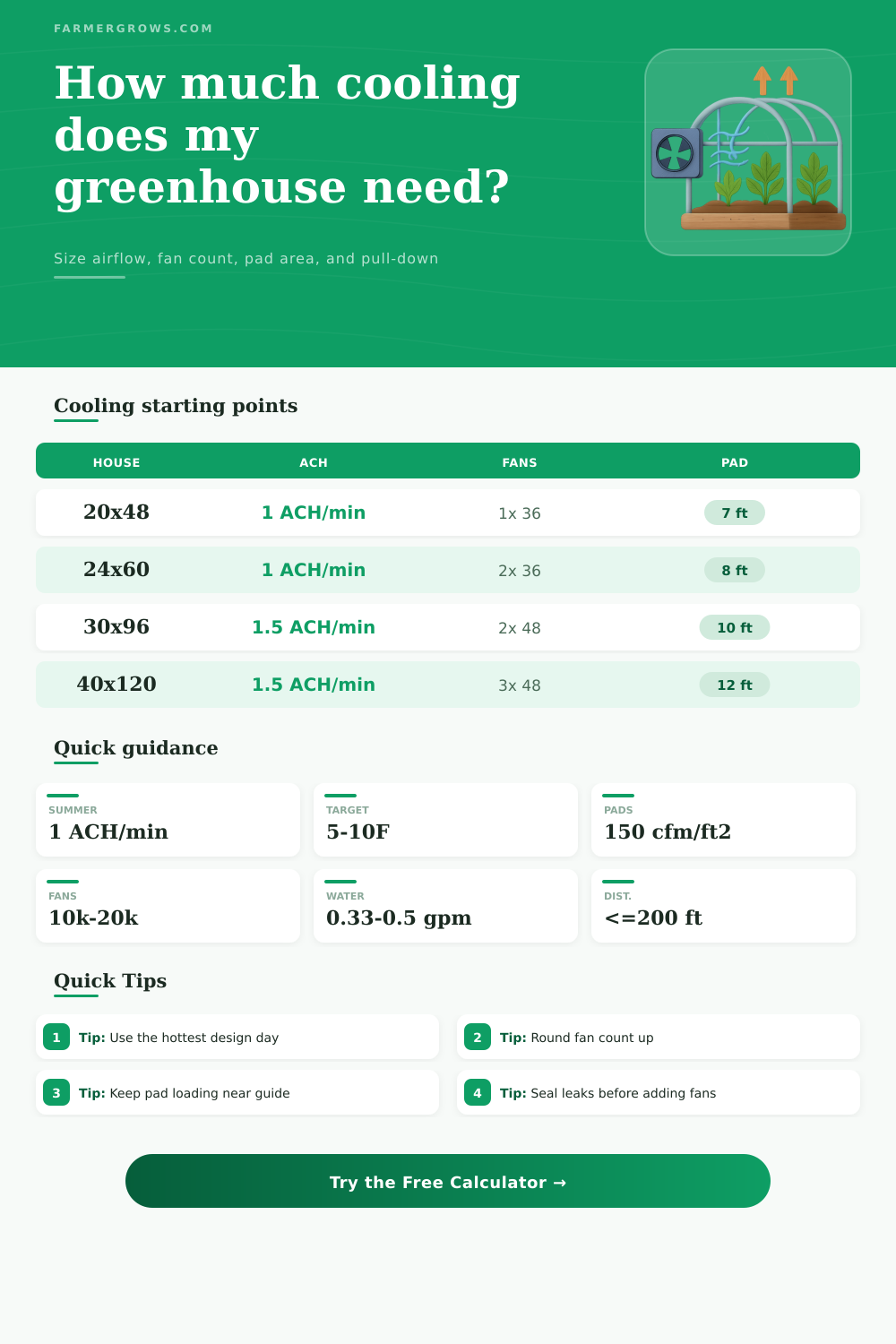
Estimate greenhouse cooling airflow, fan count, pad area, water feed, and temperature pull-down for pad-fan systems, exhaust walls, and hybrid shade setups. The calculator sizes from the larger of air-exchange demand or sensible heat demand.
Pick a real greenhouse layout to seed the fields. Each preset loads dimensions, cooling mode, cover type, target temperature, air changes, fan delivery, pad efficiency, face velocity, shade, and internal load.
Greenhouse Cooling Output
Cooling summary will appear here.
| Type | Typical size | Target ACH | Notes |
|---|---|---|---|
| Hoop house | 20-30 x 48-100 ft | 1.5-2.5 | Simple exhaust |
| Polyhouse | 24-36 x 60-120 ft | 2.0-3.5 | Common farm use |
| Nursery bay | 12-24 x 40-80 ft | 2.5-4.0 | High crop density |
| Glasshouse | 36-60 x 120+ ft | 3.0-6.0 | Hot weather control |
| Fan size | Typical CFM | Metric | Use |
|---|---|---|---|
| Small | 2,500-4,000 | 4,250-6,800 | Benches |
| Medium | 4,000-7,500 | 6,800-12,700 | Hoop houses |
| Large | 7,500-12,000 | 12,700-20,400 | Wide spans |
| High output | 12,000+ | 20,400+ | Glasshouses |
| Pad load | Rule | Use | Note |
|---|---|---|---|
| 150 | cfm/ft2 | 85% pad | Strong default |
| 200 | cfm/ft2 | Balanced | Moderate drop |
| 250 | cfm/ft2 | Fast face | Smaller pad |
| 400 | cfm/ft2 | High speed | Light duty |
| Delta T | BTU/h per CFM | Metric note | Use case |
|---|---|---|---|
| 10 deg F | 10.8 | 3.17 W per CFM | Mild control |
| 15 deg F | 16.2 | 4.75 W per CFM | Warm day |
| 20 deg F | 21.6 | 6.34 W per CFM | Hot peak |
| 25 deg F | 27.0 | 7.92 W per CFM | Emergency purge |
Greenhouse cooling involve the movement of air to assist in lowering the temperature within the greenhouse. Should the temperature within the greenhouse become too high, the plants will cease to growing within that greenhouse, and the plants will drop there blossoms. Additionally, high temperatures within a greenhouse can lead to the loss of the crops that those plants grow.
Although many people attempt to cool there greenhouses by opening their vent or by using small fan within the greenhouses, these steps is often insufficient to provide adequate cooling for the greenhouse and its plants. In order to effectively control the temperature within a greenhouse, the air must be moved within that greenhouse structure in a calculate manner. The goal in using fans within a greenhouse is to move the air within the greenhouse in such a manner as to remove the heat that is contained within the greenhouse.
How to Cool a Greenhouse
In considering the air changes that occurs within a greenhouse each minute, the air movement will help to determine how much of the hot air within the greenhouse can be replaced with fresh air from outside of the greenhouse. The air can be moved too slow to only provide circulation of the heat that is contained within the greenhouse, yet if the air is moved too quickly, the plants may be stressed by such rapid movement of the air, or the electricity cost of the greenhouse may become high due to the operation of those fans. Thus, it is essential to find a balance between the speed of the air movement and the volume of the air that must be moved to maintain the plants within the greenhouse to an appropriate temperature.
In addition to considering how fast the air should move within a greenhouse, it is additionally essential to consider two different factor that relate to greenhouse cooling: the volume of the greenhouse, and the thermal load within the greenhouse. The volume of the greenhouse will help to determine how much air can be moved within the greenhouse, but the thermal load is the amount of heat that enters the greenhouse from the sun, and the heat that the plants and the soil within the greenhouse create. The volume and the thermal load of the greenhouse must be calculated to ensure that the cooling system is strong enough to counteract the heat load of the greenhouse, particularly during the hottest periods of the year.
If only the volume of the greenhouse is size for the cooling system, it may not be able to effectively remove the heat from inside of greenhouse during the hottest periods. Besides calculating the volume and the thermal load of the greenhouse, a decision must also be made as to which fans will be utilize within the greenhouse, as well as how many cooling pads will be installed within the greenhouse. It is easy to purchase large fans for the greenhouse but to purchase insufficient number of cooling pads.
Should large fans be installed but there is insufficient cooling pad area for the greenhouse, the fans will create a vacuum effect. Fans that create a vacuum effect will often strain against the cooling pads, and the movement of air within the greenhouse will decrease. Thus, purchasing a large fan but insufficient cooling pads will lead to the decrease in the efficiency of the cooling system.
In addition to the size and number of fans and cooling pads that are purchased for installation within the greenhouse, the rate at which those fans move the air through the cooling pads will impact the efficiency of the greenhouse cooling system. If the fans are moving the air at too high of a velocity through the cooling pads, the air will not be able to take on the moisture from the cooling pads, and the air will not drop in temperature. If the velocity is too low, though, there is a risk of the cooling pads being too large for the area of the greenhouse, leading to an inefficient use of space within the greenhouse structure.
Thus, an appropriate face velocity must be established for the air movement to drop in temperature. Another consideration for greenhouse cooling is that the fans may deliver less air to the plants than the rated amount for the fans. Fans are often rated for high amounts of cubic feet per minute (CFM) when tested in the laboratory.
Yet, in the greenhouse, air movement will be limited by the static pressure of the water within the cooling pads. The inclusion of static pressure will impact the efficiency of the fans that are circulating the air for cooling purpose. Thus, it is essential to include additional fans to ensure that the system is able to handle the hottest period of the year.
The location of the greenhouse is another factor in the determination of any cooling system that is established within the greenhouse. Cooling systems that use cooling pads work best in areas with dry climate and low humidity levels. In areas with high humidity, such cooling systems will not work as well.
In these cases, exhaust walls or shade setups may be utilized. Shade is helpful in that it will prevent heat from entering the greenhouse structure in the first place, which is more efficient than attempting to remove the heat from inside of the greenhouse structure. The establishment of a cooling system within a greenhouse involves a trade-off between the costs of the cooling system and the stability of the crops within the greenhouse.
Should the cooling system within the greenhouse be undersized relative to the potential heat load of the greenhouse, the crops will be lost. Should the cooling system be oversized, though, the costs of electricity will rise. The goal is to provide a cooling system that ensures that the plants are comfortable and the system itself is working within its normal range of operation.
By calculating the volume of the greenhouse, the thermal load, and the face velocity, an efficient cooling system can be developed to provide for the plants in that greenhouse structure. You’ll find that a moddern system should of help with this.