
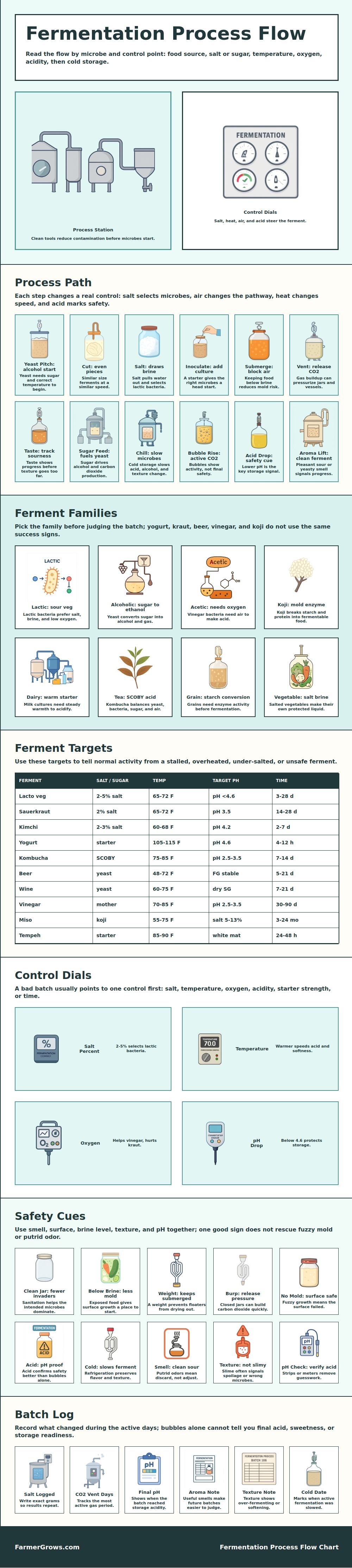
To perform fermentation effective, you must control the environment in which the beneficial microbe will grow. Fermentation create an environment for beneficial bacteria to grow while harmful bacteria cannot thriving. To accomplish this goal, you must control variables like the salt levels, the temperature, and the exposure to oxygen in a fermentation jar.
If you dont control these variable, harmful bacteria will grow in the food instead of the beneficial bacteria. Salt is one of the first variable that you must control for fermentation. Salt will draw moisture from the vegetables to create a brine in which the vegetables will ferment.
How to Control Fermentation
The salt in the brine will prevent harmful bacteria from thriving in the brine. If you use too little salt, harmful bacteria will thrive. However, if you use too much salt, the beneficial bacteria will not be able to grow and ferment the vegetable.
Therefore, you must measure the amount of salt that you will use for fermentation to ensure that the salt levels is appropriate for the type of fermentation that you would like to perform. Another critical variable to control are the temperature of the fermentation environment. If the temperature of the fermentation environment is too high, the microbes will grow too quick in the jar.
This rapid growth of the microbes will produce undesirable flavors in the fermented vegetables. However, if the temperature is too low, the microbes will grow too slow or not at all. Therefore, you must monitor the temperature of the fermentation environment to control the rate of the biological reaction occurring in the jar.
Additionally, another critical variable to control is the pH level of the ferment. The pH level will indicate the acidity of the fermented vegetables. As the beneficial bacteria break down the sugar in the vegetables, the bacteria will produce acid.
This acid will decrease the pH level of the vegetables. A low pH level will create an acidic environment in which the harmful pathogen cannot survive. The third variable that you must control is the exposure of the ferment to oxygen.
Depending on the type of fermentation process that you are using, some processes, such as sauerkraut, require an anaerobic environment. For these types of fermentation process, you must keep the vegetables in contact with the brine to keep them away from exposure to oxygen. By keeping the vegetables in contact with the brine, mold will not be able to grow on the vegetable.
For other fermentation processes, the vegetables will require exposure to oxygen. Therefore, you must control the exposure of the vegetables to oxygen to ensure that the proper microbe will grow and ferment the vegetables. You need to observe the signs of fermentation that are occurring in the jar.
However, you should not rely on your sense alone to determine the safety of your ferment. For example, bubbles will form in the jar as a sign of the fermentation process as the beneficial microbes will produce carbon dioxide. Therefore, the presence of bubbles is a sign of microbial activity.
However, the presence of bubbles is not a guarantee that the fermentation process is complete or that the resulting ferment product is safe to eat. Additionally, you must ensure that the ferment does not show signs of spoilage. For instance, bad smells or a slimy texture in the ferment are a sign of spoilage.
Therefore, if the ferment contains these sign of spoilage, it is spoiled and you must discard it as it is not safe to eat. To gain more control over the fermentation process, you can keep a batch log of each batch of ferment that you produce. Your batch log will allow you to not only write the percentages of salt that you used for fermentation, the temperature of the fermentation environment, and the pH level of each batch.
By keeping a batch log, you can begin to track the various fermentation pattern that you produce. Furthermore, by tracking these variables, you can begin to understand why some batch of ferment produce better results than others. Therefore, by using a batch log, you can transform from guessing the outcome of the fermentation process to knowing the result of the fermentation process through the data that you track in your batch log.