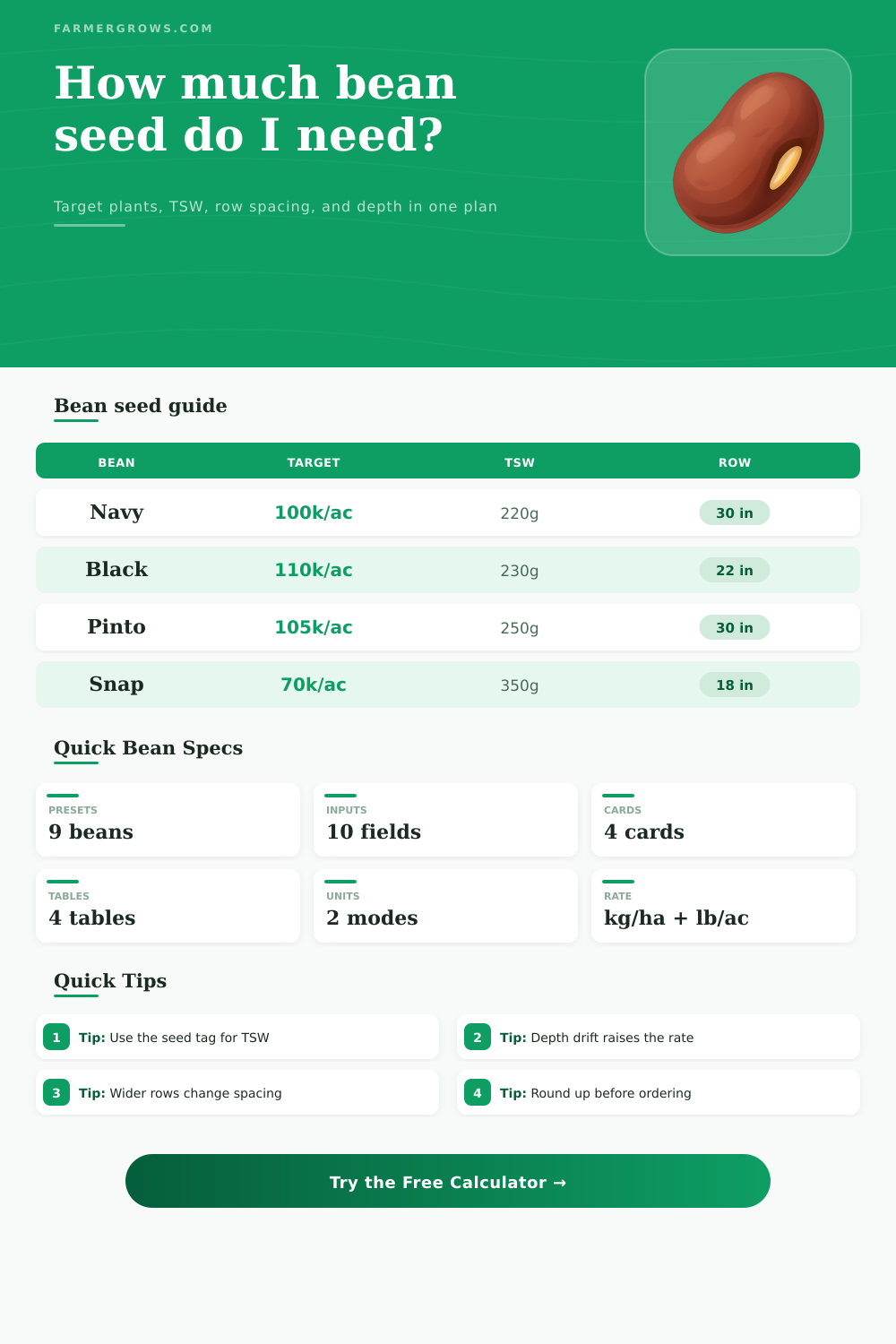
Bean Seed Rate Calculator - Plants, TSW, and Row Spacing
Estimate bean seed rate from target plants, germination, thousand seed weight, row spacing, and seeding depth.
Fast canopy cover and tighter spacing.
Balanced light, flow, and stand control.
Good for cultivation and spray lanes.
Best for trellis and large seed lots.
| Bean class | Row spacing | In-row gap | Typical rate |
|---|---|---|---|
| Early drill | 15-18 in | 4-5 in | 140-170 kg/ha |
| On-time row | 18-24 in | 5-7 in | 150-190 kg/ha |
| Wide row | 24-30 in | 6-8 in | 130-175 kg/ha |
| Broadcast | Wide | Dense | 180-230 kg/ha |
| TSW | Seeds/kg | Seeds/lb | Bean note |
|---|---|---|---|
| 250 g | 4,000 | 1,814 | Small bean |
| 350 g | 2,857 | 1,296 | Medium |
| 450 g | 2,222 | 1,008 | Large bean |
| 550 g | 1,818 | 825 | Heavy lot |
| Row spacing | In-row gap | Plants/m2 | Seeds/ha |
|---|---|---|---|
| 15 in | 4 in | 167 | 666,667 |
| 18 in | 5 in | 120 | 480,000 |
| 24 in | 6 in | 83.3 | 333,333 |
| 30 in | 8 in | 50.0 | 200,000 |
| Field | Germination | Buffer | Note |
|---|---|---|---|
| Firm moist | 94-97% | 0-5% | Best start |
| Normal seedbed | 92-95% | 5-10% | Common |
| Dry topsoil | 88-92% | 10-15% | Add seed |
| Crusted/no-till | 84-90% | 15-20% | Watch loss |
To successfully plant bean seeds, you must calculate the correct amount of bean seeds to plant in a field. If you dont calculate the number of bean seeds for your field correct, you place your bean plants at a risk of growing poor. If you plant too few bean seeds, the weed will take over the field.
On the other hand, if you plant too many bean seeds, the bean plants will compete for the resources necessary to create the bean pod. Bean seed density is another component of planting bean seeds. Bean seed density refer to the number of bean plant that should be in a specific area in the field.
How Many Bean Seeds to Plant
The target density for many field is 100,000 plants per acre. However, the number of plants per acre may differ depending on the variety of beans to be planted. High bean seed density prevent other plants from growing in the field by creating a canopy of leaves over the ground.
However, if there are too many bean in one area of the field, they will become too crowded. This can lead to poor air movement through the plants, which can result in the development of plant disease. Row spacing is another aspect to consider within the calculation of bean seed density.
Row spacing refer to the distance between the rows of bean plant that will be planted in a field. Rows of beans can be spaced 18 inches apart to encourage the beans to create a canopy over the field. These narrow row are used for snap bean.
Rows can be spaced 30 inches apart for pinto beans or for field with heavy residue. Within any given row, there must also be a specific distance between each individual bean plant. This distance should be adjusted according to the row spacing to accommodate the number of plants per acre target.
Thousand-seed weight (TSW) is another component to consider when planning to plant bean seeds in a field. The thousand-seed weight is the weight of one thousand bean seeds and you can find it on the tag of each bag of seed. The heavier the weight of the seeds, such as with lima beans, the more energy the bean plant will have to seed and grow.
However, the heavier the thousand-seed weight, the more each individual plant will cost. The thousand-seed weight will factor into the calculations required for determine the total weight of the bean seeds. Germination percentage is another component to consider.
Like the thousand seed weight, you can also find the germination percentage on the tag of the seed. This percentage indicate how many of the planted seeds are going to sprout. You should not solely rely on this measurement to determine how many bean seeds to plant in the field.
Other factor such as dry soil may prevent the beans from sprouting. Similarly, other environmental factor such as birds will eat the planted seeds. To account for this, you may need to add 10 percent to the count for good growing condition or 20 percent for poor growing condition.
Another factor to consider is the planting depth. Planting depth is an essential aspect to ensure that the number of bean plant that emerge from the field is sufficient for the potential yield of the field. Bean seeds will grow best at a depth of 1.5 inch.
If the soil in the field is dry, planting the seeds deeper than 1.5 inches will prevent them from emerging from the soil. However, if the soil is too shallow for the seeds, they will dry out. If you incorrectly set up the depth at which the seeds are to be planted, you may need to increase the rate at which the seeds are planted by 5 to 10 percent.
Calculators are available online to calculate the total weight of the bean seeds necessary to achieve the target number of plants in a field. The calculator will use the area of the plot, the target number of plants per acre, the thousand seed weight, and the germination percentage of the bean seeds to determine the total weight of the seeds that must be purchased for the field. In addition to calculating the total weight of the seeds, the calculator will also calculate the number of individual seed.
It will also calculate the rate of the seeds per acre or hectare so that you can compare your calculated rate with the quotes from various supplier of bean seeds. When calculating the rate at which to plant the bean seeds, there are some mistake to avoid. The first mistake is to skip the measurement of the thousand seed weight of the beans.
Each variety of beans will have a different thousand seed weight. The second mistake is to ignore the need for a buffer rate for marginal ground. If the grower ignores the buffer, there will be thin stand of bean plant in the field.
Finally, other factor to consider are the soil type and the crop rotation for that area. If the soil in the field is sandy, it may be necessary to increase the number of bean seeds to be planted in the field. This is due to the fact that the sandy soil will wash the seeds out of the ground.
If the field has been planted with beans for several growing season, the germination rate may drop because of the development of disease in that soil.