🧪 Pesticide Calibration Calculator
Calibrate nozzle flow from speed and swath, verify with a catch test, and turn the final spray rate into a tank mix plan without leaving the page.
Full breakdown
Nozzle flow
Uses target rate, travel speed, and spacing to find the gpm needed from each nozzle.
Swath check
Cross-checks the boom width against the measured catch flow to show the actual spray rate.
Catch test
Turns the collected volume and test time into a nozzle flow reading for calibration.
Tank mix
Converts product rate and tank coverage into product per tank and mix concentration.
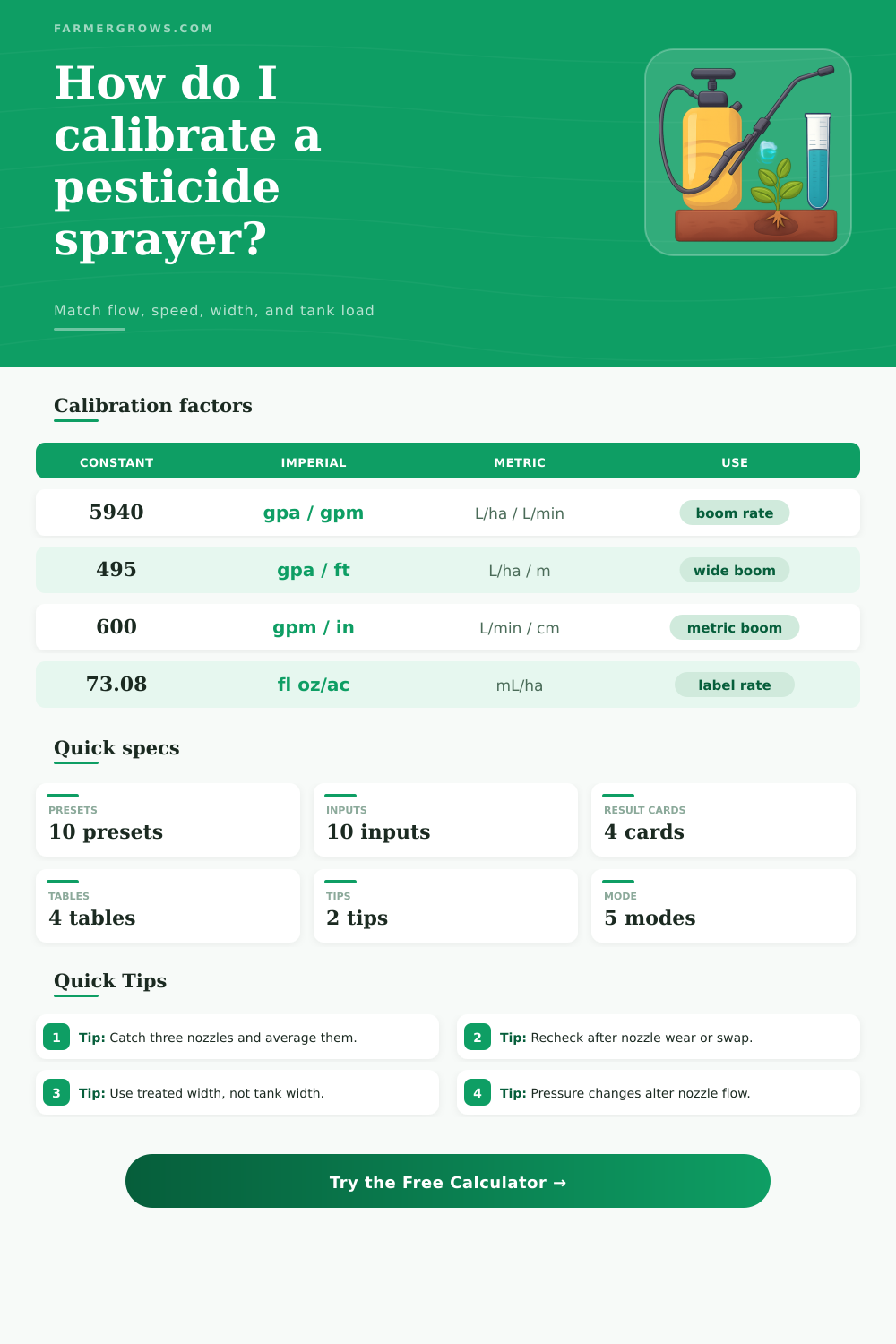
| Constant | Imperial formula | Metric formula | Use |
|---|---|---|---|
| 5940 | gpa = 5940 x gpm / (mph x in) | L/ha = 600 x L/min / (km/h x cm) | Boom rate |
| 495 | gpa = 495 x gpm / (mph x ft) | L/ha = 60 x L/min / (km/h x m) | Wide boom |
| 600 | gpm = gpa x mph x in / 5940 | L/min = L/ha x km/h x cm / 600 | Reverse math |
| 73.08 | fl oz/ac to mL/ha | mL/ha to fl oz/ac | Label rate |
| Imperial | Metric | Use | Note |
|---|---|---|---|
| 1 gal | 3.785 L | Tank volume | Liquid load |
| 1 fl oz | 29.57 mL | Catch volume | Spray sample |
| 1 acre | 0.4047 ha | Area | Field size |
| 1 mph | 1.609 km/h | Speed | Travel rate |
| Color | Code @ 40 psi | Flow | Common use |
|---|---|---|---|
| Orange | 015 | 0.15 gpm | Low output |
| Green | 02 | 0.20 gpm | Light spray |
| Yellow | 03 | 0.30 gpm | Small boom |
| Blue | 04 | 0.40 gpm | General boom |
| Red | 05 | 0.50 gpm | Wide pattern |
| Brown | 06 | 0.60 gpm | Higher output |
| Gray | 08 | 0.80 gpm | High output |
| White | 10 | 1.00 gpm | Very high |
| Catch | Time | Flow | Note |
|---|---|---|---|
| 8 fl oz | 15 sec | 0.25 gpm | Quick check |
| 16 fl oz | 30 sec | 0.25 gpm | Bench check |
| 20 fl oz | 30 sec | 0.31 gpm | Mid-flow tip |
| 32 fl oz | 60 sec | 0.50 gpm | High flow |
Tip: Catch output from three or more nozzles, then average the readings before changing rate.
Tip: Recheck calibration after nozzle wear, speed changes, or tip swaps because every one of them shifts rate.
Sprayer calibration involve ensuring that the sprayer applies the correct amount of pesticides to a specific area. Proper calibration is essential because incorrect calibration can result in either underdosing of the weeds or applying too much pesticide. If a person apply too little pesticide to the weeds, the weeds will survive.
However, if the person applies too much pesticide, then the person is wasting the pesticide and money. Calibration makes sure that the rate at which the person sprays the area is according to the pesticide label, based off the ground speed and the spray width of the sprayer. The two most important factor to consider with sprayer calibration are the ground speed and the spray width of the sprayer.
How to Calibrate a Sprayer
If a person is moving at a ground speed that is faster than the rate that they plan on traveling, the gallons per acre will be lower than the amount that the person intends to apply to the weeds. Additionally, if the person is using an older sprayer that has a higher spacing between nozzle, more areas will be left untreated to the weeds. In this case, a person must account for both the ground speed and the spray width of the sprayer.
For backpack sprayers, the person must ensure that their walking speed is steady to ensure that the swath of the area that they treat is consistent. For boom sprayers, the person must account for the total number of nozzles on the boom sprayer. The mathematical equation for determining the flow, the ground speed, and the spray width will determine the application rate of the pesticide to the weeds.
Additionally, the person targets fifteen gallon per acre. Therefore, the person must calculate the flow in gallons per minute that each nozzle on the sprayer should have. Should the person miss the target flow rate by 10%, the amount of pesticide applied to the weeds will be insufficient to control the growth of those weeds.
The math for the equation will balance the amount of gallons of pesticide applied per unit of area with the amount of time it takes to spray that area. The rate is calculated by dividing the flow of the pesticide by the area that is covered by the sprayer. The area covered by the sprayer is calculated by multiplying the ground speed by the spray width.
The pressure at which the person sprays the weeds is another critical factor in the calibration of the sprayer. If the person increases the pressure used to spray the weeds from 30 psi to 40 psi, the flow of the nozzles will increase by approximately 20%. Therefore, the labels for the sprays will state the pressure at which the person should apply the pesticide to the weeds.
Additionally, the wear on the nozzles will affect the flow rate of the spray. When the nozzle wears down, the size of the opening of the nozzle increases. A larger opening in the nozzle result in the flow rate of the nozzle increasing unevenly.
Therefore, if the person sets their sprayer to a certain flow rate when the nozzles are new, after some use of the sprayer, the flow rate may not match the calibrated flow rate. Besides the terrain on which the person is spraying the weeds, there are other physical factor that will affect the rate at which the person applies the pesticide to the weeds. The terrain affects the rate at which the person can spray the weeds because if they are traveling uphill, they will travel at a slower ground speed.
Therefore, if the persons ground speed slows down, the amount of pesticides that are applied to the ground will increase. The amount of wind in the area will also affect the amount of pesticides that land on the weeds because the wind can create drift of the pesticides, especially if the person is utilizing a backpack sprayer. The type of soil in which the person is spraying the weeds will also affect the rate at which the person sprays the weeds.
The sandy soil may require a higher volume of the pesticide to reach the roots of the plants as compared to clay soil. Additionally, the person must be careful with the units in which the rates are measured. Some labels will use ounces per acre while others may use milliliters per hectare.
There are a couple of methods that a person can use to ensure that their sprayer is calibrated correctly. The catch test will allow the person to determine whether the flow of each nozzle is the same. To perform a catch test, the person should collect the amount of output from three different nozzles on the sprayer.
The person will measure the average output from these three nozzles by collecting the amount of gallons that is dispensed from each nozzle for a period of thirty seconds and then dividing the total gallon by three. Once the person measures the flow of each nozzle, that measurement should be compared with the target flow rate for the weeds. If the measured flow is higher than the target flow, the person should decrease the pressure with the sprayer’s control valve.
However, if the flow from the nozzles is lower than the target flow rate, then the person may need to increase the pressure with the sprayer or replace the nozzles. Besides the calibration of the sprayer, there are other factor related to the spraying of the weeds with the pesticide that the person who is applying the pesticides should consider. For example, the person should time the spraying to occur when there is no wind in the area so that the pesticides dont drift from the weeds.
Additionally, the person should avoid spraying the weeds when the temperatures are hot because high temperatures increase the volatility of the pesticides. The carrier volume should match the type of herbicide that is being used. Contact herbicides should have a higher volume than soil-active herbicides.
Finally, a person should log all the settings for their sprayer within a notebook so that they can reference those settings when spraying weeds in the future.