🌿 Cover Crop Nitrogen Calculator
Estimate plant-available nitrogen from cover crop biomass — enter your crop, biomass, and area to get N credits in lbs/ac or kg/ha
⚡ Quick Presets
📝 Calculator Inputs
📊 Nitrogen Credit Results
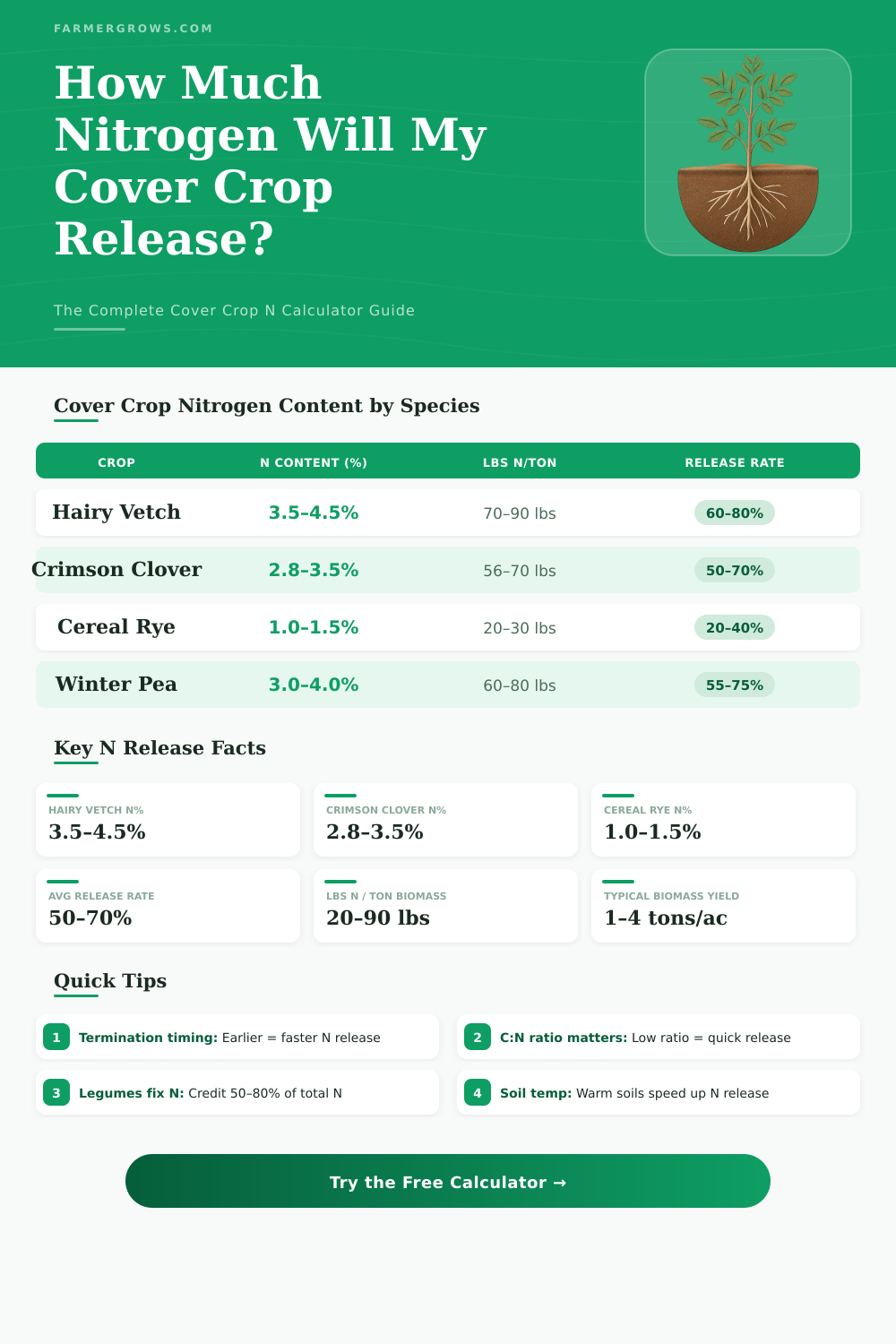
📊 Cover Crop N Content Reference
3.5–4.5%
Hairy Vetch N%
2.8–3.5%
Crimson Clover N%
3.0–4.0%
Cowpea / Pea N%
1.0–1.5%
Cereal Rye N%
3.5–5.0%
Sunn Hemp N%
2.5–3.2%
Red Clover N%
1.5–2.5%
Buckwheat N%
1.2–1.8%
Oats / Sorghum N%
📋 Species Nitrogen Data Table
| Cover Crop | N Content (%) | N (lbs/dry ton) | C:N Ratio | Release Rate | Typical Biomass (tons/ac) |
|---|---|---|---|---|---|
| Hairy Vetch | 3.5–4.5% | 70–90 | 9:1–11:1 | 60–80% | 1.5–4.0 |
| Crimson Clover | 2.8–3.5% | 56–70 | 10:1–13:1 | 50–70% | 1.0–3.0 |
| Red Clover | 2.5–3.2% | 50–64 | 12:1–15:1 | 50–70% | 1.0–2.5 |
| Winter / Austrian Pea | 3.0–4.0% | 60–80 | 10:1–14:1 | 55–75% | 1.0–3.0 |
| Cowpea | 3.0–4.0% | 60–80 | 11:1–14:1 | 55–75% | 1.0–3.5 |
| Sunn Hemp | 3.5–5.0% | 70–100 | 8:1–12:1 | 60–80% | 2.0–5.0 |
| Buckwheat | 1.5–2.5% | 30–50 | 20:1–30:1 | 30–50% | 0.5–2.0 |
| Cereal Rye | 1.0–1.5% | 20–30 | 25:1–40:1 | 20–40% | 1.5–5.0 |
| Oats | 1.2–1.8% | 24–36 | 22:1–35:1 | 25–45% | 1.0–3.5 |
| Sorghum-Sudangrass | 1.2–1.8% | 24–36 | 30:1–40:1 | 20–35% | 3.0–8.0 |
📐 N Release by Timing After Incorporation
| Weeks After Termination | Legume N Released (%) | Grass N Released (%) | Notes |
|---|---|---|---|
| 1–2 weeks | 15–25% | 5–10% | Initial flush, warm soils |
| 3–4 weeks | 30–45% | 10–20% | Peak release window |
| 5–8 weeks | 50–65% | 20–35% | Main crop uptake window |
| 9–12 weeks | 60–75% | 30–45% | Slowing decomposition |
| 13–26 weeks | 70–80% | 35–55% | Residual slow release |
| > 26 weeks | 75–85% | 40–60% | Long-term SOM contribution |
🔁 Imperial ↔ Metric Conversion Reference
| Imperial Value | Metric Equivalent | Imperial Value | Metric Equivalent |
|---|---|---|---|
| 1 acre | 0.4047 hectares | 1 ton / acre | 2.242 t / ha |
| 1 lbs / acre | 1.121 kg / ha | 1 ton (short) | 907.2 kg |
| 100 lbs N / ac | 112.1 kg N / ha | 1 t / ha | 0.446 tons / ac |
| 1 lb N | 0.4536 kg N | 1 kg / ha | 0.892 lbs / ac |
💡 Calculation Tips
All nitrogen calculations should be based on dry matter weight, not fresh weight. Fresh biomass contains 70–85% water. If you harvested fresh weights, multiply by 0.15–0.25 to estimate dry tons.
Nitrogen mineralization is fastest when soil temperatures are 50–86°F (10–30°C). Cold soils (<50°F) slow release significantly — reduce your expected N credit by 20–40% for spring applications in northern climates.
Cover crop are plants that are grown in order to provide benefit to the soil, as well as to contribute to the nutrient content of the soils for crop that will be planted following the cover crop phase of the agriculture rotation. Legume cover crops, like hairy vetch or crimson clover, contains the ability to uptake nitrogen gas from the atmosphere and to use those nitrogen gas molecule to produce proteins within the legume plants. Thus, when a farmer terminates these legume cover crops, that stored nitrogen can be released into the soil and utilize by a crop like corn.
However, nitrogen is not always released in a predictable manner from these cover crop plants, and the release of nitrogen from these plants is dependent upon various variable. One variable that impact the amount of nitrogen that is available to the soil is the type of cover crop that is planted and the growth stage of the legume cover crop. Legume cover crops contain a nitrogen concentration of around 3% by dry weight; they host bacteria that fix atmospheric nitrogen into usable forms for the plants.
How Cover Crops Add Nitrogen to Soil
Thus, legume cover crops will contain more nitrogen than grass cover crops, which typically contain less nitrogen by dry weight. The grass cover crops have high carbon-to-nitrogen ratio, which indicate that they will contain a high amount of carbon relative to the amount of nitrogen that the plants contain. Because microbes will use up the nitrogen in the soil to break down the residue of these grass cover crops, grass cover crops will not contribute much nitrogen to the soil.
Thus, if legume and grass cover crops are planted together, the resulting mixture will provide nitrogen to the soil, but there will be less total nitrogen available than if only legume cover crop were planted. Another variable that will impact the amount of nitrogen that is available in the soil after termination of the cover crops is the timing of the termination of those cover crops. If the legume cover crops are terminated during their early bloom stage, their tissue will contain a high amount of nitrogen, and the soil microbes will break down the dead legume plants quickly.
During the vegetative stage of the cover crops, the plants will release nitrogen quickly, but they will contain less biomass than if the crops were planted into a field during the emergence of the vegetative growth stage. During the mature seed set stage of the cover crops, the nitrogen will be more “locked” into the biomass of the cover crops, preventing the nitrogen from being released into the soil; in this case, the nitrogen will not be available to the soil for a period of six to ten week. Thirdly, the way in which the residue from the cover crops is handled after termination of the cover crops will impact the amount of nitrogen that is available to the soil.
If you till the cover crop residue into the soil, the residue will be exposed to soil biology, which will allow for the full release of nitrogen. If the residue is left on the soil surface as standing cover crops or is rolled with a roller crimper, the decomposition process will occur at a slower rate, which can be a problem if the spring soils are relatively cool to the touch. The fourth variable include the size of the field.
The biomass of the cover crops can be measured in units of pounds per acre or kilograms per hectare. Thus, the size of the field and the area that is planted with the cover crops must be calculate in order to measure the amount of nitrogen that will become available to the soil. Finally, the condition of the soil and the weather during the cover crop phase of the agricultural rotation will affect the function of the cover crops.
During periods of wet and cold soil, soil microbes will not be as active as they would be under more suitable soil conditions; these soils will release nitrogen at a slower rate. Cover crops will lose nitrogen to sandy soils at a faster rate than soils that contain clay; clay soil hold onto nitrogen at a faster rate than sandy soils. Many mistake are made in attempting to calculate the amount of nitrogen that will be available to the soil from cover crops.
One mistake is to overestimate the biomass of the cover crops. Another mistake is to ignore the percentage of legumes within a mixture of legume and grass cover crops; if the percentage of grass within the mixture is high, that grass will reduce the amount of nitrogen that is available to the soil. Yet another mistake is to mix different unit for measuring both cover crop biomass and soil nitrogen; mixing such units will result in error in calculating the amount of nitrogen that will be saved by using cover crops.
In order to maximize the benefits of using cover crops, the legumes should be terminated during their early bloom stage, and the biomass should be incorporated into the soil if possible. An additional practice that can be performed with cover crops is the application of sidedress nitrogen to the fields that contain the cash crops; this will ensure that the cash crops have adequate amount of nitrogen for there growth. Through measuring the different plot that will be planted with the cover crops, determining at what stage each cover crop is growing, and tracking the amount of nitrogen that each acre of field can save, each farmer can gain an understanding of the way in which cover crops work within there own fields and soils.