Greenhouse Roof Pitch Calculator
Measure roof angle, rise, rafter length, and glazing area for a greenhouse frame that fits the span and panel layout you plan to build.
📌Preset Roof Layouts
Choose a greenhouse shape to seed the fields. Each preset sets the form, pitch mode, span, length, eave height, overhang, and framing spacing.
⚙Calculator Inputs
Roof Geometry Output
Calculated from the greenhouse span, pitch mode, and framing inputs above.
📊Pitch Conversion Guide
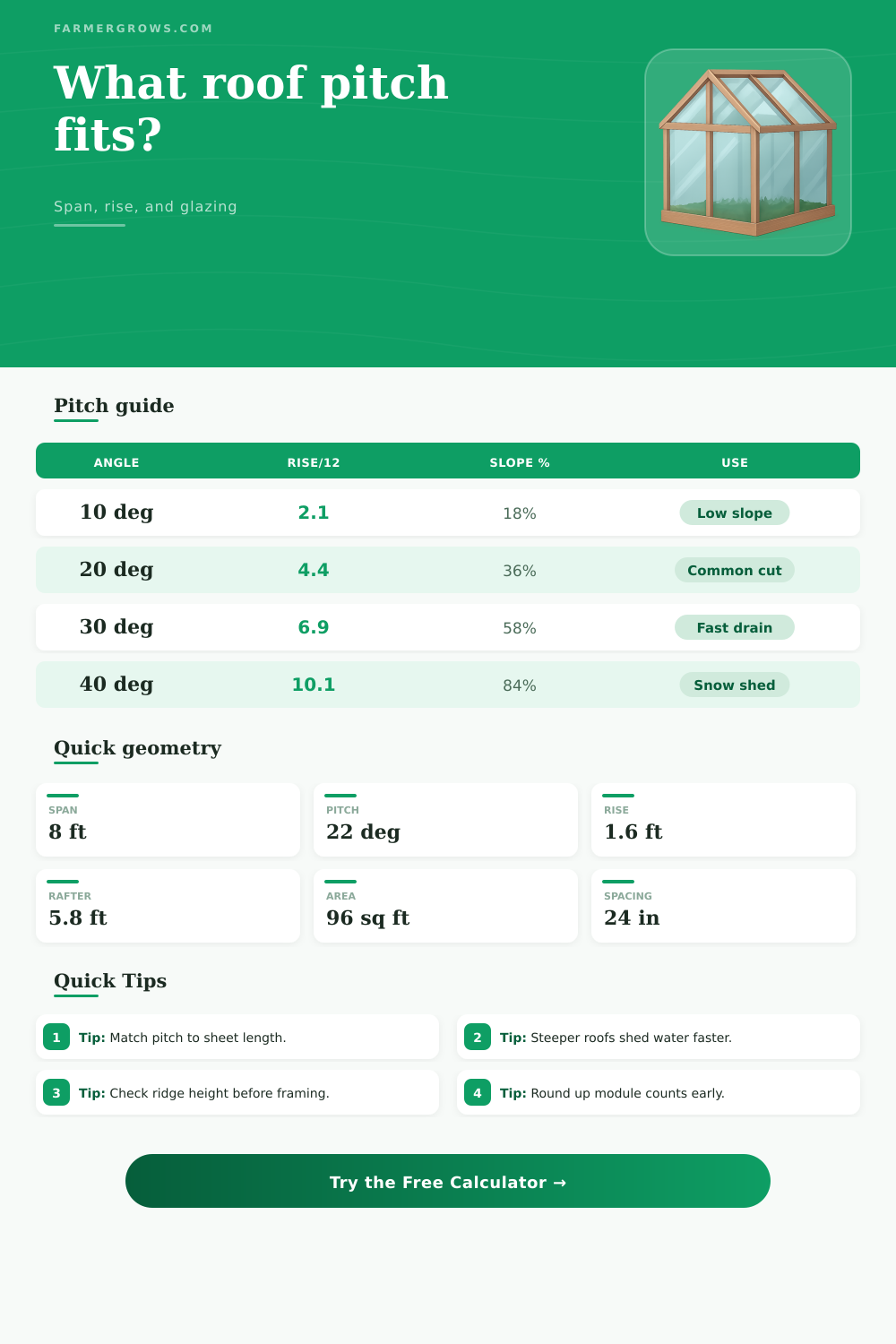
| Angle | Rise/12 | Slope % | Use note |
|---|---|---|---|
| 10 deg | 2.1 | 18% | Very low |
| 15 deg | 3.2 | 27% | Gentle run |
| 20 deg | 4.4 | 36% | Common fit |
| 25 deg | 5.6 | 47% | Balanced |
| 30 deg | 6.9 | 58% | Fast drain |
| 35 deg | 8.4 | 70% | Steep roof |
| 40 deg | 10.1 | 84% | Snow shed |
📐Span and Rise Guide
| Total span | Gable run | Lean-to run | Note |
|---|---|---|---|
| 6 ft | 3 ft | 6 ft | Compact bay |
| 8 ft | 4 ft | 8 ft | Backyard size |
| 10 ft | 5 ft | 10 ft | Walk-in width |
| 12 ft | 6 ft | 12 ft | Wide hobby house |
| 14 ft | 7 ft | 14 ft | Nursery span |
| 16 ft | 8 ft | 16 ft | Large frame |
🧱Rafter Length Factor Guide
| Angle | Factor | 6 ft run | 8 ft run |
|---|---|---|---|
| 10 deg | 1.02 | 6.09 ft | 8.12 ft |
| 15 deg | 1.04 | 6.21 ft | 8.28 ft |
| 20 deg | 1.06 | 6.39 ft | 8.53 ft |
| 25 deg | 1.10 | 6.62 ft | 8.83 ft |
| 30 deg | 1.15 | 6.93 ft | 9.24 ft |
| 35 deg | 1.22 | 7.32 ft | 9.76 ft |
| 40 deg | 1.31 | 7.83 ft | 10.44 ft |
📈Common Greenhouse Profiles
| Project | Form | Span x length | Pitch |
|---|---|---|---|
| Compact bay | Gable | 6 x 8 ft | 25 deg |
| Patio wall house | Lean-to | 4 x 10 ft | 18 deg |
| Hobby greenhouse | Gable | 8 x 12 ft | 24 deg |
| Tomato house | Gable | 10 x 20 ft | 26 deg |
| Snow-shedding bay | Gable | 12 x 24 ft | 34 deg |
| Nursery run | Gable | 14 x 28 ft | 20 deg |
| Tall crop house | Gable | 16 x 32 ft | 24 deg |
🔄Roof Form Comparison
When you builds a greenhouse, you must determine the correct pitch for the greenhouse roof. The pitch of the greenhouse roof are the angle of the slope of the roof. The pitch of the greenhouse roof will dictate how water and snow move off of the greenhouse roof.
If the pitch of the greenhouse roof are too shallow, snow will accumulate on the greenhouse roof, which may result in the greenhouse roof collapsing under the weight of the snow. If, however, the pitch of the greenhouse roof is too steep, then the rafters for the greenhouse roof will be too long; long rafters will cost to much money for the greenhouse roof. The span of the greenhouse is the width of the greenhouse from one eave to the opposite eave.
How to Pick the Right Roof Angle for a Greenhouse
Before you can calculate the pitch of the greenhouse roof, you must measure the span of the greenhouse. The span of the greenhouse will dictate the height of the peak of the greenhouse. Greenhouses with gable roofs has the greenhouse roof divide the span into two equal sides; each side of a gable roof greenhouse runs half of the total span of the greenhouse.
Lean-to greenhouses have only one slope for their roof that runs the entire width of the greenhouse against one of the greenhouse wall. Lean-to greenhouses often dont recieve as much light as greenhouses with gable roofs; they are often built in areas that naturaly receive little sunlight. The pitch of the greenhouse roof can be measured in degrees, rise over run, or as a percent slope.
Degrees are the most common method of measuring the angle of the greenhouse roof; 25 degrees is a common pitch angle for greenhouses. Rise over run measurements states the number of inches that the greenhouse roof rises over a distance of 12 inches; 4 over 12 is a common rise over run measurement. Engineer often use percent slope measurements, stating the slope as a percentage of the horizontal run of the roof.
Choose the measurement system that is the easier for you to use when constructing the greenhouse roof; using any other system may lead to error. The overhang of the greenhouse roof is the portion of the roof that extends beyond the greenhouse walls. Include an overhang on the greenhouse roof to allow the greenhouse walls to remain dry; overhangs allow gutters to remain in place against the greenhouse roof.
If your greenhouse area receives heavy snowfalls, ensure that your overhang is large enough to allow snow to slide off of the greenhouse roof. The eave height is the vertical distance from the ground to the lowest portion of the greenhouse roof. Ensure the eave height is high enough to allow for an individual to walk under the greenhouse without stooping; 7 feet is a common eave height for greenhouses.
The glazing material is the transparent material that cover the greenhouse roof. The width of the glazing material will dictate how you space the rafters for the greenhouse roof. Most polycarbonate glazing sheets are 4 feet in width; therefore, the rafters for the greenhouse roof should be spaced to allow for 4-foot intervals between each rafter.
If you do not space your rafters accordingly to the width of the glazing sheets, you will have to cut the glazing sheets to fit the greenhouse roof; cutting the glazing sheets may result in waste of that glazing sheet. The climate in which you intend to build your greenhouse will dictate the pitch of the greenhouse roof. If your climate is dry, you will want to use a relatively low pitch to the greenhouse roof; low pitches allow for the entry of sunlight into the greenhouse.
In contrast, if your climate is wet, you will need to use a steeper pitch for your greenhouse roof; the steeper pitch will allow rain to drain off the greenhouse roof. In snowy climates, you will need to use a very steep pitch for your greenhouse roof; the steep pitch will keep snow from accumulating on your greenhouse roof. Choose a pitch for your greenhouse roof that accounts for the extreme weather condition in your greenhouse climate; using a pitch that is adequate for the average weather may not be enough to ensure the roof does not collapse during an extreme weather condition.