Chicken Coop Roof Pitch Calculator
Estimate pitch, ridge rise, rafter length, and roof area for a coop roof that drains well and frames cleanly.
Pick a common coop layout to seed the fields. Each preset sets style, span, length, wall height, pitch, overhangs, spacing, waste, and cover.
Chicken Coop Roof Output
Geometry and covering numbers are based on the selected style, pitch, and plan dimensions.
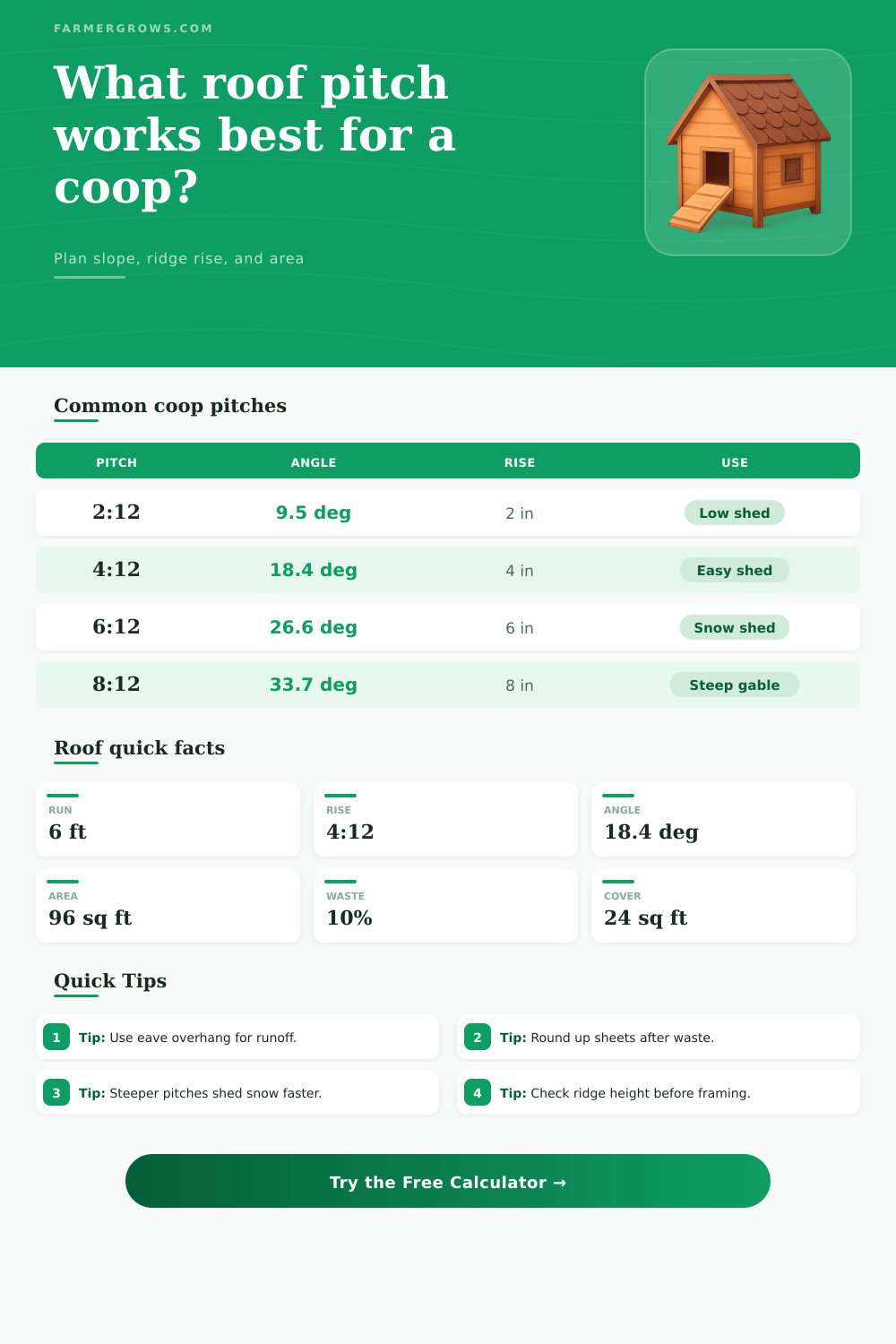
| Pitch | Angle | Rise / 12 | Best use |
|---|---|---|---|
| 2:12 | 9.5 deg | 2 in | Low shed roof |
| 3:12 | 14.0 deg | 3 in | Light runoff |
| 4:12 | 18.4 deg | 4 in | Common coop roof |
| 5:12 | 22.6 deg | 5 in | Balanced slope |
| 6:12 | 26.6 deg | 6 in | Strong drainage |
| 8:12 | 33.7 deg | 8 in | Snow country |
| 10:12 | 39.8 deg | 10 in | Steep framing |
| 12:12 | 45.0 deg | 12 in | Very steep roof |
| Cover | Nominal size | Eff. cover | Use note |
|---|---|---|---|
| 26-ga metal panel | 3 x 8 ft | 24 sq ft | Compact coop |
| 29-ga metal panel | 3 x 10 ft | 30 sq ft | Longer run |
| Asphalt shingles | 1 bundle | 33.3 sq ft | Steep gable |
| OSB roof sheet | 4 x 8 ft | 32 sq ft | Solid deck |
| Corrugated poly | 2.5 x 8 ft | 20 sq ft | Light run roof |
| Steel rib panel | 2 x 8 ft | 16 sq ft | Narrow cover |
| Span | Gable run | Rise @ 6:12 | Practical note |
|---|---|---|---|
| 4 ft | 2 ft | 1 ft | Brooder size |
| 5 ft | 2.5 ft | 1.25 ft | Small coop |
| 6 ft | 3 ft | 1.5 ft | Easy walk-in |
| 8 ft | 4 ft | 2 ft | Standard shed |
| 10 ft | 5 ft | 2.5 ft | Roomier frame |
| 12 ft | 6 ft | 3 ft | Large coop |
| Item | Common size | Where used | Why it matters |
|---|---|---|---|
| Drip edge | 1.25 in flange | Eaves and rakes | Pushes water clear |
| Ridge cap | 10 to 12 in | Peak line | Covers the seam |
| Closure strip | 1 to 3 in | Eave and ridge | Blocks gaps |
| Vent strip | 1 to 2 in | Ridge vent line | Moves moist air out |
| Washer screw | 9/16 in EPDM | Panel ribs | Keeps roof sealed |
| Fascia board | 1 x 6 in | Roof edge | Supports trim |
A chicken coop roof must have the proper pitch to allow water and snow to shed off the roof. The pitch of a chicken coop roof is the measurement of the rise of the roof over the run of the roof. The pitch is expressed as the number of inches that the chicken coop roof rise vertically for every twelve inches that the roof runs horizontally.
A 4:12 pitch, for example, indicate that the roof rises four inches for every twelve inches of horizontal distance the roof covers, which forms an eighteen-degree angle. A steeper pitch such as 6:12 or 8:12 is a more useful pitch for a chicken coop roof since the steeper pitch will shed the snow and leave the coop more effective than a shallow pitch. A shallow pitch such as an 2:12 pitch can result in water pooling on the coop roof, which can foster the growth of algae in the coop and eventually lead to the coop roof rotting.
How to Choose a Chicken Coop Roof
There are different types of chicken coop roofs that you can build. For instance, you can use either gable or shed roof design for your chicken coop. A gable roof split the coop into two sides and sheds the water down each side of the coop.
A shed roof design for the coop roof only tilts in one direction and typically sheds the water towards the chicken run. The span of the coop roof is the total width of the coop that the chicken coop roof will cover. The span will determine how high the ridge of the coop will rise above the walls.
A four foot span of coop will rise one foot if you use a 6:12 pitch for the coop roof. If the span of the coop is larger than four feet, the ridge of the coop will rise higher than one foot. Overhangs for the coop roof will protect the walls of the coop from accumulating water.
The overhang at the eave of the coop roof will shed the water away from the walls of the coop. End gables will prevent water from entering the coop structure. Additionally, another component to consider when constructing the coop roof are the rafters.
Rafters will support the roof of the coop and should be spaced twenty-four inches apart to save on the lumber needed for constructing the coop. If the coop roof will need to shed heavy snow, the rafters will need to be placed closer together. Add a waste factor of ten percent to the total amount of lumber needed for constructing the coop roof to provide extra lumber for any cuts to the rafters.
The material for the coop roof will change the total amount of material that will be needed for the coop roof. Metal panels are one of the most common roof materials for chicken coops. A 26-gauge metal panel shed twenty-four square feet of coverage.
Asphalt shingles are another common material for chicken coop roofs. However, asphalt shingles will require that you construct a solid deck on the coop roof first. Each material for the coop roof will impact the total area of the coop roof and, ultimatey, the number of sheets of metal or asphalt shingles will be required to cover the coop roof.
Therefore, you must calculate the ridge height, the length of the rafters, and the total area of the coop roof before purchasing the building materials for the coop. The climate in which you will construct the chicken coop will impact the pitch of the coop roof. In areas with alot of rainfall, a 5:12 or 6:12 coop roof pitch is recommended.
In areas with heavy snowfall, the coop roof should have an 8:12 pitch or even be steeper to allow the snow to shed off the coop roof. In areas that is hot and humid, large overhangs and ridge vent will help to shed heat from the coop. When framing the coop roof, use specific components that will seal the coop roof against the elements.
Use a drip edge at the eaves of the coop roof to ensure that the water does not splash against the coop siding. Use a ridge cap to seal the coop roof ridge. Additionally, use closure strips to prevent insects from entering the coop through the metal panels.
Use vents at the top of the coop roof. These vents allow the moist air that accumulates in the coop to escape the coop. For metal chicken coop roofs, use washer screws with rubber seal to ensure the coop roof doesnt leak during periods of rain or hail.