Rainwater Harvesting Calculator
Estimate how much water a roof can collect, how much is actually usable after runoff and collection losses, and what tank size makes sense for your demand target.
Pick a familiar roof and storage setup to load realistic values. The presets cover small sheds, homes, barns, schools, and farm-scale cistern planning.
Your Rainwater Harvest Results
Use these numbers to compare yield, storage, and demand coverage before you buy a barrel, tote, or cistern.
| Surface | Runoff coefficient | Typical loss | Best use |
|---|---|---|---|
| Metal / standing seam | 0.95 | Very low | Highest capture on clean roofs |
| EPDM / membrane | 0.90 | Low | Flat and low-slope roofs |
| Asphalt shingles | 0.85 | Moderate | Typical home roof |
| Concrete tile | 0.80 | Moderate | Durable residential roofing |
| Clay tile | 0.78 | Moderate to high | Decorative roof with more splash loss |
| Polycarbonate panel | 0.88 | Low | Greenhouses and light structures |
| Green roof | 0.65 | High | Stormwater friendly, lower harvest |
| Painted concrete | 0.92 | Very low | Hardscape catchment and courtyards |
| Period | Input meaning | Annual multiplier | Example use |
|---|---|---|---|
| Per storm | Depth for one storm event | Storms per year | Design rainfall capture |
| Per month | Average monthly depth | 12 | Seasonal planning |
| Per quarter | Average 3-month depth | 4 | Quarterly collection view |
| Per year | Annual total depth | 1 | Long-range water budget |
| Storage class | Capacity | Practical supply | Best fit |
|---|---|---|---|
| Rain barrel bank | 55 gal | Short garden use | Patios, herbs, seedlings |
| IBC tote | 275 gal | 1-2 irrigation days | Small homes and nurseries |
| Above-ground cistern | 1,000 gal | About 2 weeks for light demand | Average household backup |
| Farm tank bank | 2,500 gal | 2-4 weeks for moderate demand | Yards, hoop houses, orchards |
| Buried cistern | 5,000 gal+ | Long dry-spell coverage | Large homes and commercial sites |
| Modular tank bank | Custom | Scale to roof and demand | Mixed-use farm planning |
| System type | Efficiency | Loss factors | Notes |
|---|---|---|---|
| Basic screen + barrel | 70% | Leaf debris, splash, coarse screens | Simple and inexpensive |
| First-flush diverter | 82% | Initial wash-off and holdback volume | Good for cleanable roofs |
| Mesh + calm inlet | 88% | Fine sediment and turbulence | Balanced farm setup |
| Cartridge filtration | 93% | Filter replacement and backwash | Cleaner water for reuse |
| Multi-stage cistern | 96% | Pre-screen, first flush, settling | Strong all-around performance |
| Ultra-clean roof system | 98% | Very small transfer losses | High-maintenance premium option |
Rainwater harvesting are the process of collecting the rain that falls on your roof and storing it in an tank to use later. Many individual attempt to implement a rainwater harvesting system in their homes, but they dont calculate how much rainwater they will be able to collect. If they do not calculate the appropriate amount of rainwater they can collect during the year, there tank will dry up during dry spells in the area.
By using a rainwater harvesting calculator, individuals can avoid this drying up of the tank and ensure that the amount of water that is stored in the tank will meet the demand of the household. The first variable that must be calculated in the process of implement a rainwater harvesting system is the area of the roof. You must measure the area of the roof because it will determine how much rainwater can fall on to the roof and fall into the tank.
How to Calculate Rainwater and Size Your Tank
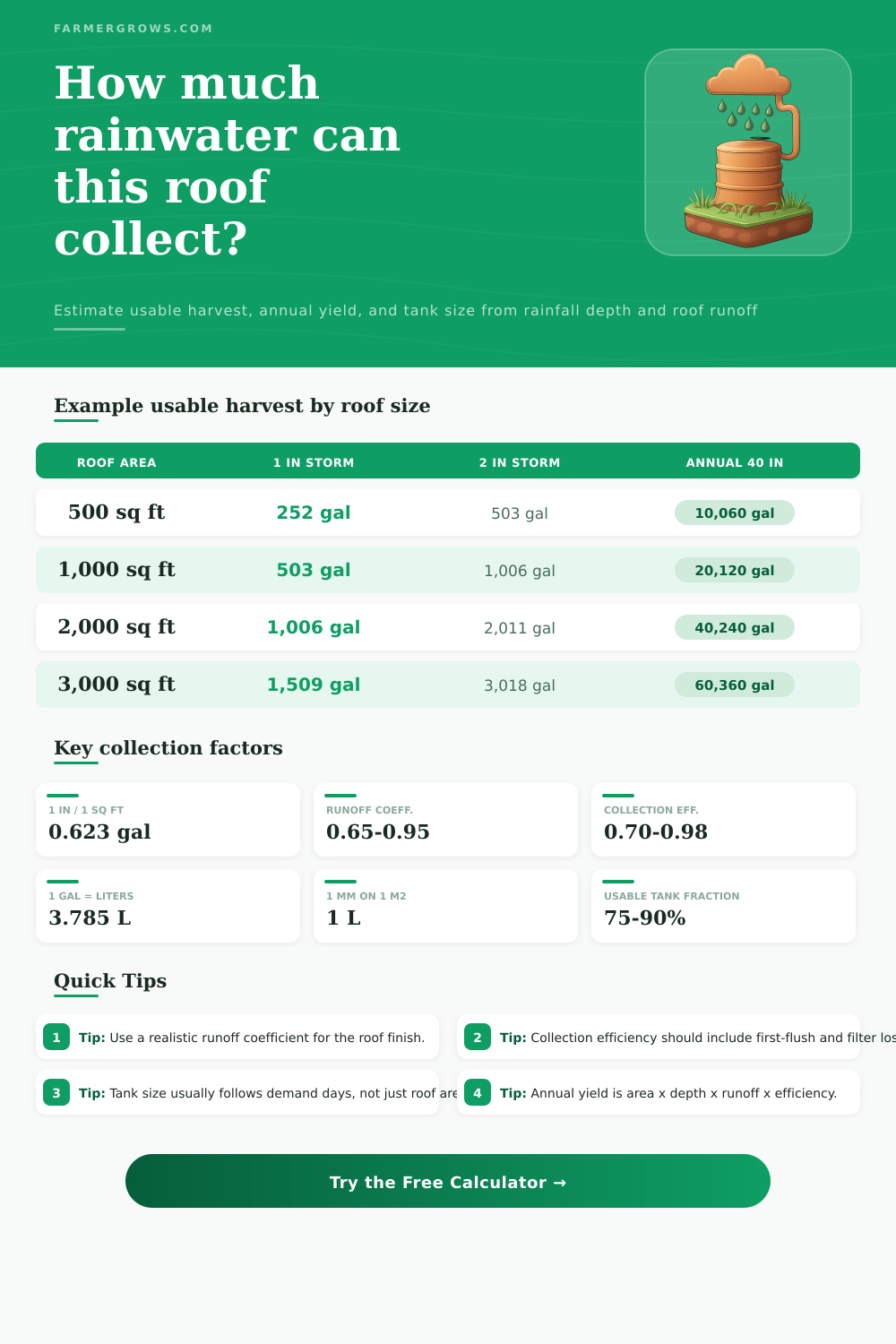
Additionally, the different surface of the roof will affect how much rainwater that falls into the tank. Each of these roof surfaces has a runoff coefficient that describe the amount of rainwater that falls off of that roof surface. Metal roofs have high runoff coefficient because they allow rainwater to fall off of the roof.
However, green roofs has low runoff coefficients because they absorb the rainwater that falls on to them. If you do not account for these coefficients, the rainwater that is harvested will be underestimated. The second variable in the system is the collection efficiency of the rainwater.
A person calculates the collection efficiency of the rainwater by determine the amount of rainwater that is lost due to first-flush diverters and filters. A first-flush diverter allow the initial amount of dirty rainwater to leave the system. It ensures that the stored rainwater in the tank is as clean as possible.
Additionally, filters will lose some of the rainwater because any leaf or debris that fall onto the roof will be caught by the filter. The collection efficiency of a basic barrel system for rainwater may be 70% however, the collection efficiency of a complex cistern system may be 96%. The collection efficiency must be accounted for to ensure that the calculated yield of rainwater will be the same than the actual yield of rainwater.
The third variable in the system is the sizing of the tank. To size the tank for a rainwater system, the daily water demand for an area and the number of dry day between rains will have to be calculated. Knowing these two variables will allow an individual to calculate the total amount of water that the individual will be need.
However, the tank will not be 100% of the total volume of water that the roof will produce because there will always be some air space within the tank for the tank to expand and some sediment that will be produced in the tank that will not be usable for various purpose. Thus, 85% of the tank will be usable for different purposes. Additionally, the layout of the tank will play a critical role in how much rainwater can be collect.
The gutters will play a critical role in collecting the rainwater because they will channel the water from the roof into the tank. However, if the gutters are poorly laid out and built, some of the rainwater will be lost due to splash and evaporation. Furthermore, the catchment area should be placed away from trees because the trees will drop leaves into the gutters that will clog the filters that allow rainwater to enter the tank.
Finally, by calculating each of these variables, an individual can ensure that the yield of rainwater from the system will meet the demands for water in the area. If the calculated yield of rainwater is higher then the demand for water, there will be a surplus of rainwater. However, if the calculated yield is less than the demand for water in the area, there will be a shortage of water for various use.
Thus, by measuring and calculating each of these variables and accounting for them in the creation of the rainwater harvesting system, an individual can ensure that the system provide enough water to meet the demand of the household.