🛠 Gate Post Size Calculator
Estimate hinge post size, latch post size, embedment depth, and footing diameter for farm gates, driveway gates, and yard entries.
Post Sizing Results
Enter the gate details to see the hinge and latch post recommendations.
Calculation Breakdown
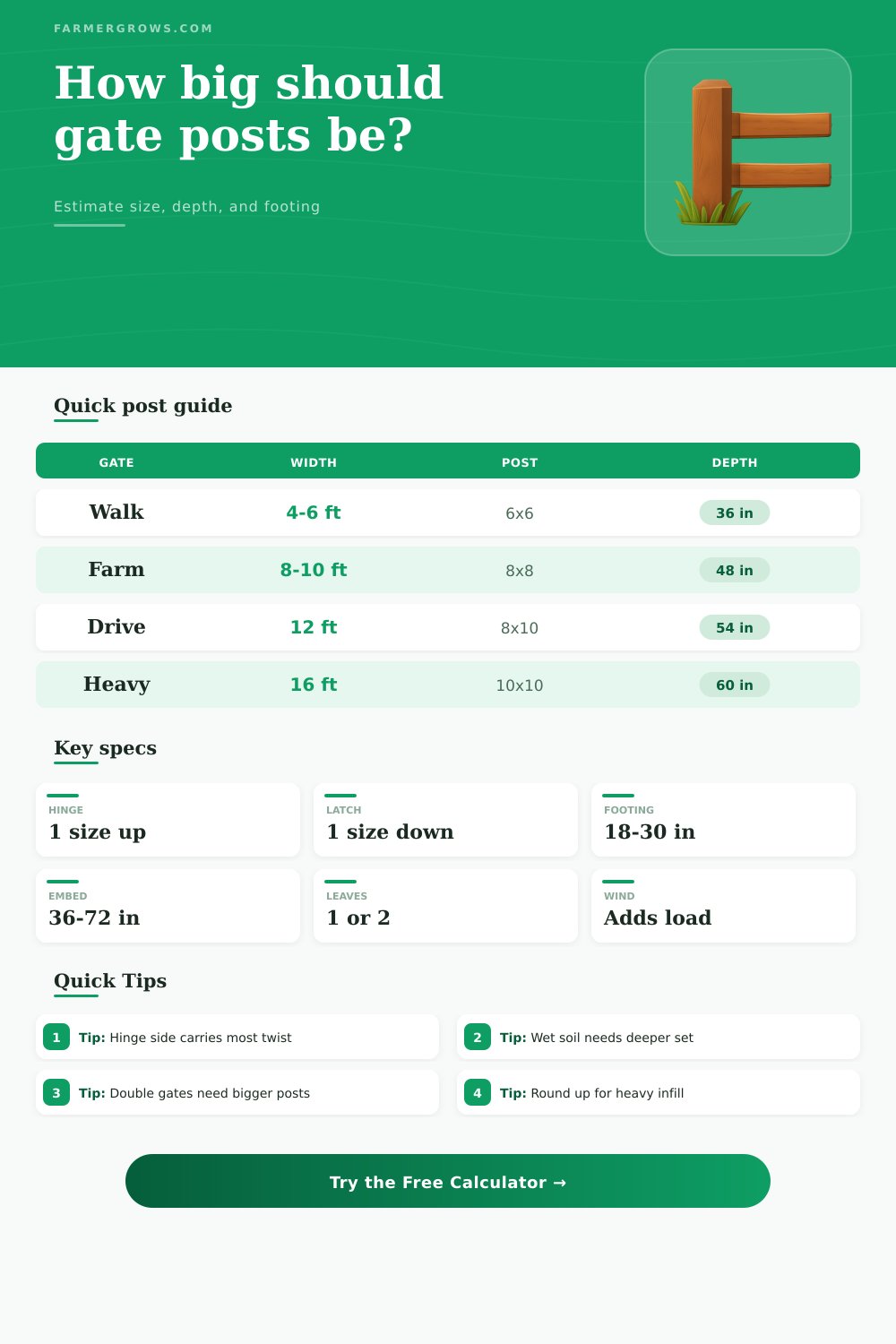
| Opening | Hinge post | Latch post | Embedment |
|---|---|---|---|
| 4 to 6 ft | 6x6 PT | 6x6 PT | 36 to 42 in |
| 8 to 10 ft | 8x8 PT | 6x8 PT | 42 to 48 in |
| 12 to 14 ft | 8x10 PT | 8x8 PT | 48 to 60 in |
| 16 ft and up | 10x10 PT | 8x10 PT | 60 to 72 in |
| Gate height | Soil | Embedment | Footing |
|---|---|---|---|
| 5 to 6 ft | Firm | 36 to 42 in | 18 to 20 in |
| 6 to 7 ft | Average | 42 to 54 in | 20 to 24 in |
| 7 to 8 ft | Soft | 54 to 66 in | 24 to 30 in |
| 8 ft and up | Wet | 66 to 84 in | 30 to 36 in |
| Gate type | Load factor | Typical infill | Use case |
|---|---|---|---|
| Walk gate | 0.90 | Open frame | Garden path |
| Farm gate | 1.00 | Pipe rail | Pasture entry |
| Driveway gate | 1.08 | Mesh or rail | Vehicle access |
| Cantilever gate | 1.28 | Steel infill | Wide opening |
| Project | Opening | Hinge post | Latch post |
|---|---|---|---|
| Garden walk | 4 x 6 ft | 6x6 PT | 6x6 PT |
| Pasture entry | 10 x 6 ft | 8x8 PT | 6x8 PT |
| Drive access | 12 x 6 ft | 8x10 PT | 8x8 PT |
| Heavy lane | 16 x 8 ft | 10x10 PT | 8x10 PT |
Always size the hinge post first. It carries the swing load, so a weak hinge side can make even a small gate sag early.
On soft or wet soil, step up the post or deepen the set. Good footing matters as much as the nominal post size.
This gate post size calculator helps compare hinge post size, latch post size, embedment depth, and footing diameter. Use it to size farm, driveway, and yard gates with confidence.
A gate posts must be sized appropriate to prevent a gate from sagging or leaning on the post. If the gate post is to small for the gate, the gate post wont be able to support the gates weight, leading to failure of the gate post. When choosing the size for a gate post, you must consider the weight of the gate, the types of material for the post, and the soil conditions for that area.
The hinge post and latch post performs two different functions with the gate. The hinge post must be able to support the gate’s weight; thus, the hinge post should be larger and more strong than the latch post. The hinge post endures a twisting force whenever the gate is opened or closed.
How to Choose the Right Gate Post Size and Depth
In contrast, the latch post only endures a compressive force. For these reasons, many people chooses a larger gate post for the hinge side of the gate. In addition, different soil types will affect the gate post performance.
Gate posts has a stronger grip on firm clay soil. In contrast, if the soil is too wet, the gate post will shift and move within ground. In these cases, an deeper hole must be dug for the gate post to remain secure.
Different types of gate will place different amount of stress on the gate posts. Garden gates are small and light, so they do not place much stress on the gate posts. Driveway gates are much heavier as they must support the weight of vehicles.
Consequently, driveway gate posts is much larger than those for garden gates. Solid board gates will catch the wind, much like a sail. The wind will act on the gate posts.
For these reasons, solid board gate posts must be more stronger than open mesh or pipe rail gates. Gate posts can be made of many different material. Treated pine posts are the most common and economical for gate posts.
For taller gates, hardwood or glulam posts are stronger materials. Steel tube posts are also common for gate posts because the tubes can withstand twisting forces good, and they are very strong materials. You can use many different gate post materials to adjust the strength of the gate post system.
It is recommended that you add a buffer of 10 or 20 percent to the calculations for the strength of the gate post. This buffer will provide for unexpected force on the gate, such as wind or livestock. The size of a gate post can be determined by considering several requirements.
The hinge requirement for the gate will determine the minimum size for the hinge post. The embedment depth requirement will determine how deep the post will be bury in the ground. Gate posts should be buried at least one-third of the length of the gate post below the grounds surface.
This will help prevent the gate from sagging. The footing for the gate post should be wide enough to prevent the frost from moving the gate post. The diameter of the gate post should be large enough for the gate post to be secure in the ground.
If the selected gate posts are too small, you must select a larger gate post for the gate. Environmental factor will affect the strength of a gate post. Wind is one of the most common.
Even if the gate is relatively light, high wind can create enough force to bend the gate post. In areas where strong winds is common, it might be better to use a deeper gate post setting or a mesh gate. In areas where the soil is soft, the gate posts will rock back and forth over time.
It is important to probe the soil prior to installing the gate posts. If the soil is very wet, you should use gravel or sonotubes in the gate post holes. Some common mistakes in installing gate posts include using wood that is not pressure-treated to increase the life of the gate post.
Hinges mounted too high on the gate posts will place too much leverage on the top of the post. Using only gravel in the hole to bury the gate post will cause water to collect in the gravel and loosen the gate post from the ground. The top of the gate post should be beveled to prevent water damage on the wood.
Many different types of gates exist, and each have different specifications for the gate posts. Livestock gates must be very strong to hold the weight and pushing force of the livestock. Driveway gates must have gate posts that are tall enough to allow for vehicle passage.
Such driveway gates might use glulam posts so that they do not bend as heavy as the rest of the gate. The slope of the land might require that the gate posts be stepped down to accommodate for the slope in such a way that the gate remain level. Finally, if you choose the correct size and depth for the gate post, the gate will function correct for a long time.
You should of checked the soil first. This is actualy a very important part of the process, and youll want to make sure the post is stable. Its better to do it right the first time than to deal with a sagging gate later on.
This is more better than doing it twice.