🚧 Box Culvert Calculator
Estimate runoff, choose a box opening, and compare capacity, velocity, and cover before you set the crossing.
This planner uses a runoff-based design flow and a full-flow Box Manning check for box culvert sizing. It is a practical first pass for farm lanes, ditch crossings, yard drains, and small road crossings.
Imperial uses feet, inches, and cfs. Metric uses meters, millimeters, and m3/s.
Box Culvert Summary
Runoff, recommended box opening, capacity, velocity, and cover check from the current inputs.
Calculation breakdown
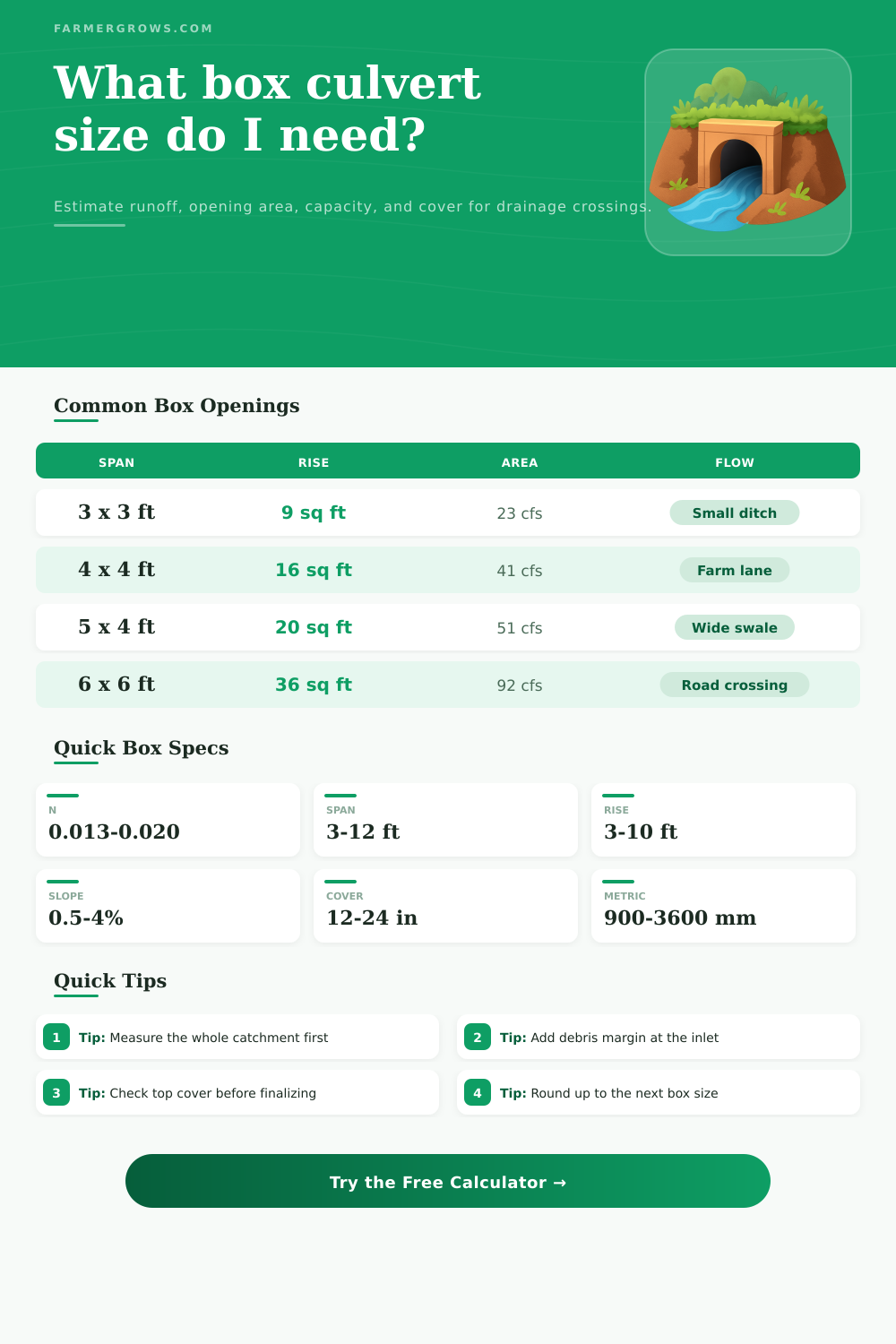
| Span x rise | Area | Full flow @1% | Typical use |
|---|---|---|---|
| 3 x 3 ft | 9.0 sq ft | 23 cfs | Small ditch |
| 4 x 4 ft | 16.0 sq ft | 41 cfs | Farm lane |
| 5 x 4 ft | 20.0 sq ft | 51 cfs | Wide swale |
| 6 x 6 ft | 36.0 sq ft | 92 cfs | Road crossing |
These values are quick planning guides. The calculator below still recomputes the full Manning result from your own inputs.
| Opening | Ratio | Use | Note |
|---|---|---|---|
| 3 x 3 | 1:1 | Compact | Square box |
| 4 x 3 | 4:3 | Low headroom | Shallow |
| 5 x 4 | 5:4 | Balanced | Common |
| 6 x 4 | 3:2 | Large flow | Road |
Use the ratio guide to match rise and span to the available cover, embankment depth, and hydraulic target.
A box culvert allow water to pass under a road or driveway. Box culverts is often used instead of round pipes because a box culvert can handle heavier volumes of water and it has a flat floor that can manage debris. A box culvert is also design to handle heavy traffic loads due to its stiff walls.
To determine the size of the box culvert that is needed, the designer must first determine the size of a watershed that will direct water into the culvert. A watershed is the area of land that collect rain water and channels it into a specific location. Watersheds can be of any shape, such as a rectangle, a triangle, or a circle.
How to Size and Install a Box Culvert
The shape of the watershed will help dictate the amount of water that will flow into the box culvert. Watersheds that is long and narrow will collect more rain water than those that is short and wide. A sketch of the watershed can be drawn to determine the size of the box culvert that will be ordered.
Once the designer has determined the watershed, the rainfall intensity is calculated. Rainfall intensity is given in inches of rain per hour. Rainfall maps can be used to determine the intensity of rain that falls in the area.
Runoff coefficients can also be used to determine how much rain will flow into the box culvert. A runoff coefficient is a number that indicate how much rain runs off the land rather than soaking into the soil. Clay-based soil have a high runoff coefficient, indicating that it does not soak up rain water as well as soil that is packed with sandy soil, like loamy pasture.
A safety margin of 10% can be added to the calculations to account for both rain storms that may be more intense than the calculated rainfall, as well as to account for the potential for debris to collect into the inlet of the culvert. The slope of the land will also impact the box culvert. The slope of the land will help to determine both the velocity of the water through the culvert and how much water will pool before it enter the culvert.
A slope of 1 to 2% is recommended. If the velocity of the water through the culvert is too fast, it will lead to erosion of the land downstream of the culvert. The Manning’s n value of the material used in the culvert will also impact the velocity of the water.
For instance, if smooth material is used in the culvert, such as high-density polyethylene, the Manning’s n value will be low. A low Manning’s n value makes it easier for the water to move through the culvert. The amount of soil covering the culvert is referred to as the cover of the culvert.
The cover is another critical measurement in the determination of the needed size of the culvert. The soil cover will protect the culvert from both frost heave, as well as protect the culvert from the weight of the vehicles that travels over it. 12 to 24 inches of soil must be placed over the culvert.
If not, the weight of the vehicle may crush the culvert. The design of the inlet of the culvert can also impact the performance of the culvert. In some cases, a beveled edge or a headwall can be built at the inlet to allow for the water to enter the culvert smooth.
The Manning’s equation can be used to calculate the size of the culvert that is needed. Manning’s equation use variables like the flow of water (measured in cubic feet per second), the slope of the land, and the Manning’s n value to calculate the size of the culvert that should be used at the site. For instance, if the flow of water is 40 cubic feet per second, and the slope is 1%, the equation can reveal whether a 4-foot by 4-foot culvert will be appropriate.
There are some mistakes in the installation and design of culverts that should be avoided. One of the most common is undersizing the culvert. Because debris like leaves, manure, and gravel can enter the inlet of the culvert, if the culvert is undersized it will not be able to handle the amount of water that enter it.
Another mistake is the ignoring the amount of soil that should be placed over the culvert. If the culvert is crushed under the weight of the traffic, it will cause damage to the culvert. Additionally, if the velocity of the water through the culvert is too fast, it will erode the soil downstream of the culvert.
Another mistake is not checking the area for specific condition that could impact the culvert. For instance, terraces upstream of the culvert may fail, increasing the amount of water that enters the culvert. Additionally, there may be beaver dam downstream of the culvert that may cause the water to back up.
If heavy trucks will be driving over the culvert, reinforced boxes should be used. Reinforced culverts are made stiff enough to bear the live loads of the trucks driving over the culvert. Additionally, although box culverts cost more than round pipes, they are a good investment because they require less maintenance and can handle more traffic through the culvert.