🚧 Culvert Sizing Calculator
Estimate runoff, choose a round pipe or box culvert, and compare capacity, velocity, and cover before you set the crossing.
This planner uses a runoff-based design flow and a full-flow Manning check. It is a practical first pass for farm lanes, ditch crossings, yard drains, and small road culverts.
Imperial uses feet, inches, and cfs. Metric uses meters, millimeters, and m3/s.
Size Summary
Runoff, recommended culvert size, capacity, velocity, and cover check from the current inputs.
Calculation breakdown
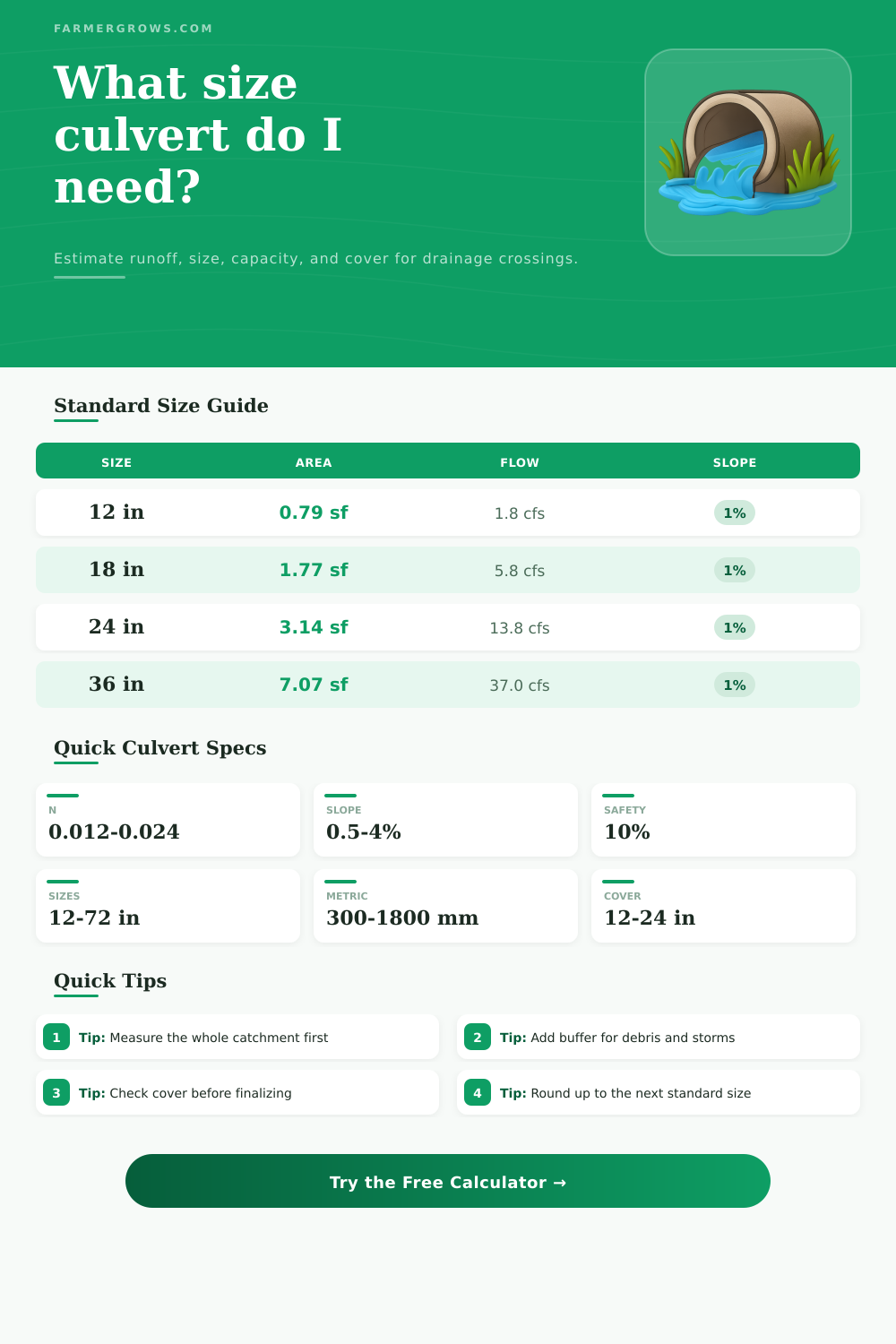
| Diameter | Area | Full flow @1% | Typical use |
|---|---|---|---|
| 12 in | 0.79 sq ft | 1.8 cfs | Driveway edge |
| 18 in | 1.77 sq ft | 5.8 cfs | Farm lane ditch |
| 24 in | 3.14 sq ft | 13.8 cfs | Pasture swale |
| 36 in | 7.07 sq ft | 37.0 cfs | Road crossing |
Values above are quick planning guides. The calculator below still recomputes the full Manning result from your own inputs.
| Surface | C | Storm response | Typical use |
|---|---|---|---|
| Roof | 0.90 | Fast | Outlets |
| Gravel | 0.40 | Moderate | Drive lanes |
| Pasture | 0.25 | Slower | Grass catchment |
| Pavement | 0.95 | Very fast | Aprons |
If the catchment mixes roof, gravel, and soil, choose the coefficient that best reflects the peak runoff path into the culvert.
Culvert sizing are the process of determining the diameter of the culvert and the material of the culvert so that the culvert effective manages the water that will run over it. Choosing a culvert that is too small will result in flooding over the culvert; too larger of a culvert will cost too much money for the project. In order to size the culvert apropriately, four factor must be calculated: the contributing area, the runoff coefficient, the slope of the land, and the capacity of the culvert.
The contributing area is the area of land that drain into the culvert. It is important to determine the shape of the contributing area. For instance, a rectangular area will drain more differently than a circular area.
How to Size a Culvert
Calculators is available online to calculate the area of the contributing area. Once you know the area of the contributing area, you can determine how much water will run into the culvert. The next factor to calculate is the runoff coefficient.
The runoff coefficient is the amount of water that run off of the surface into the culvert compared to the amount of water that infiltrates into the ground. Different surface will have different runoff coefficients. For instance, areas covered in gravel will have higher runoff coefficients than pastures that cattle graze.
Similarly, roofs will have higher runoff coefficients than areas covered in bare soil. If you select a runoff coefficient that is too low, the culvert will be too small for the amount of water that will run into it. If the selected coefficient is too high, the culvert will be overbuilt.
Another factor to calculate is the intensity of the rainfall that will fall on the contributing area. The third factor is the slope of the land. The slope of the land will determine the velocity of the water that will move through the culvert.
Steeper slope will allow for faster movement of water through the culvert. High velocities of water can erode the outlet of the culvert. The slope should be between 0.5 and 4 percent to ensure that the water moves through the culvert without erode it.
The material of the culvert will also affect the velocity of the water through the culvert. For instance, smooth materials such as concrete will allow for higher velocities of water through the culvert than rough materials such as corrugated-metal. You can use Manning’s equation to calculate the flow capacity of the culvert.
Manning’s equation takes into consideration the roughness of the culvert material. The capacity of the culvert is the amount of water that it can carry. Based off the calculations of the contributing area, the runoff coefficient, the slope of the land, and the capacity of the culvert, software will recommend a standard size for the culvert.
For instance, the software may recommend a round pipe that is between 12 and 72 inches in diameter or a box-culvert. It is important to include a 10 percent buffer in the calculations for the capacity of the culvert. This 10 percent buffer ensure that there is enough space in the culvert for debris to clear the entrance to the culvert.
Additionally, 10 percent buffer can provide extra capacity in the case of unexpected storms. Another factor to consider is the depth of the soil that will be on the culvert. The soil will provide support for the culvert.
If there is not enough soil on top of the culvert, the weight of the vehicle may crush the culvert. For instance, culverts made of concrete may require 12 inches of soil on top of the culvert, but HDPE culverts may require 24 inches of soil on top of the culvert. Finally, there are certain practices that must be followed during the installation of the culvert.
The culvert should be placed on a bed of gravel or sand. The gravel or sand will provide a foundation for the culvert. Additionally, you should protect the outlet of the culvert with riprap.
Riprap will allow the velocity of the water to not erode the soil at the outlet. The culvert should also be constructed in a way that allows for debris such as leaves or silt to not enter the culvert. For instance, if the total amount of the contributing area is not measured correctly (for example, if the ditch is measured but not the area of the hillside), the culvert may fail during heavy rain due to not being built to handle the total amount of water that may run into the culvert.