Feed Bin Capacity Calculator
Estimate gross volume, usable storage, feed weight, and bag count for round, square, rectangular, or hopper feed bins with a clean farm-friendly layout.
Start with a real feed storage setup. Each preset fills the bin shape, size, feed type, headspace, daily use, and bag size so you can calculate fast.
This calculator is tuned for farm feed bins, tote bins, and hopper storage, so it emphasizes volume, feed density, and hand-on-ration planning instead of pricing.
Feed Bin Capacity Output
Estimated gross and usable storage, feed weight, and bag count from the settings above.
| Feed | Lb / ft3 | Kg / m3 | Notes |
|---|---|---|---|
| Pellet feed | 38 | 609 | General ration |
| Layer mash | 33 | 529 | Loose poultry feed |
| Dairy pellet | 42 | 673 | Dense mixed ration |
| Horse feed | 36 | 577 | Textured equine feed |
| Calf starter | 32 | 513 | Fine starter ration |
| Goat ration | 40 | 641 | Mixed grain blend |
| Alfalfa pellets | 34 | 545 | Light forage pellet |
| Mineral mix | 70 | 1121 | Very dense additive |
| Shape | Formula | Use | Notes |
|---|---|---|---|
| Round | pi r2 h | Bulk bins | Most common |
| Square | s2 h | Totes | Simple footprint |
| Rectangle | l w h | Room bins | Corner losses |
| Hopper | Cyl + cone | Free flow | Bottom taper |
| Bag | Bag wt | Volume | Use |
|---|---|---|---|
| Small bag | 25 lb | 0.66 ft3 | Top-offs |
| Standard bag | 40 lb | 1.05 ft3 | Small bins |
| Feed bag | 50 lb | 1.32 ft3 | Common ration |
| Bulk bag | 100 lb | 2.63 ft3 | Large stores |
| Example | Shape | Gross ft3 | Approx feed lb |
|---|---|---|---|
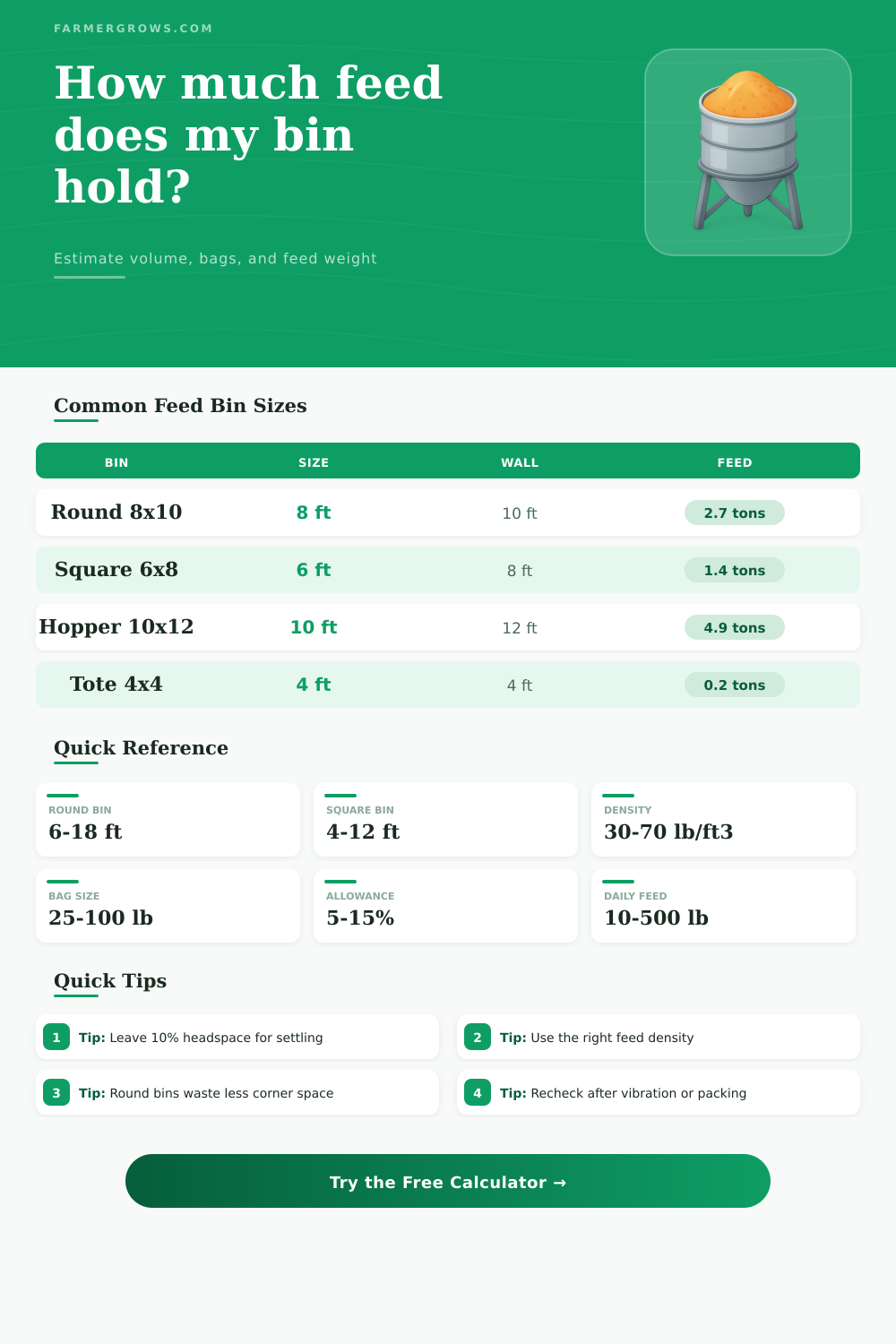
| Small tote 4x4 | Square | 64 | 2,400 |
| Horse bin 8x10 | Round | 503 | 19,100 |
| Calf bin 8x8 | Rectangle | 512 | 19,500 |
| Hopper 10x12 | Hopper | 942 | 35,800 |
Feed storage require careful planning because the amount of feed that a feed bin can hold depend on various factors. These factors include the shape of the feed bin, the density of the feed, and the number of animal that consume that feed every day. If farm owners dont consider these factor and plan for feed storage using math and number, they will eventually run out of feed before the next delivery of feed arrive on the farm.
The shape of the feed bin can change the feed bins capacity. Round feed bin are the most efficient for storing feed because feed bins do not have corners like square or rectangular feed bins. Because round feed bins do not have corner, there is no wasted space within those corners of the feed bin.
How to Plan Feed Storage
Square feed bins do have corners that could lead to feed overflow out of those corners of the feed bin. Furthermore, if the farm owners has limited space for their feed bins, then square feed bins are helpful because they can fit within the available sheds. For farms with ample space to store feed, round feed bins that can hold more feed are betterer options for feeding the animals on the farm.
There must be headspace within the feed bin. The amount of space that you should leave within the feed bin is approximately ten percent of the total volume of the feed bin. The vibration of the feed bins and gravity cause feed settling within the feed bin over time.
If there is no headspace within the feed bin, it is possible that the feed will overflow out of the feed bin, which could cause the feed to create blockage in the feed system. Furthermore, because feed will settle over time, the total volume of feed that can be stored in the feed bin will always be less than the total volume of the feed bin. Feed density is the weight of the feed within a specific volume of the feed bin.
The density of the feed can change depending on the type of feed. Pellets are a type of feed that is dense, meaning that it weighs forty pounds per cubic foot. Mases is less dense than pellets because they contain more air.
Mases may weigh only thirty pounds per cubic foot. Minerals are also very dense and can weigh as much as seventy pounds per cubic foot. If you dont know the density of the feed you are using for your animals, then you will not know the actual weight of the feed that is sitting in your feed bin.
The size of the bags of feed that your operation use will also have an impact on how you will need to fill your feed bin. Many operations use bags of feed that weigh fifty pounds. However, some may use bags that weigh either twenty-five pounds or one hundred pounds.
To determine how many bags of feed you will need to fill your feed bin, you must calculate how much usable weight your feed bin can hold and the daily consumption of the animals in your operation. Daily consumption of the animals is the amount of feed that your animals will eat every day. Depending on the daily consumption of the animals, you can determine how many days the feed in your feed bin will last.
Feed bins come in many different shapes and sizes. Some examples of the different types of feed bins that are used in different operations include hopper bins and straight-wall bins. Hopper bins include features like tapered bottoms that utilize the force of gravity to move the feed within the bin.
The cylindrical section of the hopper bin holds the majority of the feed. The cone section of the hopper bin ensures that the feed move downward. Alternatively, straight-wall bins are much simpler than hopper bins.
However, straight-wall bins may include dead spot where the feed wont move. Vibrations within the feed bin can change the amount of feed that is within the feed bin. For instance, the machinery or the animals within the farm can cause vibrations in the feed bin.
These vibrations will cause the feed within the feed bin to pack down. Therefore, if feed is packed down within the feed bin, it is important that you recheck the capacity of the feed bin after a few weeks of feeding. Furthermore, it is also important to plan for a buffer of extra feed for your operation.
This buffer of feed will provide the animals in your operation with extra food during the long period between deliveries of feed. Overall, if you plan for feed storage for your operation using the concept of density, shape, and headspace within the feed bin, you will have a steady supply of feed for your animals.