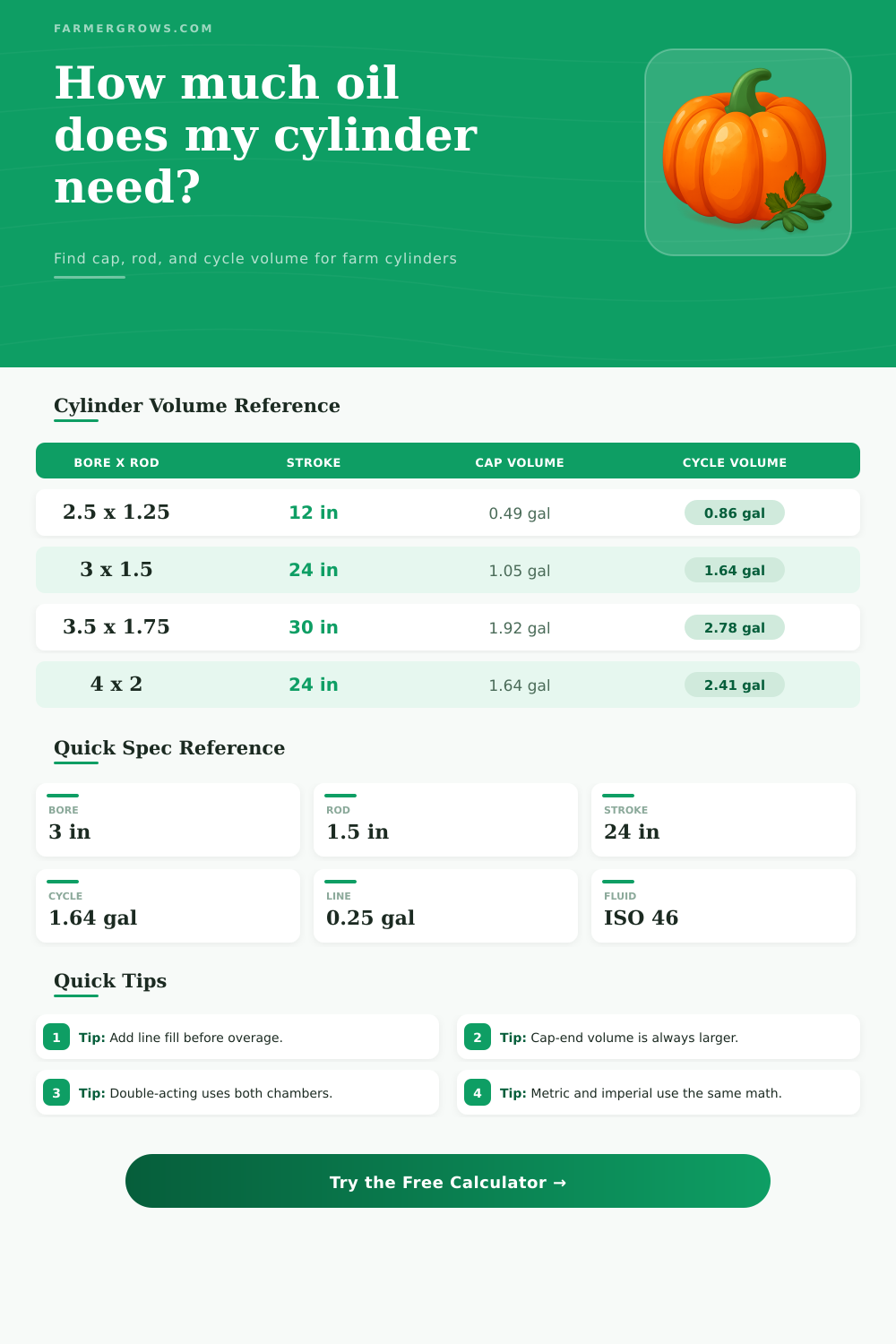
🔧 Hydraulic Cylinder Volume Calculator
Calculate cap-end, rod-end, and total fluid volume for farm cylinders
Calculated Output
| Bore x Rod | Cap in3/In | Rod in3/In | Cycle gal/In |
|---|---|---|---|
| 2.5 x 1.25 | 4.91 | 3.68 | 0.036 |
| 3 x 1.5 | 7.07 | 5.30 | 0.054 |
| 3.5 x 1.75 | 9.62 | 7.56 | 0.075 |
| 4 x 2 | 12.57 | 9.42 | 0.095 |
| Job | Size | Cycle Gal | Buffered Gal |
|---|---|---|---|
| 3 Point Hitch Lift | 3 x 1.5 x 12 | 0.52 | 0.57 |
| Compact Loader | 2.5 x 1.25 x 18 | 0.67 | 0.74 |
| Dump Trailer Hoist | 4 x 2 x 24 | 1.36 | 1.50 |
| Log Splitter | 4.5 x 2.25 x 24 | 1.95 | 2.15 |
| Volume Unit | In3 | Gallons | Liters |
|---|---|---|---|
| 1 in3 | 1 | 0.004329 | 0.01639 |
| 1 gal | 231 | 1 | 3.78541 |
| 1 L | 61.024 | 0.264172 | 1 |
| 1 ft3 | 1728 | 7.48052 | 28.3168 |
| Fluid | Lb/Gal | Kg/L | Use Note |
|---|---|---|---|
| ISO 32 | 7.25 | 0.87 | Light duty |
| ISO 46 | 7.40 | 0.89 | General use |
| ISO 68 | 7.50 | 0.90 | Warm weather |
| Bio Hydraulic | 7.30 | 0.88 | Eco fluid |
Calculating the correct amounts of hydraulic fluid for a machine is necessary because including the wrong amount of fluids could cause air bubble to form inside the hydraulic lines. If a person dont provide the correct amount of hydraulic fluid to a system, then the hydraulic cylinder may hesitate when the machine is in operation. Furthermore, these cylinder might cause additional problems for the hydraulic reservoir.
In order to avoid these problems, it is essential to calculate the specific amount of oil that each hydraulic cylinder require in order to function correct. Hydraulic cylinders are mechanical device that transform fluid pressure into movement. Furthermore, hydraulic cylinders has a piston that moves in a cylindrical bore.
How to Calculate Hydraulic Fluid Needed
The diameter of this bore determine the capacity of the cap end of the cylinder. A larger diameter will allow the cylinder to hold more fluid per stroke of the piston. Additionally, the diameter will allow the cylinder to create more force with each stroke.
The diameter of the metal rod that moves in the cylinder is smaller than the diameter of the bore. The rod takes up some of the space within the cylinder, specifically within the rod side of the piston. If you dont account for the diameter of the rod, then the volume of hydraulic fluid that the cylinder require will be calculated incorrectly.
The volume of fluid that enters and exits the cylinder during one cycle is known as the cycle volume. The stroke length of a hydraulic cylinder is the distance that the piston travels within the cylinder bore. If you multiply the area of the cylinder by the stroke length, the total volume of fluid move through the cylinder in cubic inches.
There are several different types of hydraulic cylinders. In order to calculate the proper amount of hydraulic fluid for each cylinder, it is essential to know the type of hydraulic cylinder that is being serviced. Double-acting cylinders use hydraulic fluid to move the piston both forward and backward within the cylinder.
Therefore, you must perform calculations for both the cap end and rod end of the cylinder. Single-acting cylinders use hydraulic fluid to move the piston in only one direction. The piston return to its starting position due to the use of gravity and spring mechanism.
Single-acting cylinders only require fluid to fill the cap end of the cylinder. Therefore, single-acting cylinders require less hydraulic fluid than double-acting cylinders. Additionally, there may be multiple hydraulic cylinders in a system.
In such cases, it is necessary to calculate the amount of fluid for only one cylinder, then multiply that amount by the total number of hydraulic cylinders in a system. In addition to the fluid necessary for the cylinders, you must also account for the volume of the hydraulic lines and the hydraulic system fittings. The lines are where the fluid is held.
If you dont account for the volume of the lines, there will not be enough hydraulic fluid to fill the hydraulic system. Additionally, it is a helpful idea to include a buffer to the system. For example, a buffer can account for fluid need in cases like temperature changes in the system.
If the temperature within the hydraulic system changes, the fluid within may expand or contract in size. A buffer ensures that there is enough extra hydraulic fluid to account for these change. To calculate the amount of hydraulic fluid in the system, multiply the area of the hydraulic cylinder by the length of the stroke of the cylinder.
You can convert the number of cubic inches to gallons of hydraulic fluid by dividing the number of total cubic inches by 231. There are 231 cubic inch in one gallon of fluid. To calculate the cap end of a hydraulic cylinder, multiply pi by the diameter of the bore within the hydraulic cylinder, square that value, and divide that by four.
Multiply that value by the length of the stroke. To calculate the rod end of a hydraulic cylinder, first subtract the area of the rod from the area of the bore in the hydraulic cylinder. You can then multiply that value by the length of the stroke.
For double-acting cylinders, the volume for one complete cycle is the cap end volume plus the volume for the rod end. To measure the diameter of a hydraulic cylinder, calipers are the best tool to use. Measuring the outer diameter of the cylinder will not provide an accurate measurement of the bore of that cylinder.
The stroke length of the cylinder should also be measured. For optimal result, measure the length of the cylinder when it is fully extended. Additionally, since the diameter of hydraulic hoses can vary, each hose may hold a different amount of hydraulic fluid.
Therefore, measuring the hoses will provide the necessary information to calculate an accurate allowance for the hydraulic line. If there isnt enough hydraulic fluid in the system, the hydraulic pump may experience cavitation. Cavitation can damage the hydraulic system’s component.
If there is too much hydraulic fluid for the hydraulic system, it could lead to spills of that fluid, wasting the money that was used to purchase that much fluid. Therefore, it is necessary to calculate the amount of fluid that is needed for the hydraulic cylinders, the lines, and the buffer for the hydraulic system in order to determine the total amount of hydraulic fluid that should be fill into the system.