🔧 Hydraulic Cylinder Wall Thickness Calculator
Size barrel wall thickness from bore, pressure, material strength, and practical manufacturing allowance.
Recommended cylinder wall
Uses the governing wall from thin-wall, ASME-style, and Lamé checks.
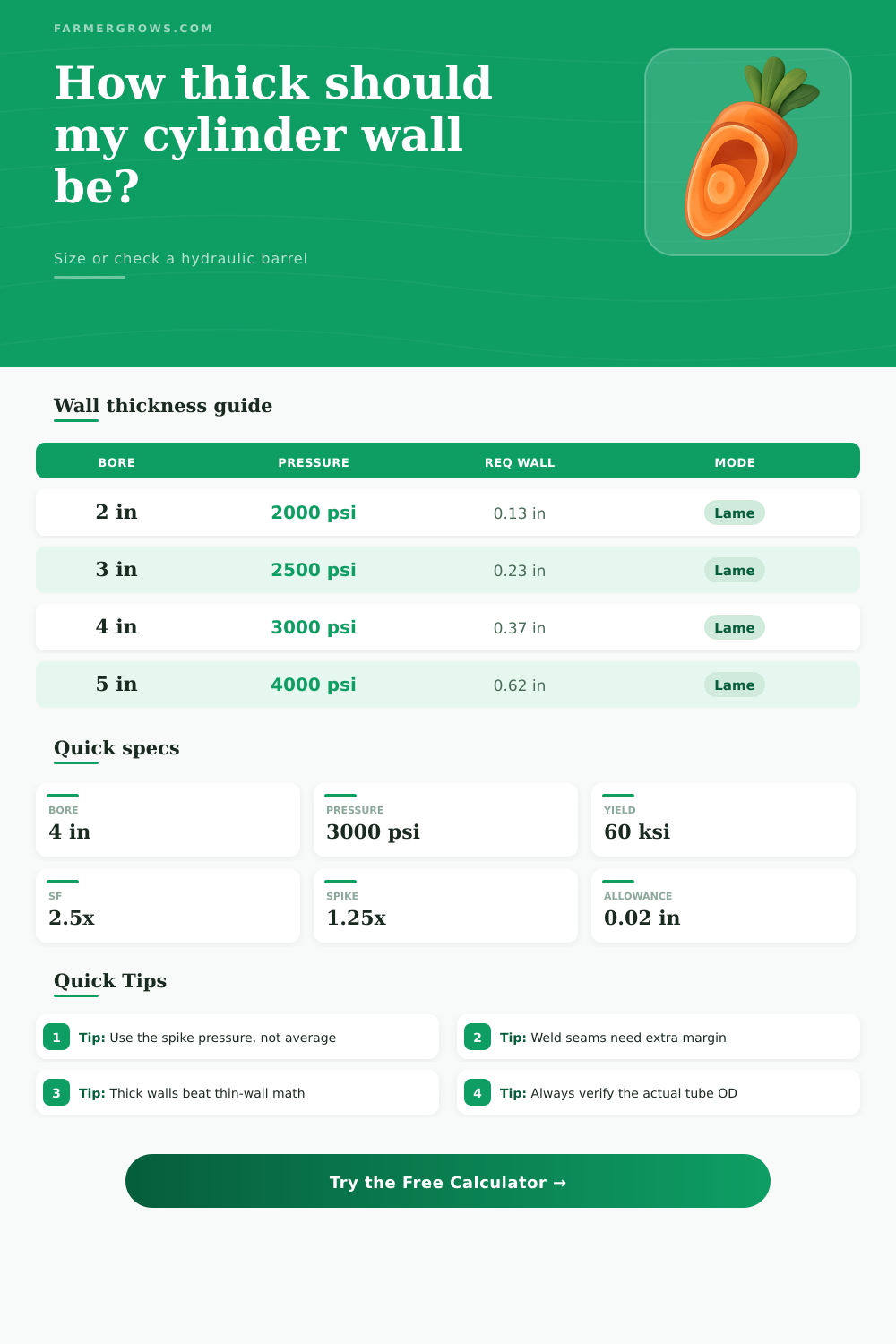
| Bore | Pressure | Required wall | Recommended OD |
|---|---|---|---|
| 2.0 in | 2000 psi | 0.13 in | 2.26 in |
| 3.0 in | 2500 psi | 0.23 in | 3.46 in |
| 4.0 in | 3000 psi | 0.37 in | 4.73 in |
| 5.0 in | 4000 psi | 0.62 in | 6.23 in |
| Grade | Yield | Density | Notes |
|---|---|---|---|
| A36 | 36 ksi | 0.283 lb/in3 | General welded steel |
| E355 | 51 ksi | 0.283 lb/in3 | Common tube option |
| 1026 DOM | 60 ksi | 0.283 lb/in3 | Strong farm cylinder tube |
| 4130 | 90 ksi | 0.283 lb/in3 | High strength choice |
| 304 SS | 30 ksi | 0.289 lb/in3 | Corrosion resistant |
| 316 SS | 29 ksi | 0.289 lb/in3 | Chemical exposure |
| t / bore | Meaning | Use case | Risk |
|---|---|---|---|
| 0.05-0.10 | Light wall | Small tube, low psi | Fatigue can bite |
| 0.10-0.15 | Moderate wall | General duty barrel | Good starting range |
| 0.15-0.20 | Common cylinder | Most farm hydraulics | Balanced weight |
| 0.20-0.30 | Heavy wall | Shock load or big bore | Check cost and mass |
| 0.30+ | Very thick | Press or severe duty | Review thick-wall math |
| Preset | Bore | Pressure | Target wall |
|---|---|---|---|
| Compact Loader | 2.5 in | 2500 psi | 0.25 in |
| Log Splitter | 4.0 in | 3000 psi | 0.37 in |
| Dump Trailer | 5.0 in | 4000 psi | 0.62 in |
| Grapple Clamp | 2.0 in | 3000 psi | 0.13 in |
A hydraulic cylinder barrels must be designed to withstand the internal pressures. The thickness of the hydraulic cylinder barrel wall is important to the hydraulic cylinder’s safety and long life. If the hydraulic cylinder should fails, it would result in the flying of the hydraulic cylinder barrel or the piston would move in an uncontrolled manner.
Therefore, it is essential to size the hydraulic cylinder barrel correctly so the hydraulic cylinder can handles the intended load. The internal pressure create stress on the hydraulic cylinder barrel walls. The stress that acts perpendicularly on the wall is referred to as hoop stress.
How to Choose the Right Hydraulic Cylinder Wall Thickness
If the wall is too thin, fatigue cracks will forms on the welds or scratches on the hydraulic cylinder barrel wall. If the hydraulic cylinder barrel wall is too thick, it will add to the weight of the hydraulic cylinder and decrease the efficiency of the hydraulic cylinder equipments. The thickness of the hydraulic cylinder barrel wall must be balanced with the peak loads of the hydraulic cylinder since the peak load will be higher than the steady load rate of the hydraulic pump.
Hydraulic systems features pressure spikes. A pressure spike occurs when the hydraulic system valve are reversed or the hydraulic system gets impacted by a clogged filter full of dirt. The hydraulic system may sit at a steady 3000 psi pressure but the pressure spike will push the pressure to 4000 psi.
The working pressure of the hydraulic cylinder must be multiplied by a spike factor to determine the thickness of the hydraulic cylinder barrel wall. Since most farm equipment features hydraulic systems that experience more pressure spikes than industrial hydraulic presses, a spike factor should be added to the working pressure of the hydraulic cylinder to provide protection for the hydraulic system. The material for the hydraulic cylinder barrel will determine the strength of the cylinder barrel.
Mild A36 steel is a common material for hydraulic cylinder barrel construction but for application with lower hydraulic pressures such as gate lift. Drawn-over-mandrel tube, also known as 1026 DOM is another very common hydraulic cylinder material because 1026 DOM metal is known for its high strength without adding to the weight of the hydraulic cylinder. Alloy 4140 metal can also be used for the hydraulic cylinder barrel but only for application with high hydraulic heat and hydraulic shock.
As an alloy, 4140 metal can degrade at high temperatures and is not often needed in most applications. Stainless steel is used in applications with exposure to corrosive elements but has a lower yield strength. As a result, the hydraulic cylinder wall will have to be thicker if stainless steel are used.
Mathematical equations can be used to calculate the required thickness of the hydraulic cylinder barrel wall. Thin-wall mathematics is used for hydraulic systems with light bores and low hydraulic pressures. However, the ASME-style equation can be used for hydraulic systems with high bore diameter or high hydraulic pressures.
The ASME-style equation accounts for the amplification of the pressure at the inner surface of the hydraulic cylinder barrel. For the heaviest of hydraulic cylinder barrel applications, Lamé’s thick-wall solution should be used to calculate the radial gradients of the hydraulic cylinder barrel wall. Once you have calculated the thickness of the hydraulic cylinder barrel wall, there must be allowance for the machining of the hydraulic cylinder barrel.
Safety factors are used as an allowance for the unknown variables in the hydraulic system such as corrosion or fatigue of the hydraulic cylinder. A safety factor of 2.5 times the yield strength of the metal of which the hydraulic cylinder is made is the standard safety factor. Using this safety factor allow for the possibility of corrosion pits on the hydraulic cylinder wall or fatigue from the millions of cycle the hydraulic cylinder may experience.
A safety factor lower than 2 times the yield strength of the metal should not be used in the design of the hydraulic cylinder. For equipment that may experience unpredictable pulling or yanking forces, such as grapples or booms on excavators, use a safety factor of 3 times the yield strength of the metal. The wall ratio of a hydraulic cylinder indicates the thickness of the hydraulic cylinder barrel.
The ratio is calculated by dividing the thickness of the wall by the diameter of the bore of the hydraulic cylinder. For most general-duty application, the ratio should be between 0.10 and 0.15. A ratio of the wall thickness lower than 0.10 indicates a risk of fatigue of the hydraulic cylinder barrel.
A wall ratio higher than 0.20 is used for heavy-duty application but adds to the mass of the hydraulic cylinder. When machining the hydraulic cylinder barrel, there should be an allowance for the honing process of the hydraulic cylinder barrel. There should be an allowance of approximately 0.020 inches of material to be honed to the proper finish for the piston to run within the cylinder.
The outside diameter and the wall thickness of the hydraulic cylinder barrel stock tube must be measured with a micrometer to determine the actual dimension of the hydraulic cylinder. The margin multiplier for the hydraulic cylinder barrel should be at least 1.5 times the calculated value. If the margin for the hydraulic cylinder barrel is lower than 1.5 times the calculated value, then another tube should be used for the hydraulic cylinder.
There are many causes of hydraulic cylinder barrel failure. A hydraulic pressure spike will split the hydraulic cylinder barrel if ignored. Welded pipe used for hydraulic cylinder manufacture can fail at the seam if the hydraulic cylinder barrel wall is too thin.
The millions of cycle that a hydraulic cylinder performs can cause fatigue at the wall of the hydraulic cylinder even if the burst strength is met. Corrosion from road salt can degrade the yield strength of the hydraulic cylinder barrel steel. The weight of the hydraulic cylinder can add to the mass of the system such that the rod may bend or the seal may fail.
It is essential to find the proper balance between the thickness of the hydraulic cylinder barrel wall to the duty cycle of the machinery in which the hydraulic cylinder is installed. Its important to find the right balance based off the duty cycle of the machinery. Youll need to be carefull with how you choose the materials.
The cylinder wall thickness is vital, and it wouldnt be right to skip a step. If you dont calculate it right, things will dissapear into thin air. Most people think they can just use any steel but they should of checked the specs first.
The moddern systems requires more precision. Actually, it is alot harder than it looks.