💧 Hydraulic Ram Pump Calculator
Estimate delivered water, waste flow, pressure, and pipe losses for off-grid ram pump systems
📊 Pump Output Results
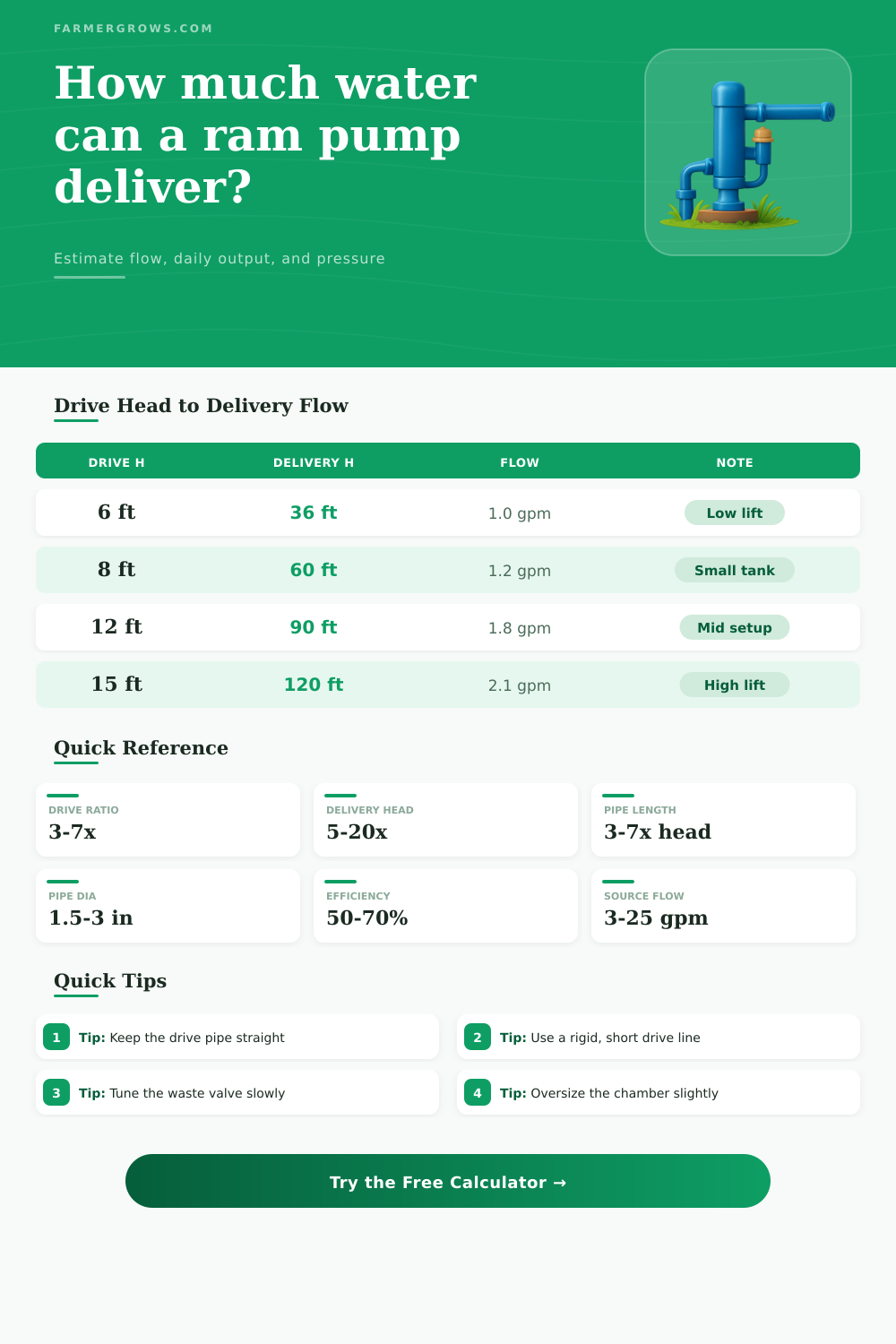
| Drive Head | Delivery Head | Expected Flow | Use Case |
|---|---|---|---|
| 4-6 ft | 30-50 ft | 0.4-1.0 gpm | Small tank |
| 6-8 ft | 50-80 ft | 0.8-1.5 gpm | Garden feed |
| 8-12 ft | 80-120 ft | 1.2-2.2 gpm | Livestock |
| 12-18 ft | 120-180 ft | 1.8-3.5 gpm | Long lift |
| 18-24 ft | 180-240 ft | 3.0-5.0 gpm | Higher head |
| Drive Head | Min Length | Ideal Range | Comment |
|---|---|---|---|
| 4 ft | 12 ft | 16-24 ft | Short line |
| 6 ft | 18 ft | 24-36 ft | Common setup |
| 8 ft | 24 ft | 32-48 ft | Good pulse |
| 12 ft | 36 ft | 48-72 ft | Steadier flow |
| 16 ft | 48 ft | 64-96 ft | Longer run |
| Pipe Dia. | Source Flow | Velocity | Material Hint |
|---|---|---|---|
| 1.5 in | 2-5 gpm | 3-5 ft/s | PVC or steel |
| 2.0 in | 5-10 gpm | 3-5 ft/s | Steel/HDPE |
| 2.5 in | 8-16 gpm | 3-5 ft/s | HDPE |
| 3.0 in | 12-25 gpm | 3-5 ft/s | Steel/iron |
| 4.0 in | 20-40 gpm | 3-5 ft/s | Large run |
| Project | Drive / Lift | Source Flow | Daily Output |
|---|---|---|---|
| Orchard tank | 6 ft / 40 ft | 6 gpm | 800-1,100 gal |
| Livestock tank | 8 ft / 65 ft | 10 gpm | 1,000-1,500 gal |
| Cabin cistern | 12 ft / 90 ft | 14 gpm | 1,800-2,700 gal |
| Nursery line | 10 ft / 110 ft | 18 gpm | 2,200-3,600 gal |
| Hill farm lift | 15 ft / 140 ft | 20 gpm | 2,800-4,200 gal |
A hydraulic ram pump is an device that use the energy of the falling waters to move the water to a higher elevation. The pump dont use electricity or fuels because it rely upon the momentum of the water and the force of gravity to function. A hydraulic ram pump use a series of components, including a check valve, a waste valve, and a pressure chamber.
The water from the water source travels down the drive pipe and gain speed as the water falls. When the waste valve slams against the waste pipe, the water is suddenly stop. This sudden stop to the water create a water hammer that push against the delivery valve, forcing it to open so that some of the water can be pushed up to the delivery tank.
How a hydraulic ram pump works
Most of the water exit through the waste valve; the portion of the water that entered the pressure chamber is the portion delivered to the higher elevation. The drive head represent the vertical distance between the water source and the hydraulic ram pump. This distance is critical to the operation of the pump.
If the vertical distance is too low, such as being under four foot, the water will not have enough energy to create a strongly water hammer. Six feet are the minimum distance many find works best for the water to create a strong enough water hammer to power the pump. The delivery head is the vertical distance between the hydraulic ram pump and the delivery tank.
This distance should be much higher then the drive head. The goal is for the delivery head to be between five and twenty times the size of the drive head. A delivery head that high will ensure the pump work correctly.
For instance, if the drive head is six feet, a delivery head of forty feet will work best. The source flows is the amount of water that comes out of the stream that feed into the hydraulic ram pump. There has to be at least enough water in the source flow to power the hydraulic ram pump.
The flow should be at least three to twenty-five gallon per minute while traveling at a velocity of three to five feet per second. The drive pipe is the pipe that carry the water from the drive head to the hydraulic ram pump. The diameter and the length of the drive pipe play a crucial role in determine the momentum that the water has before it reach the hydraulic ram pump.
For the ideal diameter of the drive pipe, it should be between one-and-a-half and three inch in diameter. Additionally, the material for the drive pipe should be steel or high density polyethylene since they are rigid materials. Using flexible hose for the drive pipe will allow the drive pipe to flex and waste some of the energy of the system.
The ideal length for the drive pipe is between three and seven times the length of the drive head. Using a drive pipe that is too short will cause the water to not accelerate enough to create momentum, while using a drive pipe that is too long will waste energy as the water travels down the drive pipe due to friction. Friction is another factor that will reduce the efficiency of the hydraulic ram pump.
Friction occur when the water rubs against the inside of the pipes. Using a pipe with a smoother surface will allow the water to experience less friction. For example, using PVC pipe will create less friction than using galvanized steel pipe.
The pressure chamber of the hydraulic ram pump store the pressure spike created by the water in order to provide a steady delivery of water. The size of the pressure chamber should be between four and twenty-four gallon depending on the flow that the hydraulic ram pump is to deliver. The efficiency of a hydraulic ram pump is typically between fifty and seventy percent.
This percentage represent the amount of water that is lost through the waste valve. Additionally, because hydraulic ram pumps operate continuously, they can fill large tank over a twenty-four-hour period. In order to guarantee that the hydraulic ram pump performs correctly, there are some mistake that should of been avoided when setting up the system.
For example, putting bend in the drive pipe will scatter the momentum of the water. Additionally, using soft hose for the drive pipe will allow the drive pipe to flex which waste some of the systems energy. Another mistake to avoid is tuning the waste valve incorrectly.
Tuning the waste valve too quickly will cause the hydraulic system to stutter in its operations. Tuning the waste valve too slowly will waste some of the systems water. It is also important to ensure that the flow of water that come from the hydraulic ram pump is sufficient for the need of the system.
If the flow of water from the source is too low, the hydraulic ram pump will starve of water. Additionally, air vent should be installed in the delivery line. Air vent allow air bubbles to exit from the delivery line of the hydraulic ram pump.
If air vent are not installed, these air bubble will prevent water from moving through the system.