Hydraulic Cylinder Force Calculator
Compare extend force, retract force, pressure demand, and load margin from one clean setup.
⚙ Inputs
📈 Results
📋 Cylinder spec grid
📊 Reference tables
| Bore | Area | 3000 psi | 4000 psi |
|---|---|---|---|
| 2.0 in | 3.14 sq in | 4.7 ton | 6.3 ton |
| 3.0 in | 7.07 sq in | 10.6 ton | 14.1 ton |
| 4.0 in | 12.57 sq in | 18.9 ton | 25.1 ton |
| 6.0 in | 28.27 sq in | 42.4 ton | 56.5 ton |
| 8.0 in | 50.27 sq in | 75.4 ton | 100.5 ton |
| Bore | 4 in stroke | 8 in stroke | 12 in stroke |
|---|---|---|---|
| 2.0 in | 0.05 gal | 0.11 gal | 0.16 gal |
| 3.0 in | 0.12 gal | 0.24 gal | 0.37 gal |
| 4.0 in | 0.22 gal | 0.44 gal | 0.65 gal |
| 6.0 in | 0.49 gal | 0.98 gal | 1.47 gal |
| 8.0 in | 0.87 gal | 1.74 gal | 2.61 gal |
| PSI | Bar | 4 in bore | 8 in bore |
|---|---|---|---|
| 1500 | 103.4 | 9.4 ton | 37.7 ton |
| 2500 | 172.4 | 15.7 ton | 62.8 ton |
| 3000 | 206.8 | 18.9 ton | 75.4 ton |
| 4000 | 275.8 | 25.1 ton | 100.5 ton |
| Setup | Bore | Pressure | Stroke |
|---|---|---|---|
| Compact Loader | 2.6 in | 2500 psi | 6 in |
| Dump Bed Pair | 4.1 in | 3000 psi | 8 in |
| Heavy Lift Ram | 6.0 in | 4000 psi | 12 in |
| Dual Cylinder Pair | 6.0 x 2 | 4000 psi | 14 in |
💡 Practical tips
Hydraulic cylinders is a machine that can transform fluid pressure into linear force. Furthermore, the hydraulic cylinder can provide either a pushing force or a pulling force, depending upon the ways in which the user is to use the hydraulic cylinder. Hydraulic cylinders can be used to perform small tasks, like splitting a log, as well as for large tasks, like operating excavator bucket.
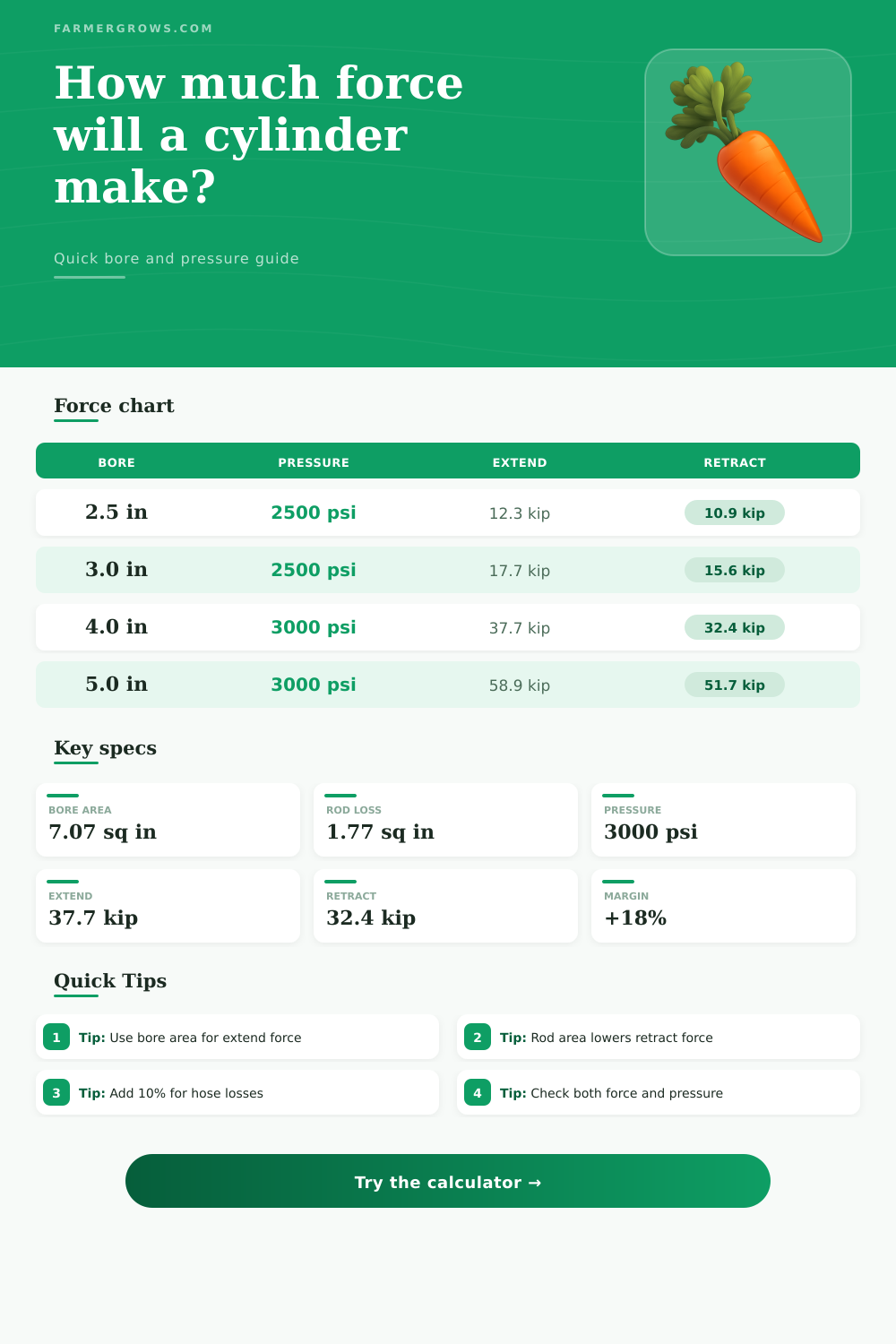
Using a hydraulic cylinder that is too small for the task will not be able to provide the necessary force to accomplish the task. Using a hydraulic cylinder that is too large for the task will cost more money then is necessary for the project. The force that a hydraulic cylinder creates, you can calculate by multiplying the pressure of the hydraulic fluid by the area over which that pressure is exerted.
How to Choose the Right Size Hydraulic Cylinder
The area over which the fluid pressure is exerted upon the piston is the full area when the piston is extending, but is smaller when the piston is retracting due to the presence of the rod. Therefore, the force that is created when the piston is retracting is always less than the force that is created when the piston is extending. Some of the force that is created in the hydraulic system is lost to friction in the seals and hose that move the hydraulic fluid, as well as lost to the heat that is created within the hydraulic fluid.
Thus, the actual force that the hydraulic cylinder creates is less than the theoretical force that an equation calculates. When designing a hydraulic system, there are a few factors to consider. One of the factors to consider is the load that the hydraulic system is to create; the target load.
Another of the factors to consider is the working pressure, or the maximum pressure that the pump and valves can provide without damaging the seals within the hydraulic system. The bore diameter of the cylinder will determine the area of the piston, meaning that a larger diameter will allow for more force to be created by the cylinder. However, larger bores will also make the cylinder heavier, as well as requiring more oil within the system.
The size of the rod will impact the retracting force of the hydraulic cylinder, as well as the stability of the cylinder in relation to potential buckling of the rod. The stroke length will impact how far the piston can move within the cylinder. Finally, the flow rate of the fluid from the pump will impact the speed at which the hydraulic cylinders perform its task.
The efficiency of the hydraulic system is another factor in the design that must be accounted for. A new system will be more efficient than an older system that may contain dirty oil and worn component. Furthermore, a hydraulic system needs to account for 10 to 20 percent margin of safety in its calculations for the same reasons that efficiency must be accounted for; to ensure that the hydraulic cylinder has enough force to perform the task that is designed for it.
Any less force will cause the hydraulic cylinder to fail in its tasks. Additionally, the hydraulic cylinder should of been designed to avoid side loads upon the rod of the cylinder. To maintain a hydraulic cylinder, the filters should be cleaned every quarter, the oil should be checked for water, the cylinders should be cycled without a load every week to ensure that the seals are properly lubricate, and the oil should be checked to ensure that it is the proper temperature.
Cold hydraulic oil is thick, while hot hydraulic oil is thin. Oil that is too thick will reduce the efficiency of the hydraulic system, but oil that is too thin may lead to hydraulic fluid leaking past the seals. Finally, to reduce the cost of the hydraulic cylinder, any custom specifications of the cylinder should be avoided in favor of the specifications listed in the manufacturer catalogs for standard stroke lengths of the cylinders and rod buckling charts.
The cylinders size and rod buckling charts is important. You’re going to need to recieve the parts from the supplier first. Its important to check everything.
Actualy, the moddern cylinders is very complex. You shouldnt use teh wrong oil. Dont forget to check the cylinders length too.
One of the most common mistake is to use a cylinder that is too small. Using a hydraulic cylinder that is too small for the task will not be able to provide the necessary force to accomplish the task. Using a hydraulic cylinder that is too large for the task will cost more money then is necessary for the project.