🌾 Bale Grazing Calculator
Estimate bale needs, winter feed days, waste-adjusted supply, and area spacing so each feeding move stays deliberate.
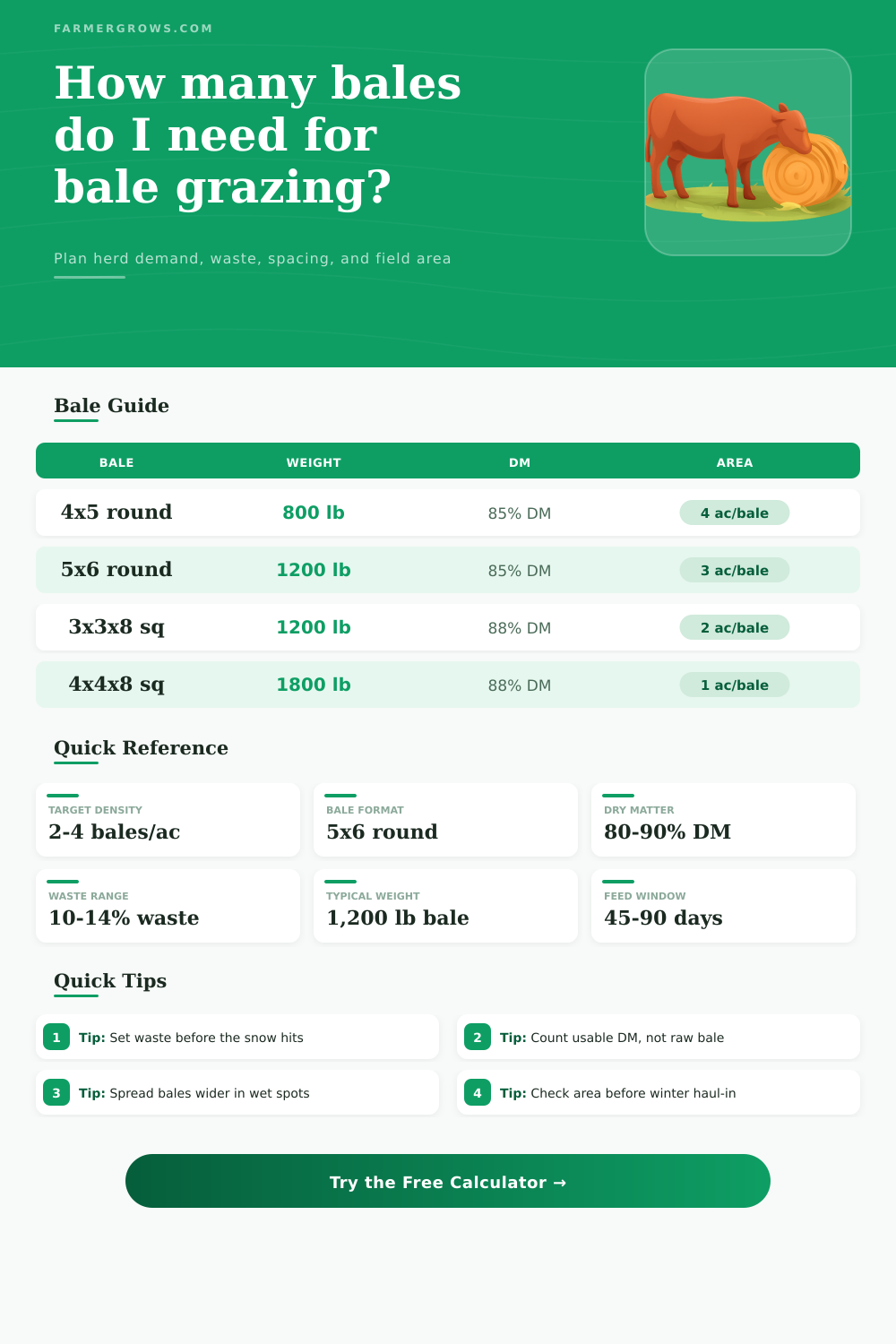
| Bale format | Typical weight | Dry matter | Use case |
|---|---|---|---|
| Round 4x5 | 800 lb | 85% | Small herd |
| Round 5x6 | 1200 lb | 85% | Common size |
| Square 3x3x8 | 1200 lb | 88% | Tight rows |
| Square 4x4x8 | 1800 lb | 88% | Heavy feed |
| Livestock class | Weight | DMI | Daily DM |
|---|---|---|---|
| Beef cow | 1200 lb | 2.5% | 30 lb/day |
| Stocker | 700 lb | 3.0% | 21 lb/day |
| Ewe | 150 lb | 4.0% | 6 lb/day |
| Goat | 120 lb | 3.5% | 4.2 lb/day |
| Density | Acres/bale | Spacing | Field use |
|---|---|---|---|
| 2/ac | 0.50 ac | 148 ft | Broad spread |
| 4/ac | 0.25 ac | 104 ft | Moderate |
| 6/ac | 0.17 ac | 85 ft | Common |
| 8/ac | 0.13 ac | 74 ft | Tight |
| Setup | Days | Bales | Area @ 6/ac |
|---|---|---|---|
| 30 cows | 30 | 30 | 5 ac |
| 60 cows | 45 | 89 | 15 ac |
| 100 cows | 60 | 197 | 33 ac |
| 150 cows | 90 | 442 | 74 ac |
Bale grazing is a method of feeding livestock by placing hay bales in a field for the animals to eat. Farmers uses bale grazing to provide feed for there herd during the winter months. Furthermore, farmers use this feeding strategy to manage their livestocks access to food.
To implement bale grazing, farmers must place hay bales in specific patterns in the field and move the fences that contain the livestock once the animals have finished eating a specific bale of hay. Bale grazing can save farmers labor to transport hay to the livestock feeders. However, another benefit of bale grazing is that the manure from the livestock fertilize the pasture land.
How to Plan Bale Grazing
However, if farmers plan the feeding strategy incorrectly, there can be a shortage in the hay supply for the livestock or the animals can destroy the pasture land. To plan bale grazing, farmers must calculate the total amount of feed there herd will require. The size of the herd and the daily appetite of the livestock must be considered when calculating the total amount of hay that will be needed for the winter months.
For example, beef cows will eat approximately 2.5% of their body weight in dry matter each day. A beef cow that weighs 1200 pounds will eat approximately 30 pounds of dry matter each day. By multiplying the amount of dry matter that one animal will eat each day by the number of animals in the herd and the number of days that the herd will need to be fed, the farmer can calculate the total amount of dry feed that is required.
The percentage of dry matter in hay is approximately 85%. Furthermore, additional feed will have to be accounted for in the calculation to provide for the moisture content in hay and waste that will be created due to the weather and movement of the livestock. The density of hay bales that are placed into the pasture determines how quickly the livestock will consume the hay.
The density can range from two to eight hay bales per acre. The placement of hay bales within a pasture can be based off the feeding needs of the livestock. If many hay bales are to be placed within a small area, it will allow the livestock to finish eating the hay more quickly.
This is often used in pastures where the snow is deep and the animals has difficulties moving to other hay bales. Placing hay bales further apart allows the manure to remain on the pasture land to fertilize the pastures grass. However, more land will be required if hay is to be placed in a larger spacing.
Placing hay bales too close together will lead to overgrazing of specific areas of the pasture. Furthermore, if the hay bales are too far apart from the herds weakest members, those animals will not be able to access the hay. Waste of hay can occur if the hay is eaten or destroyed without providing nutritional value to the livestock.
If hay feeders are used, the amount of hay that is wasted will be low. However, hay feeders will require the labor of the farmer to place the livestock into the feeders each day. If hay bales are dropped directly into the snow, the hay will be exposed to the elements such as snow and hooves that will destroy the hay.
The weight of the livestock must also be considered when calculating the amount of hay that will be wasted and the amount of hay that will be required for the pasture. For example, stocker animals will weigh less than beef cows and will eat a higher percentage of their body weight as feed. The shape of the pasture will impact the calculation of the area that will be covered in hay bales.
Many pastures are rectangular in shape. However, some pastures have triangular or even circular fields. The total acreage of the pasture must be known to calculate the total number of hay bales that will be required to feed the pasture for the winter months.
The acreage can be converted from imperial to metric measurements. Preset herd sizes can also be used to calculate the total amount of hay that is required for the winter months. However, these presets can be adjusted according to the snow depth in which the fields will be covered.
The equipment that will be used includes poly wire to build fences to contain the livestock to different areas of the pasture. A tank can also be used for the animals to avoid churning up the mud on the pasture land. A loader will be used to place the hay bales into the pasture.
However, hay bales must be carefully placed such that the hay is not torn. Different sizes of hay bales are available, including 4-by-5 bale sizes and 5-by-6 bale sizes to consider when planning the pasture. Inventory checks will allow the farmer to ensure that the bale grazing strategy is operating as it should.
If the inventory shows that there are more days of hay than were calculated for the winter months, the farmer will have a buffer in case of storms that destroy the hay supply. If the inventory indicates that there will not be enough hay to feed the livestock for the winter, the farmer will have to purchase hay or the density of the hay bales can be changed. If there is a surplus of pasture land, that area can be used for rotational grazing where the grass has time to regrow.
Bale grazing can be managed in such a way to improve the soil health in which the pasture is established rather than creating damage to that pasture land. An essential part of bale grazing is the observation of the behavior and environment of the pasture. The behavior of the herd must be watched to ensure that the dominant herd animals do not prevent the weaker herd members from gaining access to the hay bales.
The depth of the snow in the pasture fields must also be checked. If the depth is too great, the hay bales may be unable to reach the hay. If the density of hay bales is managed correctly, the manure will fertilize the pasture fields.
The hay bales that are left behind will feed the microbes in the pasture soil. By planning the bale grazing strategy correctly, farmers will be able to ensure that there livestock are fed and the pastures remain healthy for the upcoming growing season.