🌱 Canola Seed Rate Calculator
Turn canola target stand, TKW, row spacing, and field area into a precise seeding rate in kg/ha, lb/ac, and total seed.
✅ Canola Seed Rate Results
Enter your values and click calculate.
Canola Rate Guide at Common Stands
These estimates assume a standard drill, about 95% germination, 85% emergence, 99% purity, and a 10% buffer.
| Stand | 3.5 g | 4.0 g | 5.0 g |
|---|---|---|---|
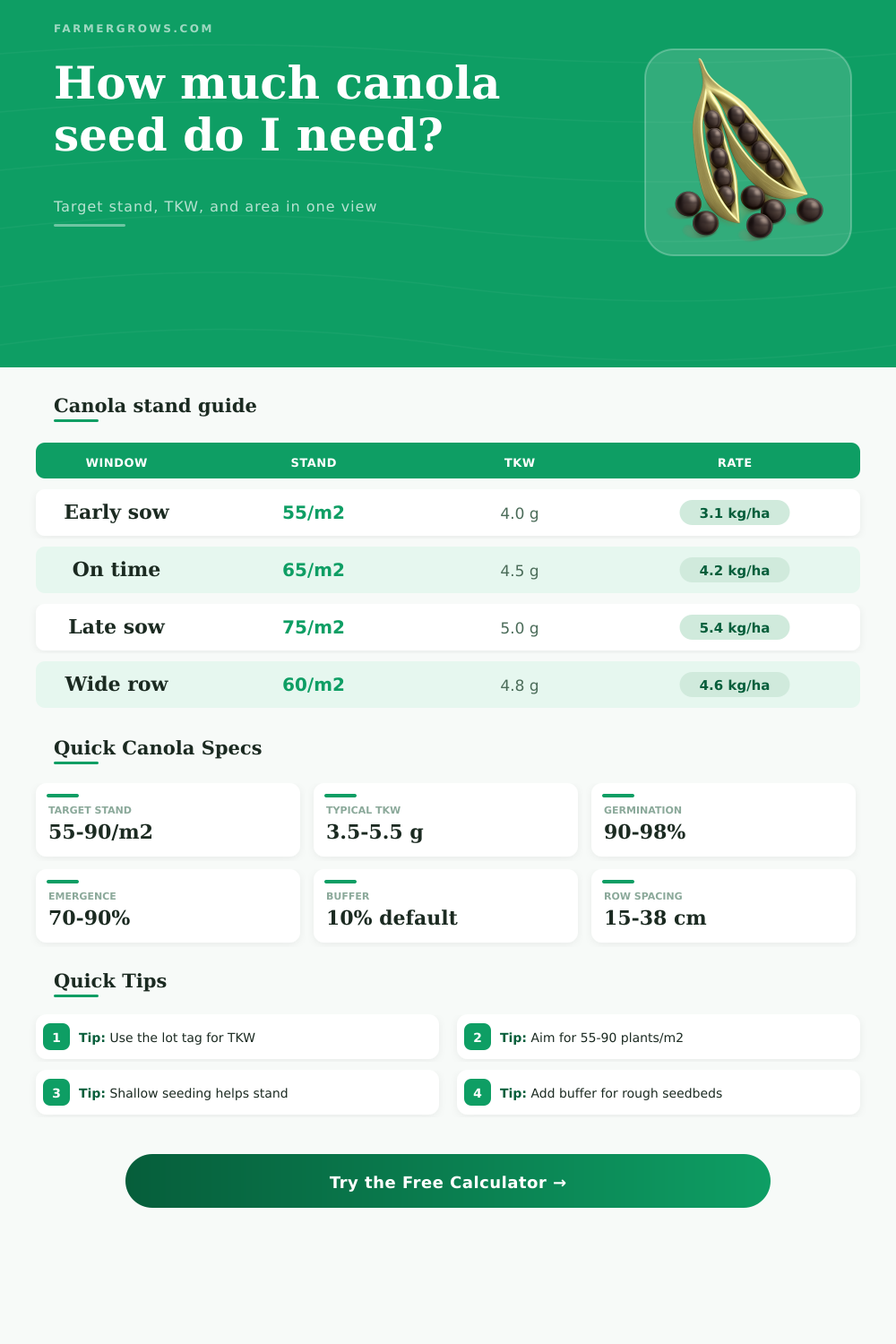
| 55 plants/m² | 2.4 kg/ha | 3.1 kg/ha | 3.8 kg/ha |
| 65 plants/m² | 2.8 kg/ha | 3.6 kg/ha | 4.4 kg/ha |
| 75 plants/m² | 3.2 kg/ha | 4.1 kg/ha | 5.0 kg/ha |
| 85 plants/m² | 3.6 kg/ha | 4.6 kg/ha | 5.7 kg/ha |
Canola Seed Size and Seed Count
TKW controls how many seeds fit in each kilogram or pound, which is why small seed lots often drill lighter rates.
| TKW | Seeds/kg | Seeds/lb | Note |
|---|---|---|---|
| 3.5 g | 285,714 | 129,730 | Small |
| 4.0 g | 250,000 | 113,398 | Base |
| 4.5 g | 222,222 | 100,898 | Common |
| 5.5 g | 181,818 | 82,471 | Large |
Row Spacing and In-Row Seed Gap
This table uses a 60 plants/m² target and shows how spacing changes the number of seeds needed along each row.
| Spacing | Seeds/m | Seeds/ft | Gap |
|---|---|---|---|
| 15 cm | 9.0 | 2.7 | 11.1 cm |
| 20 cm | 12.0 | 3.7 | 8.3 cm |
| 30 cm | 18.0 | 5.5 | 5.6 cm |
| 38 cm | 22.8 | 6.9 | 4.4 cm |
Establishment and Buffer Guide
Canola performs best with firm seed contact and enough moisture to avoid crusting and uneven emergence.
| Field | Spacing | Buffer | Note |
|---|---|---|---|
| Firm moist | 1.0-1.5 cm | 0-5% | Best start |
| Normal seedbed | 1.5-2.0 cm | 5-10% | Common |
| Dry topsoil | 2.0 cm | 10-15% | Use care |
| Cloddy/no-till | 1.0-1.5 cm | 15-20% | Watch contact |
To calculate the canola seeding rate for a field, it is necesary to consider several factor that may play a role in the final rate. Factors to consider before calculating the canola seeding rate include plant density, thousand-seed weight, germination rate, emergence rates, and purity. Additionally, factors related to how the canola seeds is to be planted in the fields, such as soil contact and row spacing, will also affect the seeding rate.
Finally, other factors related to the establishment of canola plant in the fields will impact the seeding rate, as will additional factors related to the field condition. The first factor to consider is the plant density that is to be targeted within the fields. The target plant density for canola fields is between 55 and 90 plants per square meter.
How to Calculate Canola Seeding Rate
The target plant density will change based on the time of planting of the canola seeds. For example, early planting will result in plants that branch more, so fewer plants will need to be planted into the fields compared than late planting dates. The target plant density will be translated into the thousand-seed weight of the canola seeds that are to be planted.
Thousand-seed weight is the weight of 1,000 canola seeds of a specific lot of canola seeds. Thousand-seed weight will range between 3.5 and 5.5 grams per 1,000 seeds. If the thousand-seed weight of the canola seeds that are to be planted is low, a lower weight of the seeds will be required to achieve the target plant density.
However, if the thousand-seed weight is high, a higher weight of the seeds will be required to achieve that same target plant density. Thousand-seed weight can be found on the canola seed tag. In addition to considering thousand-seed weight, other factors related to the emergence of canola plants from the seeds will impact the seeding rate.
Germination rates are the percentage of the sown canola seeds that will sprout under ideal conditions in a laboratory. However, emergence rates are the percentage of the sown canola seeds that germinate but actualy push through the soil in the fields. Emergence rates will always be lower than germination rates due to soil crusts and other environmental factors in the fields.
Lastly, the purity of the canola seeds will impact the emergence rates. Purity is the percentage of the sown canola seeds that are actual canola seeds. The pure live seed rate is calculated as the germination rate times the emergence rate times the purity rate.
Other factors related to how the canola seeds are to be planted will impact the seeding rates. If the fields are to be shallowly seeded at a depth of 1 to 2 centimeters, this may be to aid in the emergence of the canola plants when the soil is cool and moist. However, deep seeding of the canola seeds in no-till fields will cause the seeds to rot.
Additionally, the rate at which the rows of canola plants are to be spaced will also impact the seeding rate. For example, if narrow rows of 15 centimeters are to be used, the plants will be more closely spaced than if wide rows of 38 centimeters are used. The rate at which the canola seeds are to be planted will need to be adjusted according to row spacing.
Other factors related to the establishment of the canola plants in the fields will also impact the seeding rates. An overage buffer of the calculated rate may be needed to account for skipped and overlapping of the planted canola seeds. For instance, a 10 percent overage buffer may be used for planter drills, but a 20 percent overage buffer may be needed for broadcasting seeds or rough fields.
Air seeders may require a different overage buffer than precision drills. Factors related to the establishment of canola plants, such as emergence rates, will compound when calculating the seeding rates. For instance, if the target plant density is 60 plants per square meter, but establishment rates are only 83 percent, there will not be enough plants to reach the target.
In this scenario, 20 percent more canola seeds would be required to achieve the target plant density. The additional percentage will change based on the thousand-seed weight of the canola seeds. Heavier seeds will require different amounts of mass to be planted to achieve the target plant density compared with lighter seeds.
Additional factors related to the fields in which the canola plants are to be grown will also impact the required canola seeding rates. For example, canola plants that are to be planted early in the growing season will branch more, so fewer plants will be required to be planted into the fields. Additionally, in arid environments, the plant density may be lower at 60 plants per square meter because of competition for moisture.
If the fields contain heavy amounts of crop residue or experience drought conditions, emergence rates will be lower. Additionally, other factors such as flea beetle infestations will eliminate some of the canola plants from being established in those fields. Therefore, an overage buffer will need to be increased for these situations.
Finally, another factor that will impact the seeding rates is the need to calibrate the seed drills that are to be used in planting the fields. To calibrate the drill, the seed drill can be tested on a concrete area to determine the number of canola seeds that the drill drops over a distance of 100 meters. Based on the number of canola seeds per meter of row, the operator can adjust the plates of the drill.
The canola seeds may also be planted into the furrow to ensure that the rate at which the canola seeds are planted is placed into the field at the calculated rate.