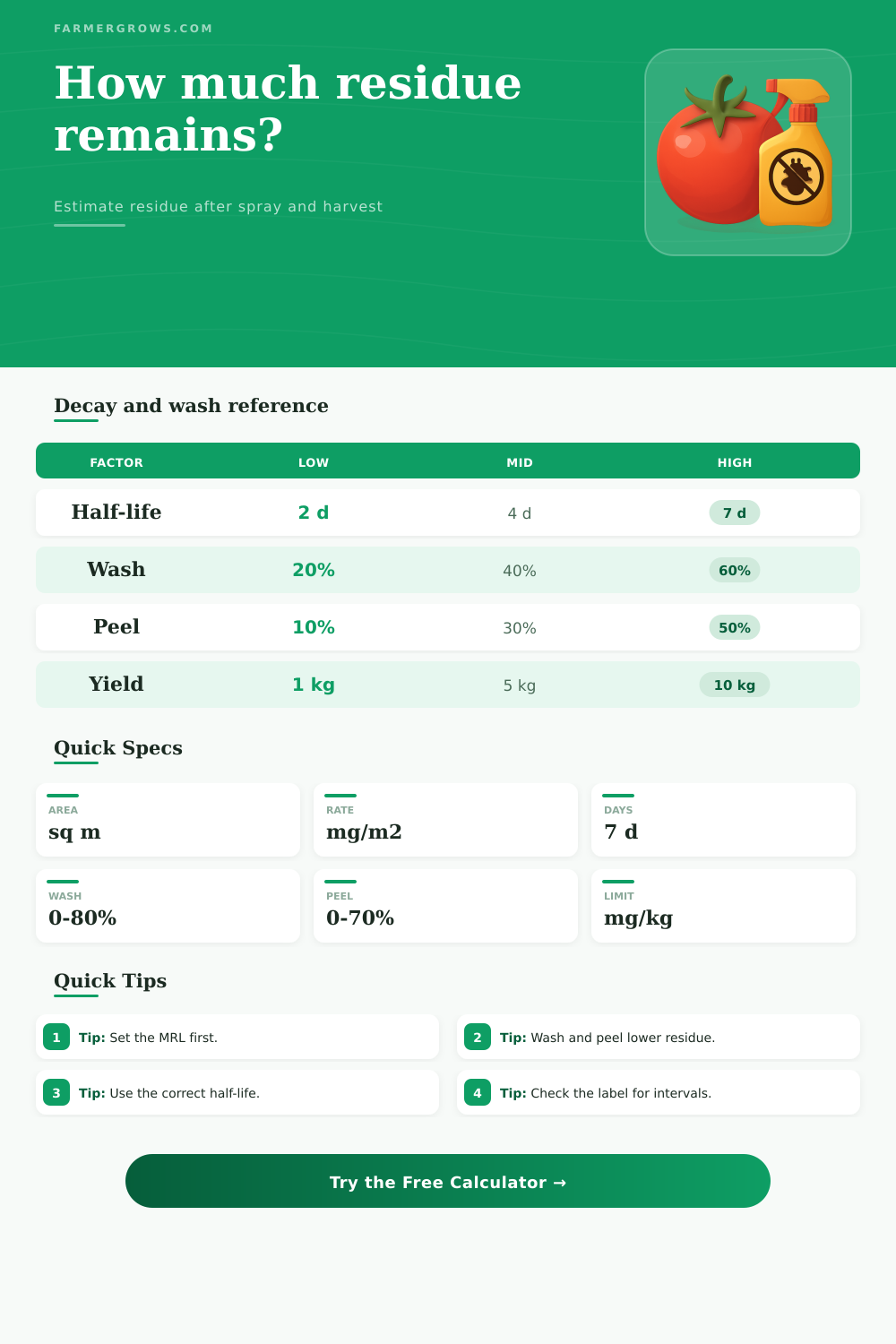
Pesticide Residue Calculator
Estimate what remains after decay, wash, peel, and crop mass checks.
Unit system and presets
Treated area setup
Residue inputs
Calculation breakdown
Reference grid
These grids keep the model grounded in simple assumptions so the output stays easy to audit.
| Half-life | Day 3 | Day 7 | Day 14 |
|---|---|---|---|
| 2 d | 35% | 8% | 1% |
| 4 d | 59% | 30% | 12% |
| 7 d | 74% | 50% | 25% |
| 10 d | 81% | 62% | 38% |
| Step | Low | Mid | High |
|---|---|---|---|
| Wash | 10% | 40% | 70% |
| Soak | 15% | 35% | 55% |
| Brush | 5% | 20% | 35% |
| Peel | 10% | 30% | 60% |
| Crop set | Area | Yield | MRL |
|---|---|---|---|
| Leafy bed | 18x24 ft | 2.6 kg/m2 | 0.50 |
| Tomato row | 10x45 ft | 3.8 kg/m2 | 1.00 |
| Berry patch | 28 ft dia | 1.9 kg/m2 | 0.20 |
| Orchard block | 80x100 ft | 4.2 kg/m2 | 0.10 |
Enter the MRL you actually need to compare against, not a guessed default.
Wash and peel reductions compound, so small changes can move the result a lot.
Residue management is a process that involves finding the balance between the number of day that have passed since the chemical spray, the technique that is used to clean the chemical residue from the crops, and the legal threshold for chemical residue that are allowed within a certain crop. The amount of chemical residue that are remaining on the crops needs to be calculate in order to determine whether or not the crops are safe to be distributed to the markets. Many growers use tool to calculate the chemical residue on their crops, as performing the calculations by hand can be difficult and can lead to error in those calculations.
Chemical residue do not remain at a constant level on the crops after application. The chemical residue will break down over time. The length of time that it takes for half of the chemical residue to dissapear from the crops is referred to as the half-life of that chemical.
How to Calculate and Manage Chemical Residue on Crops
Factors like sunlight and moisture can impact the rate at which the chemical residue break down; these factor will impact the half-life of that chemical residue. Some chemicals are applied as contact sprays, which remain on the surface of the leaves. Other chemicals are applied as systemic sprays, which the crops absorb.
Systemic sprays may be more difficult to wash off of the plants than contact sprays, as the systemic sprays interact with the plants bodies. Another factor to consider in the calculation of chemical residue on the crops is the surface area of the crops. The area of the crop canopy must be measured, as that is the part of the plant that will be sprayed with the chemical.
If the area of the canopy is not measured correctly, the calculation of the chemical residue will not be accurate. Related to the area of the canopy is the initial load of chemical that was used to spray the crops, and the capture rate of that chemical by the edible parts of the crop. Drift and runoff of the chemical can impact the capture rate, both of which will reduce the amount of chemical residue that is capture by the edible parts of those crops.
Another factor that will impact chemical residue is the number of days that have passed since the initial spray of the chemical. The more days that pass, the less chemical residue will remain on the crops. For instance, if the chemical has a two-day half-life, after three days there will be 35% of the initial chemical residue remaining on the crops.
After 14 days, only 1% of that initial chemical residue will be remaining on the crops. Additionally, washing and peeling the crops can further reduce chemical residue. Washing can remove a certain percentage of the chemical residue from the crops, and similarly, peeling the crops can remove that same percentage of chemical residue from the skin of the fruit.
These two processes are multiplicative with relation to the decay rate of the chemical; they can be added to the decay rate to determine the amount of chemical residue that will remain on the crops. Another factor to consider is the yield density of the crops. Because chemical residue concentration is measured in milligrams of chemical per kilogram of the crop, the more higher the yield density of the crops, the more diluted the chemical residue will be within the crops.
Conversely, the lower the yield density of the crops, the more concentrated the chemical residue will be within the crops. The chemical residue must always be calculated in relation to concentration, and the calculated concentration must be compared to the MRL for that type of crop. The MRL is the legal limit to the amount of chemical residue that is permitted within a certain market.
Presets can be used as a time-saving tool for growers. Presets allow the grower to input the type of crop that is to be managed (tomato, berry, etc), and the program will load realistic dimension and decay profiles for the crops of that type. Those presets can be adjusted according to the soil and weather conditions in that growers field.
While presets are useful in providing an estimate for chemical residue, the grower should make adjustments to those presets according to the grower’s spray and harvest log. The calculation will provide information regarding the total amount of chemical residue in milligrams that is left on the crops, the concentration of that chemical residue in the harvest basket, and the MRL share for that crop. The MRL share will indicate whether or not the chemical residue level for that crop pass or fail the legal limit of chemical residues.
Additionally, if the information regarding the mass of the crop at the limit is known, it is possible to calculate how many kilogram of that crop should be harvested before the chemical residue reaches the MRL for that crop. Providing this information to the packer or quality inspector will ensure that the grower’s crops are traceable and that the computations are accurate. Some mistake to avoid include ignoring the factor of yield density in relation to chemical residue; ignoring this factor will lead to incorrect calculations of the chemical residue concentrations.
Additionally, it is easy to assume that washing the crops will remove all of the chemical residue, but this isnt true; washing will only remove the chemical residue from the surface of the crops. Another mistake that should of been avoided is that of forgetting to measure the area of the crops. If the area is incorrectly measured, the moddern model that calculates the amount of chemical residue will be incorrect.
By ensuring that each of these factor is accurately accounted for, a grower can make confident decision regarding the time of harvesting their crops.