🌾 Wheat Seed Rate Calculator
Turn target stand, seed lot quality, row spacing, and field area into a precise wheat seeding rate in kg/ha, lb/ac, and total seed.
✅ Wheat Seed Rate Results
Enter your values and click calculate.
Wheat Seed Rate Guide by Planting Window
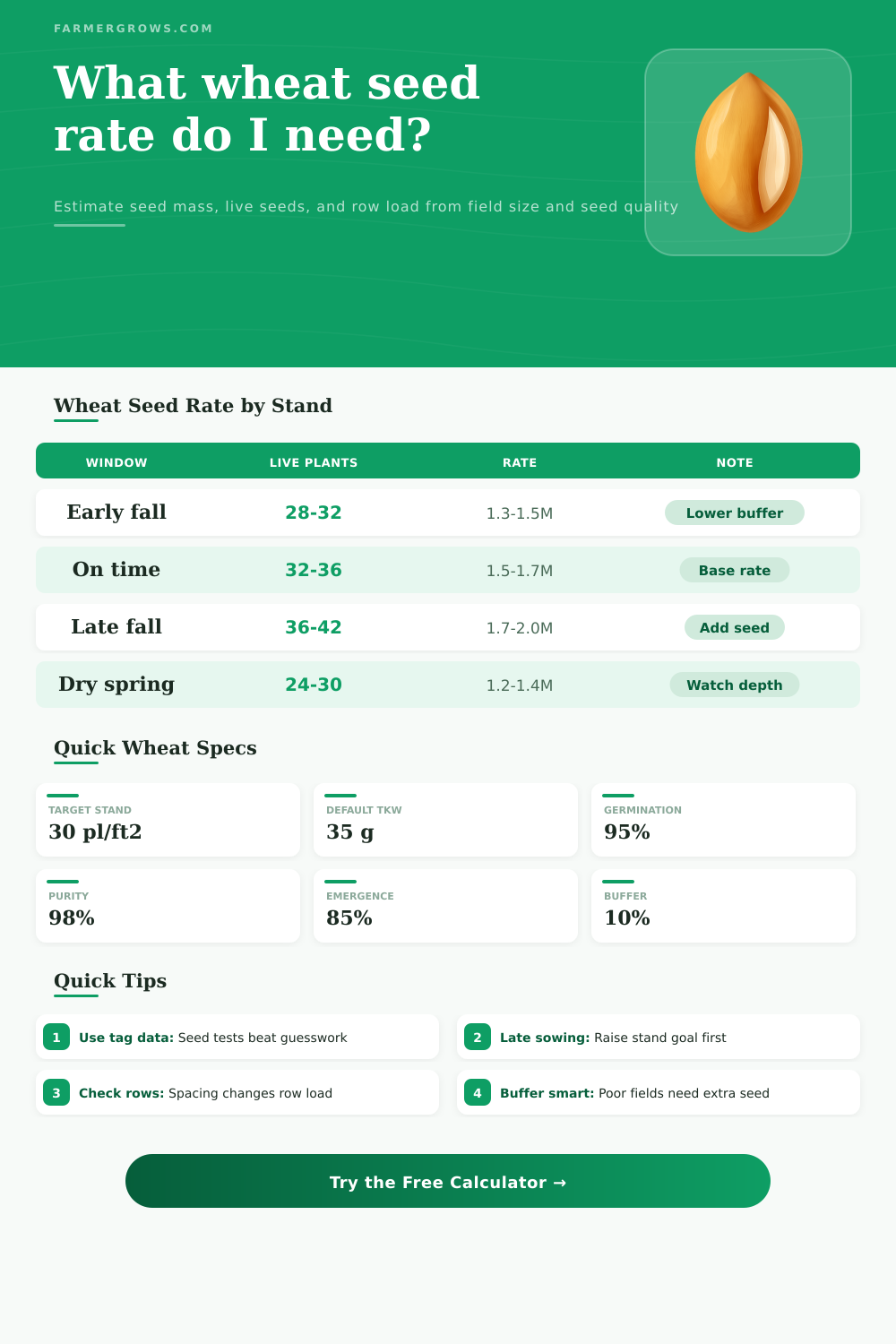
These estimates assume a standard drill, about 95% germination, 85% emergence, 98% purity, and a 10% buffer.
| Live stand | 30 g | 35 g | 40 g |
|---|---|---|---|
| 275 plants/m² | 24.5 kg/ha | 28.5 kg/ha | 32.0 kg/ha |
| 310 plants/m² | 27.5 kg/ha | 32.0 kg/ha | 36.0 kg/ha |
| 350 plants/m² | 31.0 kg/ha | 36.0 kg/ha | 40.5 kg/ha |
| 385 plants/m² | 34.0 kg/ha | 39.5 kg/ha | 50.0 kg/ha |
TKW and Seed Count
TKW controls how many seeds fit in each kilogram or pound, which is why heavier wheat lots lower seed count.
| TKW | Seeds/kg | Seeds/lb | Note |
|---|---|---|---|
| 30 g | 33,333 | 15,100 | Small seed |
| 35 g | 28,571 | 12,973 | Common lot |
| 40 g | 25,000 | 11,340 | Heavier lot |
| 45 g | 22,222 | 10,080 | Large lot |
Row Spacing and Row Load
This table uses a 325 plants/m² target and shows how spacing changes the number of seeds needed along each row.
| Spacing | Seeds/m | Seeds/ft | Gap |
|---|---|---|---|
| 15 cm | 48.8 | 14.9 | 2.1 cm |
| 20 cm | 65.0 | 19.8 | 1.5 cm |
| 30 cm | 97.5 | 29.7 | 1.0 cm |
| 38 cm | 123.5 | 37.6 | 0.8 cm |
Quality and Buffer Guide
Wheat usually performs best with shallow placement and enough moisture to avoid crusting and uneven emergence.
| Field | Depth | Buffer | Note |
|---|---|---|---|
| Firm moist | 2.5-4.0 cm | 0-5% | Best start |
| Normal seedbed | 3.0-4.5 cm | 5-10% | Common |
| Dry topsoil | 4.0-5.0 cm | 10-15% | Use care |
| Cloddy/no-till | 2.5-4.0 cm | 15-20% | Watch contact |
In order to determine the rate at which a person should plant wheat seeds, the person must take into consideration an amount of wheat seed that will be planted. If a person plants too little wheat seed, there will be thin stand of wheat, which allow weeds to grow. If a person plants too much wheat seed, the wheat plants will compete with one another for nutrients and water.
Therefore, calculating the amount of wheat seed that will be planted will ensure that the plants has enough space to grow, yet do not attempt to grow too far from one another. The target stand is the number of plants that a person want to grow in a specific area. The target stand should be large enough to allow each of the plants to capture the sunlight that it need to perform the processes necessary for growing wheat, yet the stand should not be so large that each of the plants begin to shade the other plants.
How to Decide How Much Wheat Seed to Plant
In many years, a target stand of 275 to 350 plants per square meter is sufficient, as is a target stand of 25 to 32 plants per square foot. A farmer may increase the target stand if the wheat is sown late in the spring or early in the summer, when the plants tend to establish themselves more slow. In contrast, a farmer may decrease the target stand if it is predicted that the spring will be dry and dry planting condition may lead to rotting of the wheat seeds.
In addition to the target stand, the quality of the wheat seeds will impact the total amount of wheat seed that a farmer must plant. One indicator of the quality of the seeds is the thousand-kernel weight (TKW) of the seeds. If the TKW is low, such as 30 grams per thousand kernels, the seeds are likely to be light in weight, allowing for a higher rate of planting of the seeds.
If the TKW is high, such as 40 grams per thousand kernels, more total mass of wheat seed must be planted into the field. In addition to the TKW, a farmer must also consider the germination rate and purity rate of the seeds. For instance, if the germination rate of a batch of seeds is 95% in the laboratory, it may drop to as low as 85% in the field, where the roots of the plants may encounter additional insects and other natural phenomena that prevents the seeds from emerging.
Another factor that affect the rate at which wheat seeds should be planted is the spacing of the rows in which the wheat is to be grown. If rows are narrow, such as 15 centimeters in width, there will be fewer gap between the wheat plants. In contrast, if the rows are wider, such as 38 centimeters in width, there will be more space between each row of wheat plants.
Additionally, if the rows are to be narrow, the farmer will have to calibrate their planting drill accordingly. Another factor that will affect the rate at which wheat seed should be planted is the time of planting of the wheat seeds. If a farmer plants wheat early in the fall, they may use a more conservative target stand of 28 to 32 plants per square foot.
If farmers plants wheat at the ideal time of year, a target stand of 32 to 36 plants per square foot is recommended. Finally, if a farmer plants wheat in the late fall or in the dry spring, they should increase the target stand to 36 to 42 plants per square foot. Furthermore, the method in which the farmer plans to plant the wheat will also affect the rate at which the wheat seeds should be planted.
For instance, if a farmer plans to use no-till openers or broadcast planting methods, an extra 8 to 20% of wheat seeds will be needed to account for the less even drop of the seeds into the soil. A buffer zone for wheat planting is another concept that a farmer should consider. A buffer zone is an extra amount of wheat seed that is planted into the field to ensure that the target stand is actualy achieved.
If the soil in which the wheat will be planted is poor, cloddy, or dry, a buffer rate of 15 to 20% of the total amount of wheat seeds should be planted into the field at a depth of 2.5 to 4 centimeters. In fields with firm and moist seedbeds, however, less seed is needed as a buffer zone. In this situation, the seeds may be planted at a depth of 4 centimeters.
Finally, two common mistake that farmers may make include utilizing the thousand-kernel weight measurements of the year previous to the current year of planting of the wheat seeds, or measuring the field from fence row to fence row rather than measuring the total area of land that will actualy be harvested for that years wheat crop. In either of these cases, the farmer may over-load their drill with too much wheat seed for the field.