🌱 Soybean Seed Rate Calculator
Calculate exact seed quantities needed for your soybean planting based on field size, row spacing & target population
⚡ Quick Presets
📏 Unit System
📍 Field Area
🌾 Seeding Parameters
✅ Your Soybean Seed Rate Results
📊 Seeds per Pound by Variety Size
seeds/lb
seeds/lb
seeds/lb
seeds/lb
Weight/Bushel
at 30" rows
at 15" rows
Narrow rows
📈 Target Plant Population by Row Spacing
| Row Spacing | Seeds/Acre | Plants/Acre Target | Lbs Seed/Acre (avg) | Seeds/m² |
|---|---|---|---|---|
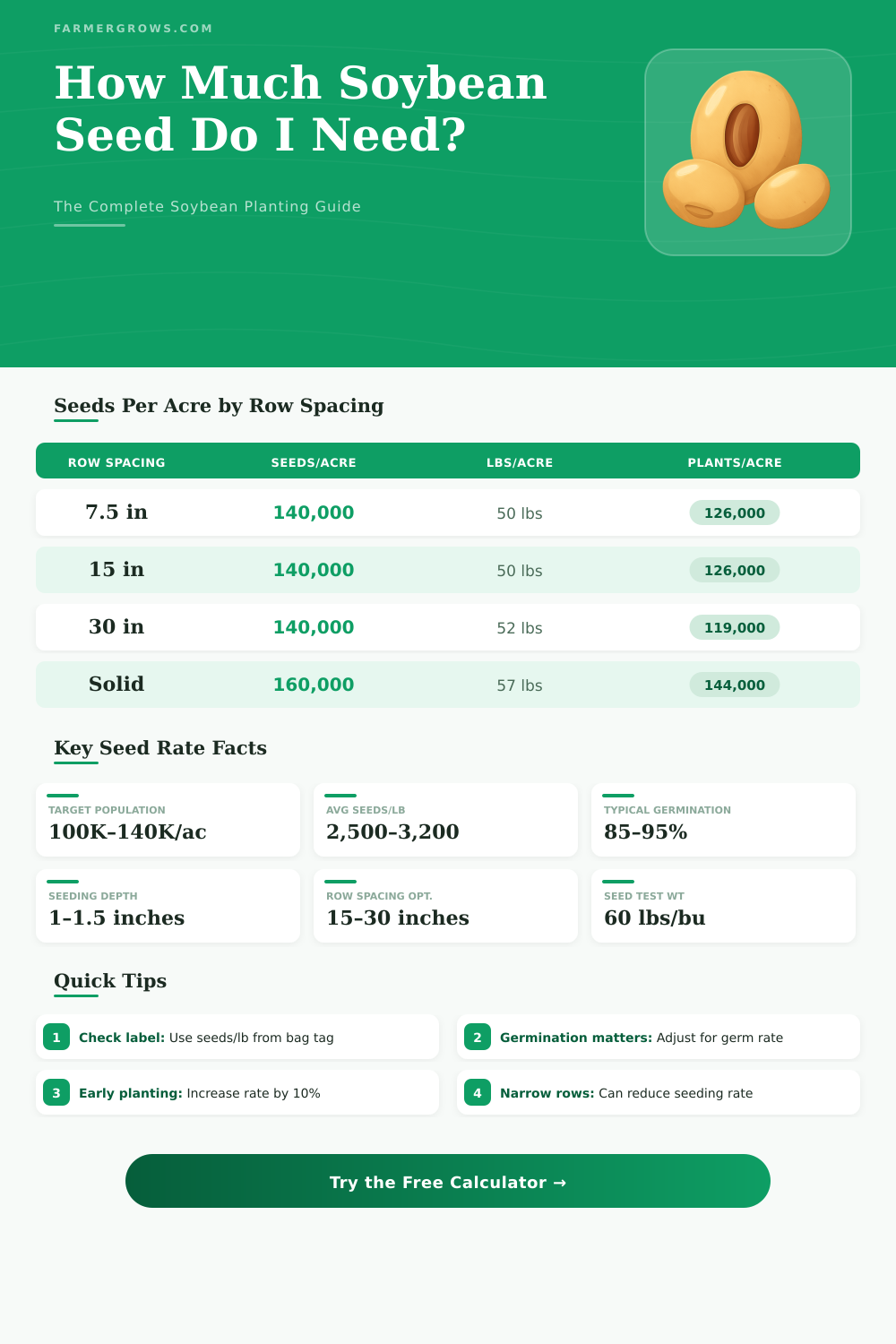
| 7.5 in (19 cm) | 160,000 | 140,000–150,000 | 57–64 | 39 |
| 10 in (25 cm) | 155,000 | 135,000–145,000 | 55–62 | 38 |
| 15 in (38 cm) | 150,000 | 130,000–140,000 | 50–56 | 37 |
| 20 in (51 cm) | 145,000 | 125,000–135,000 | 48–54 | 36 |
| 30 in (76 cm) | 140,000 | 120,000–130,000 | 44–50 | 35 |
📦 Bag Size & Quantity Reference
| Bag Size | Seeds/Bag (typical) | Lbs/Bag | Acres/Bag at 140K | Bags/100 Acres |
|---|---|---|---|---|
| 50 lb bag | 140,000 | 50 | ~1.0 | 100 |
| 140,000 seed unit | 140,000 | 50–58 | 1.0 | 100 |
| 50 lb bag (small seed) | 120,000 | 50 | ~0.86 | 116 |
| 50 lb bag (large seed) | 160,000 | 50 | ~1.14 | 88 |
| Bulk per bushel (60 lb) | ~168,000 | 60 | ~1.2 | 83 |
📋 Common Project Seed Needs (30-in rows, 140K seeds/ac, 90% germ)
| Field Size | Total Seeds Needed | Lbs Seed (2,800/lb) | 50-lb Bags | Bushels (60 lb) |
|---|---|---|---|---|
| 5 acres | 777,778 | 278 | 5.6 | 4.6 |
| 10 acres | 1,555,556 | 556 | 11.1 | 9.3 |
| 40 acres | 6,222,222 | 2,222 | 44.4 | 37.0 |
| 80 acres | 12,444,444 | 4,444 | 88.9 | 74.1 |
| 160 acres | 24,888,889 | 8,889 | 177.8 | 148.1 |
| 320 acres | 49,777,778 | 17,778 | 355.6 | 296.3 |
💡 Calculation Tips
Calculating the correct soybean seed rate are a necessary process for a person who would like to have good management of their soybean crop. If they plant too few soybean seeds, then the soybean plants will be too far apart in the field, and they wont be able to produce as much of the soybean crop then they would like. If they plant too many soybean seed, then the soybean plants will compete for nutrient in the soil, which waste the money that the farm spent purchasing those seeds.
Therefore, a person must find a balance in the number of soybean seeds that they plant versus the number of soybean plants that will grow in the field. The number of soybean plants that will grow in a field are affected by the spacing of the rows in which the soybean plants are to be planted. If narrow row are used, such as 7.5-inch rows, fewer soybean seeds should be planted, as narrow rows will allow the soybean plants to cover the ground in the field.
How to Calculate Soybean Seed Rate
In fields with wider rows, such as 30-inch rows, more soybean seeds needs to be planted to cover the field and prevent weeds from grow in those rows. Thus, row spacing is one factor that determines the number of soybean seeds that should be planted into the field. Two different factor that impact the number of soybean plants that emerge from the field are the germination rates and emergence rates of the soybean seeds.
Germination rates are the percentages that appear on the bag of soybean seeds, and they typicaly range between 85 and 95%. Emergence rates are the percentage of soybean plants that actualy emerge from the soil. Emergence rates can be lower than the germination rates because the soil temperatures is too low for the soybean plants to emerge, or if the soybean seeds did not properly make contact with the soil.
Because emergence rates can be lower than germination rates, a buffer is added to the soybean rate calculation; a 10% buffer is typicaly used to account for bird eating the soybeans, or errors made by the planters. Seed size can also impact the number of soybean seed that are included in a bag of soybean seeds. Soybean seeds that are small in size may contain 3,200 seeds per pound, but large soybean seeds may only contain 2,400 seeds per pound.
To determine the exact number of soybean seeds per pound for that specific type of soybean seed, you must check the tag on the seed bag. The number of soybean seeds per pound can vary depending on the variety of soybean that is to be planted. The maturity group of the soybean variety will also have an impact on the number of soybean seeds that should be planted.
Soybean varieties that matures early will contain more plants per acre than soybean varieties that mature late. The type of soil in which the soybean seeds are to be planted will also impact the rate at which soybean seeds should be planted into the soil. Soybean seeds should be planted at different rates into clay soil compared to sandy soil.
Sandy soil dries out quick and clay soil may crust over the soybean seeds. Using mathematics, a person can calculate the total weight of soybean seed that should be purchased. For instance, if a soybean farmer owns a 40-acre farm with 30-inch rows and wants to plant 140,000 soybean plants per acre, he or she will need to purchase 50 pound of soybean seeds per acre.
Should he or she calculate 10% more seeds than the initial calculation, the farmer will have enough soybean seeds to accommodate potential irregularities in the planting process. The actual weight of soybean seeds and the number of units of rows that the planter has will determine the calibration of the planter. The soybean planter should drop the soybean seeds at the correct rate.
Finally, soybean seeds is expensive. If the soybean farmer miscalculates the rate at which the soybean seeds should be planted by 10%, he or she may lose a significant amount of money on an 80-acre farm. To avoid losing money, the soybean farmer should use the bag tag to determine the number of seeds per pound for that specific soybean variety and should calibrate the soybean planter before planting.
Through these calculations and determinations, the soybean farmer will be able to ensure that he or she is planting the correct number and variety of soybean seeds for the field that he or she own.