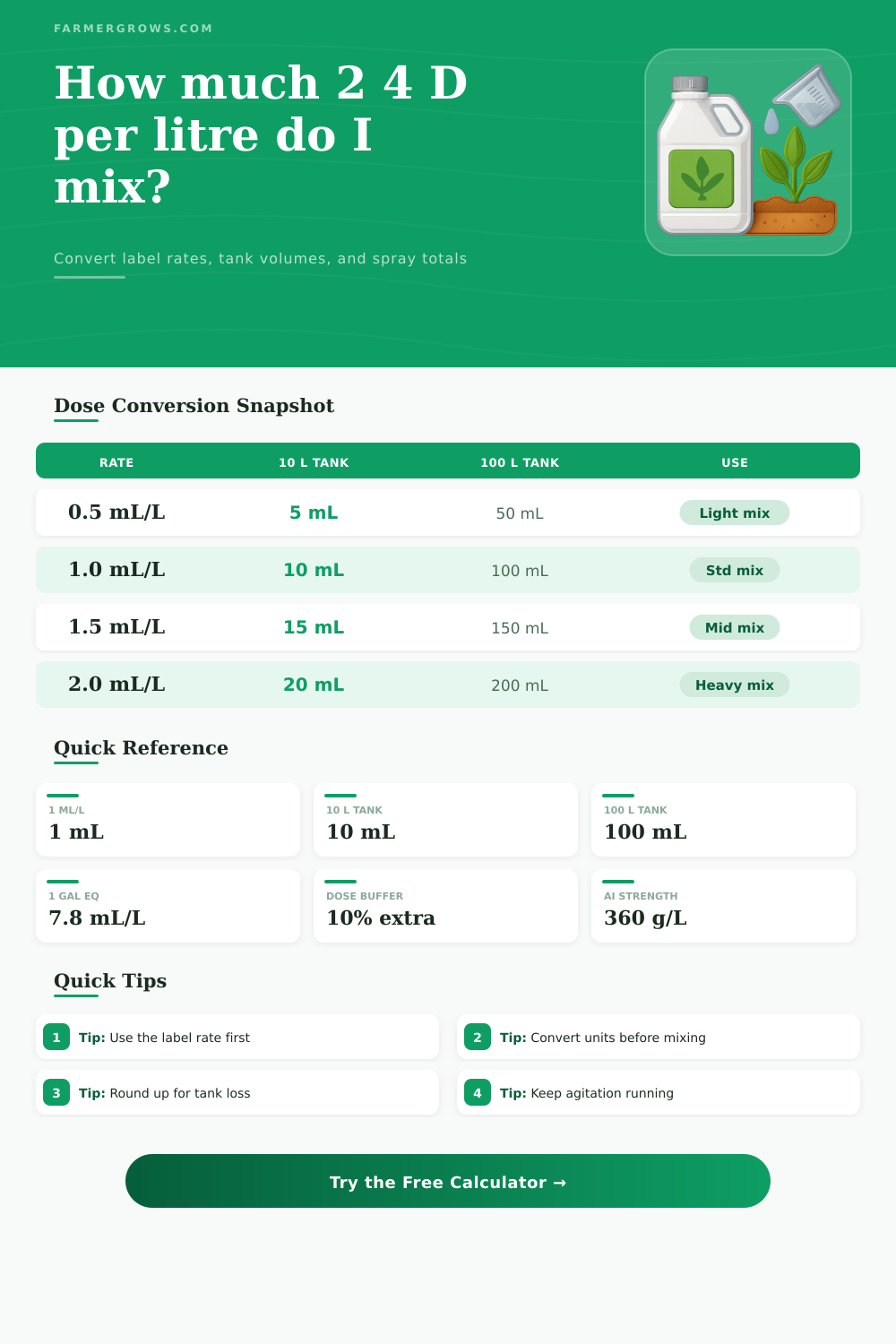
2 4 D Herbicide Dosage Per Litre Calculator
Convert label rates, tank volumes, and spray totals for 2,4-D mixes. Enter the rate from your product label and the calculator handles the rest.
📊 2,4-D Mix Results
Mix rate, tank loads, product totals, and active ingredient updates appear here.
| Rate | 10 L tank | 100 L tank | Use |
|---|---|---|---|
| 0.5 mL/L | 5 mL | 50 mL | Light mix |
| 1.0 mL/L | 10 mL | 100 mL | Std mix |
| 1.5 mL/L | 15 mL | 150 mL | Mid mix |
| 2.0 mL/L | 20 mL | 200 mL | Heavy mix |
| Tank | 0.5 mL/L | 1.0 mL/L | 2.0 mL/L |
|---|---|---|---|
| 5 L | 2.5 mL | 5 mL | 10 mL |
| 15 L | 7.5 mL | 15 mL | 30 mL |
| 20 L | 10 mL | 20 mL | 40 mL |
| 100 L | 50 mL | 100 mL | 200 mL |
| Volume rate | 1 ha | 1 acre | Note |
|---|---|---|---|
| 100 L/ha | 100 L | 10.76 gal/ac | Low vol |
| 200 L/ha | 200 L | 21.5 gal/ac | Std field |
| 400 L/ha | 400 L | 42.9 gal/ac | Heavy cover |
| 800 L/ha | 800 L | 85.8 gal/ac | Orchard |
| Job | Area | Rate | Tank note |
|---|---|---|---|
| Backpack | 0.25 ha | 1.0 mL/L | 1-2 fills |
| Boom field | 10 ac | 1.25 oz/gal | 100 gal |
| Orchard | 1.5 ha | 1.5 mL/L | 300 L |
| Spot spray | 2000 ft2 | 0.75 mL/L | 5 L |
To use 2,4-D herbicide effective, you must calculate the correct amount of 2,4-D to add to the water in which you will mix the product. Calculating the correct amount of 2,4-D to add to the water is essential; if there is too little 2,4-D the herbicide will not kill the emerged weed, but if there is too much 2,4-D you may waste the product and damage the crops that you wish protect. Always start by reading the product label to determine the instructions regarding how to use the 2,4-D.
The concentration of 2,4-D can vary depending off the formulation of the 2,4-D that is to be used.
Many 2,4-D formulations contains 360 grams of the active ingredient per litre of that product. However, the label will indicate the exact amount of 2,4-D that should be used per unit of water; amine salts and esters will contain different amount of 2,4-D than other formulations. The label will contain instructions regarding the amount of 2,4-D that should be used per litre of water or per 100 litres of water.
How to Measure and Mix 2,4-D
These instructions should be converted to the amount of 2,4-D that should be used per litre of water before you determine the amount of 2,4-D that should be mixed with the water based on the size of your sprayer’s tank. The size of your sprayer’s tank will determine the amount of 2,4-D that should be added to the water within the tank. For instance, if your sprayer tank holds 15 litres of water and the label state that one millilitre of 2,4-D should be used per litre of water, you should add 15 millilitres of 2,4-D to the sprayer’s tank.
However, do not fill the tank with the 2,4-D and water mixture to the very top of the tank. Instead, calculate the amount of 2,4-D as if you will only fill the tank to 90% of its capacity. Additionally, add a 10% buffer to the amount of 2,4-D to account for the amount of 2,4-D that may be lost within the sprayer’s line and tips.
Adding a 10% buffer to the amount of 2,4-D that you calculate ensures that enough 2,4-D is added to the tank to effectively kill the emerged weeds within the field. The volume of water that you use will change the concentration of the 2,4-D that is distributed within the field. For instance, if you use 200 litres of water per hectare to mix with the 2,4-D, the concentration of the 2,4-D will be distributed to the area.
However, if you use 100 litres of water per hectare you will distribute the 2,4-D at a higher concentration. If you use 400 litres of water or 800 litres of water per hectare, the 2,4-D will be more diluted within the field. Additionally, using more water will allow for better control of the drift of the 2,4-D within the field.
However, the drift of 2,4-D will be further limited if you use more water and must transport more water to the field. It is also essential to ensure that the area that you intend to treat is measured in hectares instead of acres. You must correctly convert the hectares into acres in order to ensure that the total amount of 2,4-D that will be added to the field is the correct amount.
It is also essential to ensure that you track the active ingredient within the 2,4-D in order to comply with government regulations. For instance, if your 2,4-D has a strength of 360 grams of active ingredient per litre, then one millilitre of 2,4-D and one litre of water will contain 0.36 grams of active ingredient per litre of sprayed water. It is important to ensure that the amount of 2,4-D that is used does not exceed the limits of the active ingredient per litre of water as set by the labels for the product and by the government regulations.
To ensure that the 2,4-D is distributed evenly throughout the water and sprayed onto the emerged weeds within the field it is important to agitate the mixture. If you do not agitate the 2,4-D and water mixture the 2,4-D will settle at the bottom of the sprayer tank. Additionally, if the 2,4-D settles at the bottom of the sprayer tank the first portion of the field that is sprayed will contain too little 2,4-D to kill the weeds, yet the last portion of the field that is sprayed will contain too much 2,4-D that could potentially kill the crops within that field.
To prevent this from occurring, fill the sprayer’s tank with 90% of the amount of water that is required for the field that you intend to treat with the 2,4-D. Turn on the agitator for the sprayer tank and slowly add the 2,4-D to the water within the sprayer tank. The weather and the growth of the emerged weeds will impact the use of 2,4-D. For instance, it is best to apply 2,4-D when the weather is calm and during the mornings as 2,4-D has the potential to drift if there is too much wind in the field or if there are temperature inversions between the ground and the air. Additionally, young emerged weeds may only require a light dose of 2,4-D to kill them while mature emerged weeds may require a heavier dose of 2,4-D to effectively kill those weed.
By calculating the amount of 2,4-D per litre of water correctly and by following the instructions that are printed on the 2,4-D product label you can ensure that the 2,4-D will effectively kill the emerged weeds within your field. Actually, you should of check the weather to be sure. It is alot of work but youll recieve better results if you follow these steps.
Dont forget that the sprayer’s length might matter too. The moddern equipment is great but it isnt magic. Use the correct dose so the weeds dissapears.