Grain Truck Bushel Calculator
Estimate bushels, cubic feet, and grain weight from truck bed dimensions.
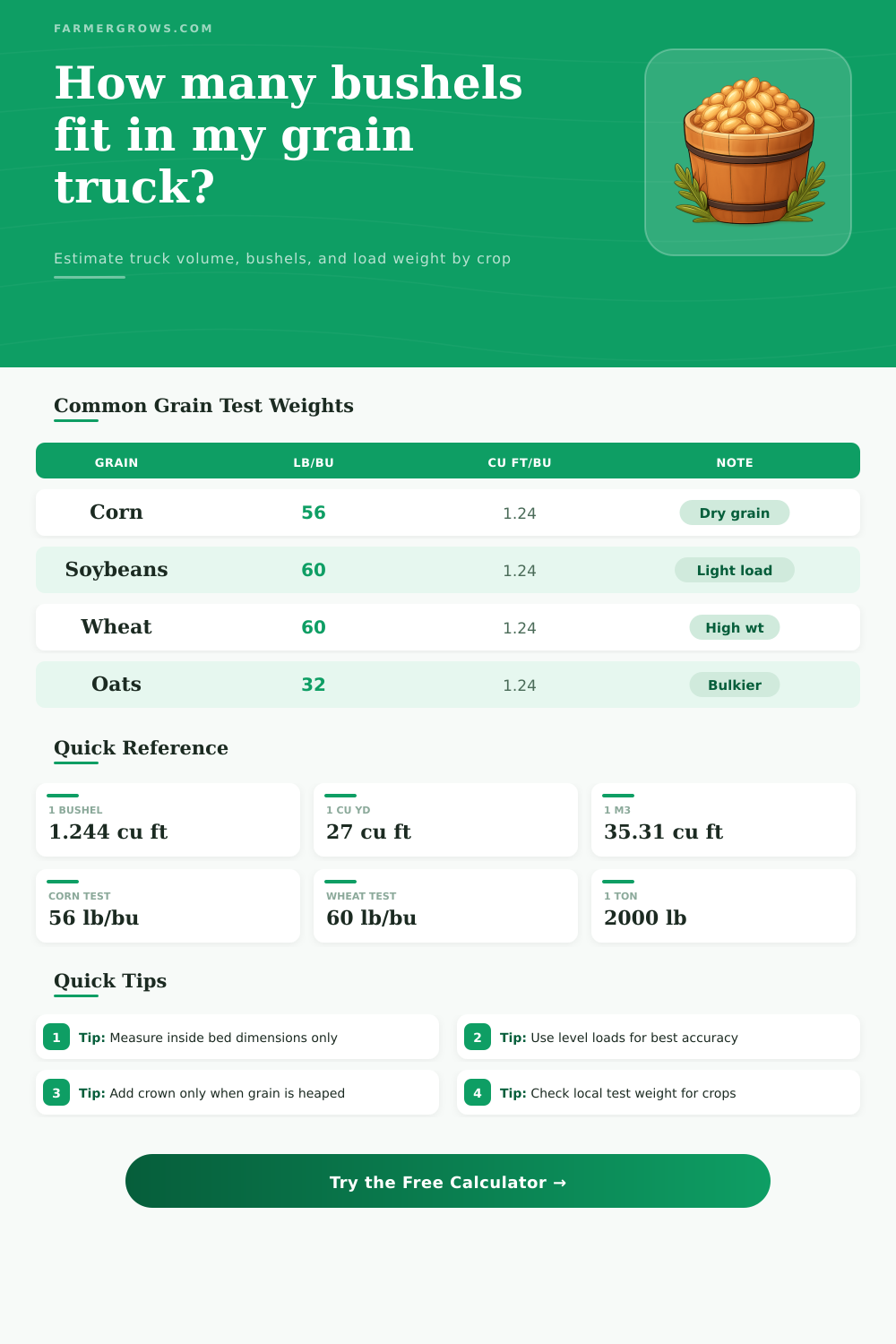
| Grain | lb/bu | cu ft/bu | Note |
|---|---|---|---|
| Corn | 56 | 1.244 | Dry grain |
| Soybeans | 60 | 1.244 | Light load |
| Wheat | 60 | 1.244 | High wt |
| Oats | 32 | 1.244 | Bulkier |
| Bed size | Level bu | Heaped bu | Use case |
|---|---|---|---|
| 8x6x2.5 | 96 bu | 104 bu | Pickup |
| 12x7x3 | 203 bu | 220 bu | Short box |
| 16x8x4 | 412 bu | 446 bu | Level load |
| 40x8.5x5 | 1,366 bu | 1,470 bu | Semi |
| Unit | Imperial | Metric | Note |
|---|---|---|---|
| 1 bu | 1.244 cu ft | 35.24 L | US bushel |
| 1 cu ft | 0.803 bu | 28.32 L | Inverse |
| 1 cu yd | 27 cu ft | 21.65 bu | Bulk vol |
| 1 m3 | 35.31 cu ft | 28.37 bu | Metric |
| Crown | Extra vol | Load type | Note |
|---|---|---|---|
| 0.5 ft | 8-10% | Light heap | Small crown |
| 1.0 ft | 10-15% | Common | Normal heap |
| 1.5 ft | 15-20% | Deep crown | High load |
| 2.0 ft | 20%+ | Very high | Spill risk |
To calculate how much grain a truck can carry, it is first important to understanding the relationship between the volume of the truck and the weight of the grain. A bushel of grain is always equal to 1.25 cubic feet of volume. However, the weight of that bushel of grain can differ; dry corn weigh 56 pounds per bushel, but oats weigh only 32 pounds per bushel.
Therefore, a truck bed filled with corn will weigh more than if it were filled with oats. The test weight of the grain must be known in order to account for the density of that type of grain. If the test weight of the grain are not known, then it is possible for the truck to either be underloaded or overloaded with that type of grain.
How Much Grain a Truck Can Carry
In order to find the capacity of the truck, you must measure the interior dimension of the truck bed. The length of the bed, the width of the truck bed, and the depth of the truck bed must be measured. These interior measurements is required because the exterior measurements of the truck bed does not take into account the space taken up by the tire wells.
If the grain is to be loaded into the truck in a heap, then that heap will create a pyramid shape on top of the rectangular bed. To account for the volume of that pyramid, a mathematical formula exists that allows for that volume to be calculated. In this case, the depth of the truck bed should not be measured to the top rail of the bed if the load of grain are not level with the bed.
The test weight of the grain will determine the weight of that grain per bushel. Test weight can be found with a grain probe or on a slip from the elevator where the grain is purchased. Each type of grain have its own test weight.
For instance, soybeans will have a more higher test weight than corn, and wheat will have a higher test weight than oats. Since the weight of the grain is the way in which it is sold, this test weight must be used to determine how much the truck will weigh when fully loaded with grain. For instance, the driver will use the test weight of corn to calculate how much the truck will weigh when loaded with corn, not wheat.
It is possible to load the truck with either a heaped load of grain or a level load of grain. A heaped load is able to increase the amount of grain that the truck can carry by 10-20%, but carries the risk of grain spilling off of the truck. Additionally, the wind can easily blow the small particles of grain off of a heaped load of grain.
An alternative to loading the truck with a heaped load is to load the truck with a level load of grain. A level load of grain is easier to manage and will be cleaner during transport, but will carry less grain than a heaped load. Grain within the truck bed will settle during transport due to the vibration of the truck.
Therefore, it is important to account for this settling of the grain, typically allowing for 2-10% of the total volume of the truck bed to allow for the grain to settle during transport. In addition to the variables discussed above, there are also additional factors that can impact the accuracy of the calculations of the amount of grain that can be carried by a truck. For instance, the grade of the road and any turns that the truck takes will impact how the grain settles in the truck bed.
Additionally, the condition of the crop will impact the weight of the grain that is within the trucks. Freshly harvested corn will contain different moisture level than stored corn. The amount of rain that falls during the growth of the corn field can also impact the weight of that grain very quickly.
Finally, the legal axle limit for the truck must also be accounted for, as it is possible that the weight of the grain can reach the maximum legal weight for an axle prior to the bed of the truck are completely filled with grain. The use of presets for the amount of grain that can be loaded into common vehicles will speed up the loading of trucks. For instance, a pickup truck with a small bed may only be able to carry 100 bushels of corn, but a large semi-trailer can carry 1,300 bushels of corn or more.
Averaging the amount of grain that is loaded into each vehicle will allow the driver to better understand how much grain can be loaded into each vehicle. Additionally, if the driver tracks the weight of each load, it will be possible to improve the ability to estimate how much grain can be loaded into each vehicle in the future. Furthermore, accurate measurements will ensure that the ticket that are printed from the scale match the mathematical estimates of the grain that was within the truck, and that accurate measurements will improve the profit of the harvest of grain.