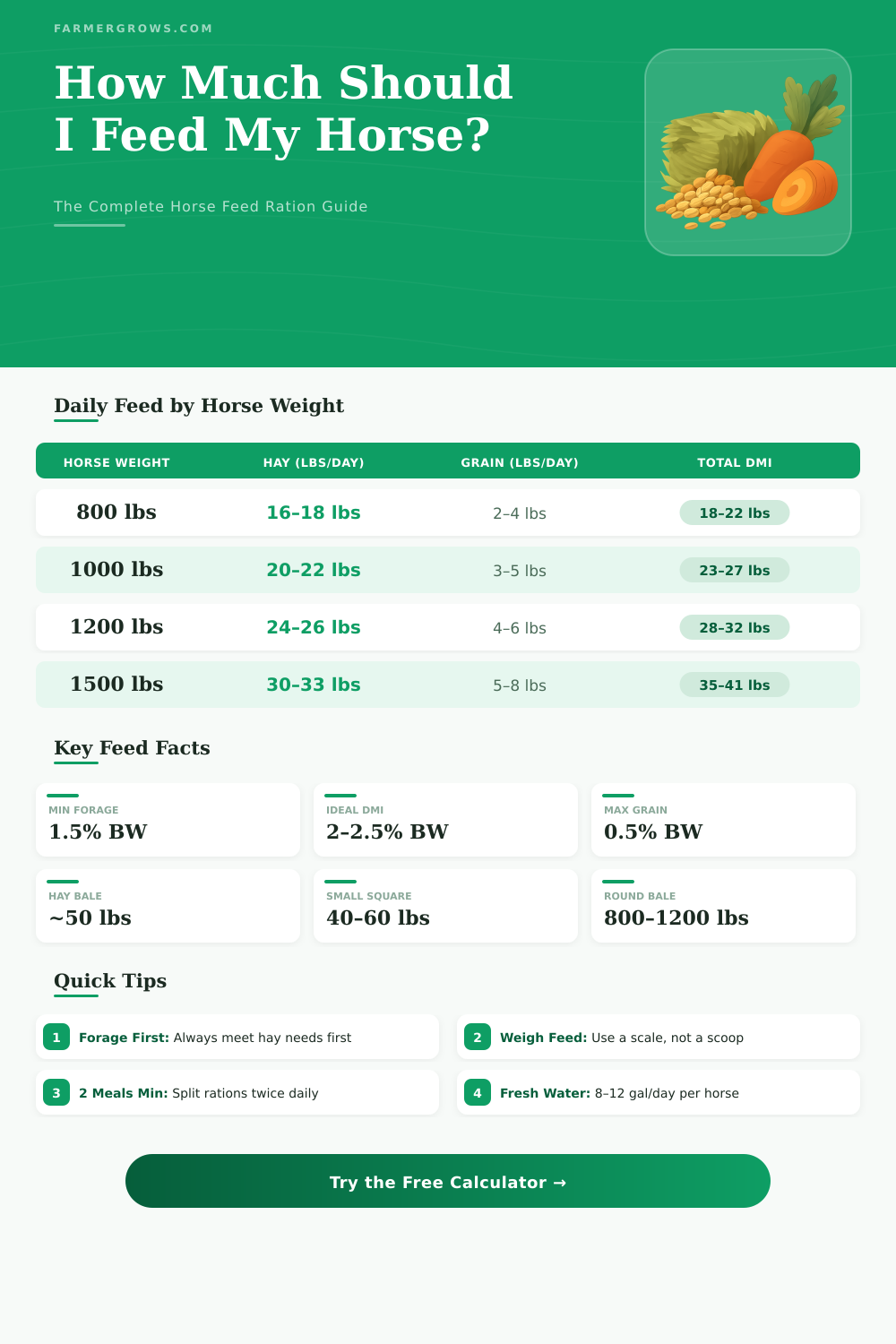
🐴 Horse Feed Ration Calculator
Calculate daily hay, grain & forage requirements based on your horse’s weight & activity level
Protein
Protein
Protein
Protein
DE per lb
DE per lb
DE per lb
DE per lb
| Activity Level | DMI % of Body Weight | 1000 lb Horse (lbs/day) | 1200 lb Horse (lbs/day) |
|---|---|---|---|
| Maintenance | 1.5–2.0% | 15–20 lbs | 18–24 lbs |
| Light Work | 1.75–2.25% | 17–22 lbs | 21–27 lbs |
| Moderate Work | 2.0–2.5% | 20–25 lbs | 24–30 lbs |
| Heavy Work | 2.25–2.75% | 22–27 lbs | 27–33 lbs |
| Performance | 2.5–3.0% | 25–30 lbs | 30–36 lbs |
| Lactating Mare | 2.5–3.0% | 25–30 lbs | 30–36 lbs |
| Growing Yearling | 2.5–3.0% | — | — |
| Bale Type | Avg Weight (lbs) | Avg Weight (kg) | Bales/Month (1000lb horse) |
|---|---|---|---|
| Small Square | 40–60 lbs | 18–27 kg | 10–15 bales |
| Large Square | 700–900 lbs | 315–410 kg | ~1 bale |
| Small Round | 400–600 lbs | 180–270 kg | 1–2 bales |
| Large Round | 800–1200 lbs | 360–545 kg | ~0.6 bales |
| Feed Type | Max Safe Daily Amount | DE (Mcal/lb) | Typical Use |
|---|---|---|---|
| Sweet Feed | 0.5% BW per meal | 1.6 | Work horses, weight gain |
| Complete Pellets | 0.5% BW per meal | 1.3 | General supplementing |
| Whole Oats | 4–6 lbs/day | 1.45 | Light concentrate needs |
| Cracked Corn | 3–4 lbs/day | 1.65 | High energy supplement |
| Beet Pulp (dry) | 4–6 lbs/day | 1.0 | Forage extender |
| None / Forage Only | — | — | Easy keepers, maintenance |
| Horse Type | Typical Weight (lbs) | Typical Weight (kg) | Min Daily Hay (lbs) |
|---|---|---|---|
| Pony (<14.2 hh) | 400–600 lbs | 180–270 kg | 8–12 lbs |
| Light Horse (15 hh) | 900–1100 lbs | 410–500 kg | 14–18 lbs |
| Warmblood (16 hh) | 1200–1400 lbs | 545–635 kg | 18–22 lbs |
| Draft Horse (17 hh) | 1500–2000 lbs | 680–910 kg | 24–32 lbs |
| Miniature Horse | 150–350 lbs | 70–160 kg | 3–7 lbs |
Most horses receive their daily nourishment in two main parts. Here roughage, like hay or feed, and concentrates. The concentrates carry grains and often include protein, minerals and vitamins.
It can include also bran, cane molasses or dried alfalfa. For adult horse of 1,100 pounds that eats 25 pounds of nourishment day it should have around 0.7 Mcal/lb on nutritious base. That bases on rating of 17 Mcal DE a day for the needs of the horse.
How to Feed a Horse
When you choose a diet consider the life stage of the horse, its age, work level and body weight. Also matters the kind of nourishment for instance full feed or ration balancer. Ration balancer commonly helps a lot.
They intend to give the lacking nourishment from forage without too much extra calories. For easily gaining horse forage together with balancer suffice well. For most horses the dose of ration balancer is 1 until 2 pounds.
If the horse receives less than 0.6 pounds for every 100 pounds of body weight day superbly supplement by means of balancer or 12:12 mineral.
Ration balancers differ to vitamin and mineral supplements. Supplements usually do not have protein. They answer for horses eating legumes like alfalfa as main forage.
Legumes has more protein than grassy forage like timothy orchardgrass or teff. High quality of vitamin and mineral supplement can improve unfortified grain diet. Note that all feeds weigh differently for one quart.
Use heavy scale for acuracy.
For good eaters the whole forage intake would not should be less than 1.5% of body weight (DM) day. If horse is underpeght even many supplements do not help. Healthy horses in good weight commonly covers caloric needs only by means of forage.
But their nutritious needs could lack so ration balancer is usefull. For toothless horse balancer pellet can soak to make a mash. Knowingly are control do the balancer coincides with the hay for instance for grass or alfalfa.