🐖 Swine Feed Ration Calculator
Estimate daily intake, total batch weight, bag count, and ingredient mix for pigs, gilts, sows, and boars
🧬Ration Setup
📦Ingredient Mix
📊Stage Reference
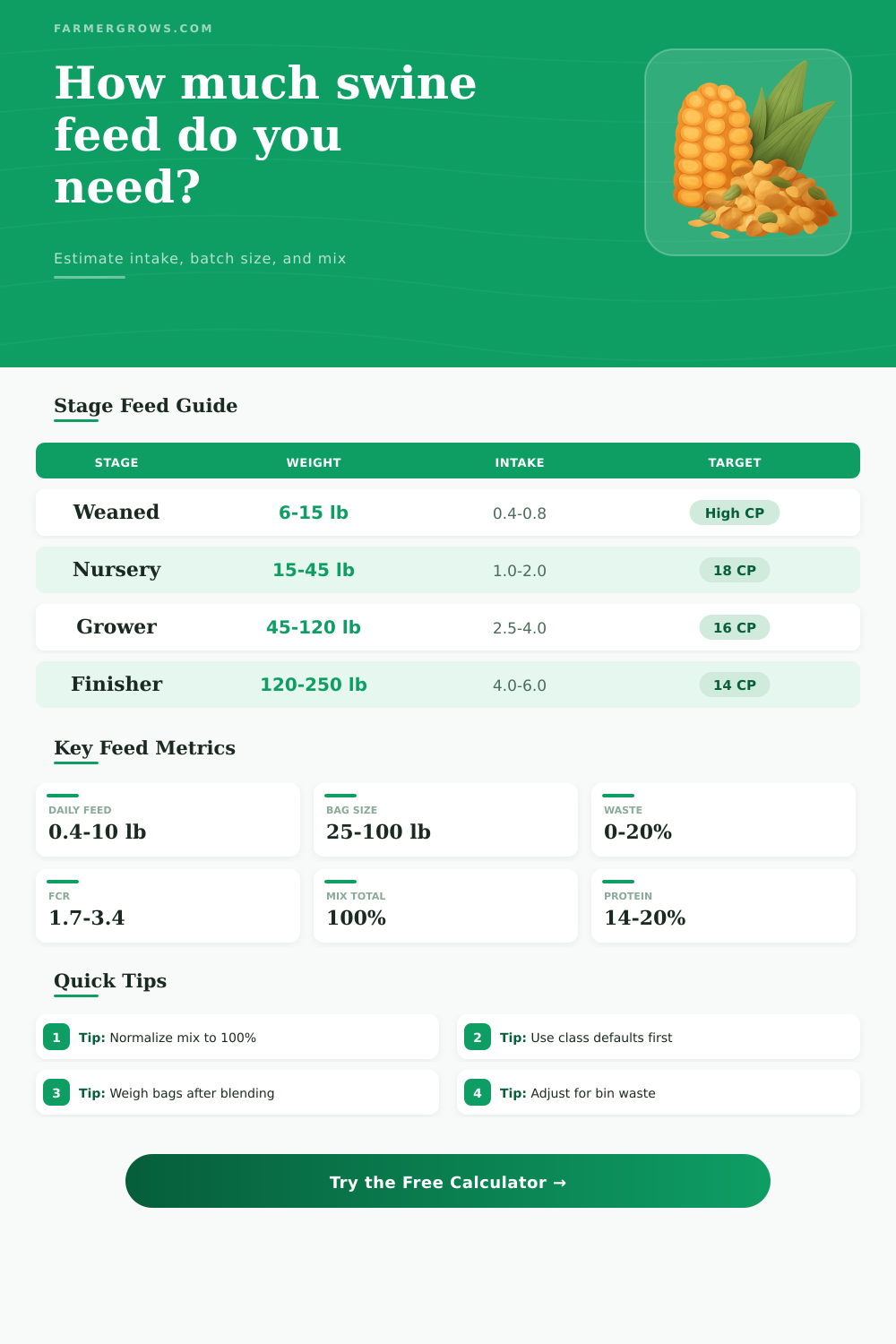
| Stage | Weight band | Daily feed | Target |
|---|---|---|---|
| Weaned pig | 6-15 lb | 0.4-0.8 lb | 20 CP / 1.45 L |
| Nursery pig | 15-45 lb | 1.0-2.0 lb | 18 CP / 1.25 L |
| Grower pig | 45-120 lb | 2.5-4.0 lb | 16 CP / 1.05 L |
| Finisher pig | 120-250 lb | 4.0-6.0 lb | 14 CP / 0.80 L |
| Replacement gilt | 120-300 lb | 4.0-5.5 lb | 15 CP / 0.90 L |
| Gestating sow | 300-450 lb | 4.5-6.0 lb | 13 CP / 0.65 L |
| Lactating sow | 350-550 lb | 8.0-14 lb | 16 CP / 0.95 L |
| Boar maintenance | 400-700 lb | 5.0-8.0 lb | 14 CP / 0.70 L |
| Ingredient | CP | Lysine | Density |
|---|---|---|---|
| Corn | 8.5% | 0.26% | 56 lb/bu |
| Soybean meal | 48.0% | 3.00% | 60 lb/bu |
| DDGS | 28.0% | 0.80% | 42 lb/bu |
| Wheat middlings | 17.0% | 0.90% | 43 lb/bu |
| Canola meal | 36.0% | 2.10% | 50 lb/bu |
| Premix | 0.0% | 0.00% | 40 lb/bu |
| Barley | 12.0% | 0.42% | 48 lb/bu |
| Oats | 11.0% | 0.35% | 32 lb/bu |
| Bag size | Mass | Bags per ton | Notes |
|---|---|---|---|
| 25 kg bag | 55.1 lb | 40.0 | Common metric sack |
| 40 lb bag | 18.1 kg | 50.0 | Light retail feed |
| 50 lb bag | 22.7 kg | 40.0 | Standard bag size |
| 100 lb bag | 45.4 kg | 20.0 | Bulk handling bag |
| 1,000 kg ton | 2,204.6 lb | 40.0 x 25 kg | Metric bulk lot |
| 2,000 lb ton | 907.2 kg | 40.0 x 50 lb | Imperial bulk lot |
| Phase | Corn | Soy | Use |
|---|---|---|---|
| Starter | 55-62% | 28-35% | Early growth |
| Grower | 65-72% | 18-24% | Frame gain |
| Finisher | 72-80% | 12-18% | Carcass finish |
| Gestation | 68-76% | 14-20% | Maintenance |
| Lactation | 50-60% | 28-35% | Milk support |
| Boar | 65-74% | 18-22% | Body condition |
🧰Practical Notes
Knowing the right way feed pigs is the most inherent part of the pork production. They require a diet rich in energy, but poor in fibers and full in proteins. All those creatures take huge amounts of food in short time.
Water is the nourishment that a pig consumes the most during his whole life. It consists about around 50 % of the weight of ended pig and even until 80 % of a piglet. Pigs always must have access to fresh and pure water.
Simple Guide to Feeding Pigs
You devige control the flow of water for ensure sufficient amount and reduce waste.
Proteins for pork commonly come from cereal grains. While you prepare a diet you consider the whole amount of particular amino acids in the ingredients. Lysine is the restrictive amino acid in pork diets and you use it for balance nourishmnets of the start.
Based on corn and soybean meal food supplies usually store enough other inherent amino acids but control them if you use synthetic lysine or different ingredients. Additives are supplements that helps to improve the efficiency and general health of pigs.
Energetic levels matter for various phases of increase. For growing supplies are ideally 1500 kilocalories each pound expressed as DE. That matches around 1440 kcal as ME.
At mixed ingredients ME-values form around 96 % of DE-values although individual ingredients a lot range. For pregnant supply mix 90 pounds of Sow 90 with 1650 pounds of corn and 250 pounds of soybean meal. For lactation supply add 90 pounds of Sow 90 to 1265 pounds of corn 365 pounds of soybean meal and 70 pounds of liquid or dry fat.
With such amounts feed that much how the sow wants to eat. A lot lactating sows receive 12.25 pounds of grain-soybean meal lactation supply with 13 percentages of coarse protein.
The convertaĵo of food for pigs are around 3:1. So necesas three pounds of food for one pound of weightgain. Good converto show that pigs well convert nourishment in physical weight.
High point that the nutritious program requires to review. This ranges according to circumstances. It depends of the place of the farm the used food the type of installations the genetiko of boars and sows.
Also the eniraj and eliraj weights affect it.