Vegetable Yield Calculator
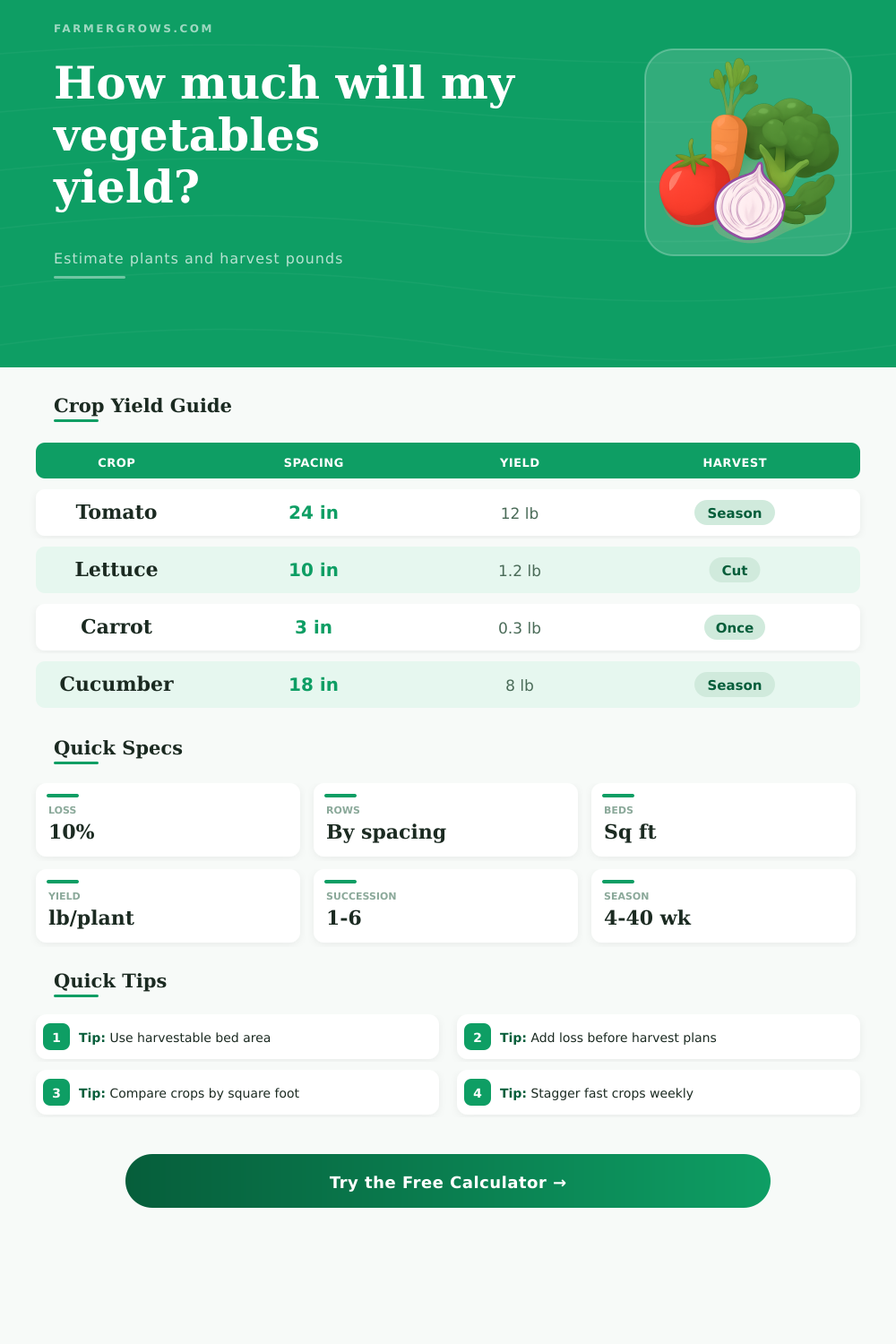
Estimate plant count, row count, harvest pounds, yield per square foot, weekly harvest pace, and season totals from crop spacing and expected yield.
Use harvestable bed or field area, not the whole garden footprint. The calculator can use bed dimensions, direct area, or row length, then adjusts the gross crop yield for expected field loss and succession plantings.
Vegetable Yield Estimate
Results update from your crop, spacing, area, loss, succession count, and season length.
| Crop | Typical row spacing | Typical plant spacing | Useful yield basis |
|---|---|---|---|
| Tomato | 24 to 36 in | 18 to 30 in | Per plant for total seasonal harvest |
| Lettuce heads | 10 to 18 in | 8 to 12 in | Per plant for heads, per foot for baby leaf |
| Carrot | 8 to 12 in | 2 to 4 in | Per plant or per square foot for dense beds |
| Cucumber | 36 to 60 in | 12 to 24 in | Per plant, especially on trellis |
| Bush beans | 18 to 30 in | 3 to 6 in | Per row foot for quick block planning |
| Sweet corn | 30 to 36 in | 8 to 12 in | Per plant or ears per row foot |
| Yield basis | Formula used | Best for | Watch out for |
|---|---|---|---|
| Per plant | plants x yield per plant | Tomatoes, peppers, cucumbers, squash | Weak stand counts can swing results fast |
| Per row foot | row feet x yield per foot | Beans, peas, greens, herbs, direct-seeded rows | Do not also multiply by plant count |
| Per square foot | area x yield per square foot | Dense beds, baby greens, mixed salad, roots | Use only harvestable crop area |
| Succession total | one planting yield x succession count | Repeat plantings of greens, roots, beans | Later plantings may yield less in heat or cold |
| Harvest loss setting | Use when | Calculation effect | Planning note |
|---|---|---|---|
| 0 to 5% | Protected crop, excellent stand | Keeps nearly all gross yield | Useful for indoor starts or covered tunnels |
| 8 to 12% | Normal garden planning | Removes light culls and missed picks | Good default for mixed vegetables |
| 15 to 25% | Pest, disease, weather, or uneven stand risk | Creates a more conservative harvest plan | Helpful for outdoor market estimates |
| 30% or more | Known pressure or poor stand | Shows only the usable crop after heavy loss | Consider replanting or adding succession area |
| Season length | Succession count | Approximate spacing | Crop examples |
|---|---|---|---|
| 4 to 6 weeks | 1 to 2 | 2 to 4 weeks apart | Radish, baby lettuce, spinach |
| 8 to 12 weeks | 2 to 4 | 2 to 5 weeks apart | Beans, cilantro, salad mix, carrots |
| 14 to 20 weeks | 3 to 6 | 3 to 6 weeks apart | Lettuce, beets, basil, cucumbers |
| Full warm season | 1 to 3 | 6 to 10 weeks apart | Tomato, pepper, squash, sweet corn |
For dense beds: Measure only planted bed surface, then use the square foot yield basis for baby greens, roots, or mixed salad rows.
For harvest planning: Apply loss before dividing by season weeks so weekly harvest targets are based on realistic marketable yield.
A yield calculator is a tool that can help individuals to determine the amount of food that a garden will produce. A yield calculator consider several different variables that will contribute to the mathematical calculation of the harvest that will grow from the seeds that are planted within the designated growing areas. Some of these variables include the amount of different plant that are to be grown, the length of the growing season, the weather within the growing area, and the potential loss of those plants to pests.
In order to calculate the yield of a garden with the calculator, an individual must first decide on the basis off the measurements of the garden. For instance, the garden may be measured for its total area, the dimension of each individual bed within the garden, or the length of each row of plants that are to be grown. The plants that are grown within the garden will impact the decision of which measurement basis is best utilized for that particular garden.
How to Use a Garden Yield Calculator
For instance, carrots and onions require less space between each plant than crops like tomatoes or cucumbers, which require more space between each plant. In addition to determining the measurement basis of the garden, it is also necessary for the yield calculator to include a percentage that accounts for the potential loss of plants that is establish within the garden. For instance, individual plants may die within the garden, the crops may not be able to produce food with the condition within the garden, or pests that live within the garden may damage the plants.
Generally, individuals use a percentage between 8% and 12% for the loss of plants. However, if there will be heavy pest pressure within the garden, or if the areas within the garden are not well-watered, the percentage should of been higher than 12%. An additional consideration for the yield calculator is the consideration of succession planting.
Succession planting is a method of planting new crop into the same areas of the garden where the previous crops were harvested. Thus, the calculator will calculate the number of succession plantings that can occur during the growing season. Fast growing crops will have high succession counts, as they mature quickly, while crops that take longer to grow will have lower succession counts.
Using more successions within the garden will increase the total yield of food that the garden produces. Finally, environmental factors may impact the yield calculator. For instance, a garden bed that has good drainage will produce more food than average, while a bed that is too wet will produce less food than a garden bed with average conditions.
Thus, individuals must use their own observations of the garden to adjust the yield calculator if their yields are different than those that are provide as an example within the calculator. Finally, the way in which crops are harvested will impact the total yield of food that grows within a particular garden. For instance, cut and come again lettuce will produce more food if the individual only harvest the outer leaves of each plant.
Other crops, such as zucchini, will produce more food if they are harvest more frequently. The zucchini plants will slow in their production of food if harvest infrequently. Many individuals make mistake when utilizing a yield calculator.
For instance, most individuals will use an optimistic percentage for the loss of plants, using a percentage of 0%. A percentage of 0% will lead to an unrealistic amount of food that is grown with the garden. Additionally, individuals may use the total area of the garden for the area in which plants are grown.
This includes paths through the garden and borders around the garden. Instead, the area that should be used is only the area within each bed in which the plants are to be grown. Finally, individuals should account for the fact that later plantings of crops will produce less food than the earlier successions of those crops, due to the differences in the weather conditions during which they are grown.
Overall, the best way to utilize a yield calculator is to use it for planning the first succession of crops. After the garden is established and after the crops are harvested, the individual will gain knowledge of the yields of each type of crop within the garden. This information can be used to adjust the calculator for the next growing season.
Thus, the yield calculator allow individuals to focus on which crops will produce the best yields for their garden, and to create a plan that adjust each year according to the information that is gained from the gardens size each year.