Harvest Date Calculator
Estimate harvest start, harvest end, weekly picking dates, GDD adjustment, frost risk, and succession timing from your planting or transplant date.
This calculator starts with seed packet days to maturity, then adjusts for crop group, variety type, heat units, transplant timing, succession number, harvest window length, zone, and frost risk.
Harvest Date Estimate
Results update from the active crop preset, days to maturity, heat unit adjustment, succession spacing, harvest window, and frost settings.
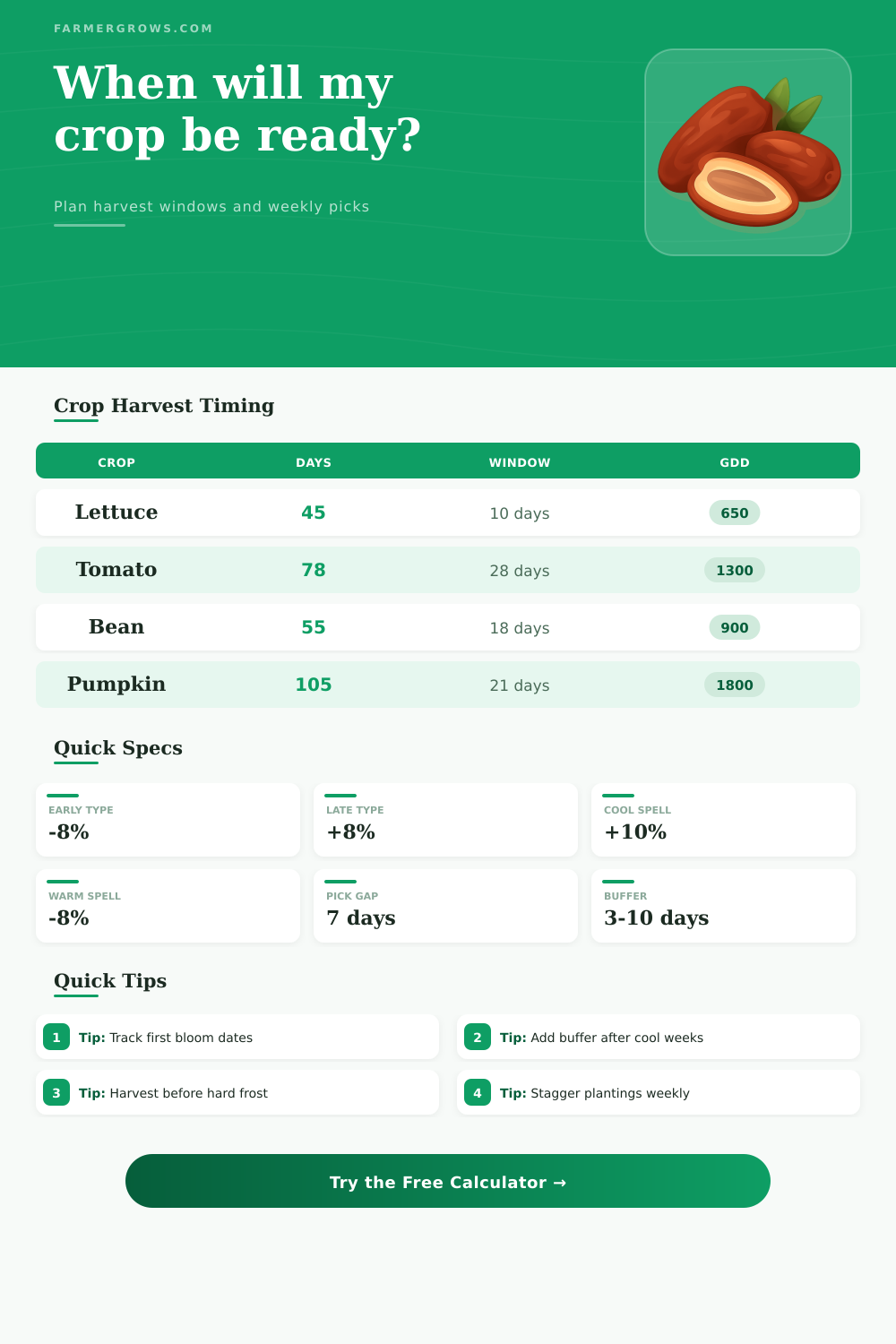
| Crop | Typical days to maturity | Base GDD target | Harvest window | Picking rhythm |
|---|---|---|---|---|
| Lettuce and greens | 28 to 60 days | 500 to 800 GDD | 7 to 21 days | Cut once or pick leaves weekly |
| Tomato | 65 to 85 days from transplant | 1100 to 1500 GDD | 21 to 42 days | Pick 2 to 3 times weekly |
| Bush beans | 50 to 60 days | 800 to 1000 GDD | 14 to 21 days | Pick every 2 to 3 days |
| Sweet corn | 70 to 90 days | 1200 to 1700 GDD | 5 to 10 days | Scout daily near silk dry-down |
| Carrot | 65 to 80 days | 900 to 1200 GDD | 21 to 45 days | Pull as size and storage allow |
| Pumpkin and winter squash | 95 to 115 days | 1600 to 2200 GDD | 14 to 28 days | Harvest after rind hardens |
| Variety type | Timing factor | Best use | Harvest note |
|---|---|---|---|
| Early variety | 92% of listed days | Short seasons and first market slots | Often shorter picking window |
| Standard variety | 100% of listed days | General garden planning | Use packet days as the baseline |
| Late or storage variety | 108% of listed days | Storage crops and fall harvests | Watch frost dates closely |
| Heirloom or variable set | 104% of listed days | Flavor-focused crops and mixed seed | Scout early for uneven ripening |
| Cut-and-come-again | 85% to first cut | Herbs, greens, salad mix | End date depends on regrowth and heat |
| Zone | Common first frost range | Warm-season caution | Cool-season opportunity |
|---|---|---|---|
| Zone 3 to 4 | Late August to late September | Choose early varieties and transplants | Use covers for fall greens |
| Zone 5 | Late September to mid October | Long crops need spring starts | Good fall brassica timing |
| Zone 6 | Early to late October | Watch late pumpkin and melon crops | Strong fall root crop window |
| Zone 7 to 8 | Late October to late November | Summer heat can slow fruit set | Second-season greens work well |
| Zone 9 to 10 | Rare to mid winter | Heat stress matters more than frost | Use cool-season calendars in winter |
| Formula | Expression | What it estimates | Example use |
|---|---|---|---|
| Succession planting date | base date + (succession - 1) x spacing | The active planting date for this round | 3rd succession at 7 days shifts 14 days |
| Adjusted maturity | days x variety factor + heat shift + basis shift | Field days until harvest start | 78 days with cool weather may become 86 |
| GDD adjustment | crop GDD x heat percent | Approximate heat unit surplus or deficit | 1300 GDD at +10% equals 130 GDD slow |
| Harvest end | harvest start + window length | The planned final pick date | July 10 start plus 28 days ends August 7 |
| Weekly picks | weeks in window x picks per week | Number of scheduled picking events | 4 weeks x 2 picks gives 8 picks |
Before locking the date: Compare the calculator date with crop signs such as flowering, fruit size, rind hardness, shoulder color, or root diameter.
Before a cold night: If frost risk is high, move the final pick earlier for tender crops and use row cover only as a short buffer.
Planning a garden harvest involve accounting for many different variables, including variables like weather and frost dates for when the crops will be ready. Although you may have planned your garden with a certain date in mind, that date may not be ready due to the potential for changes in the weather for that crop when it is ready to be harvested. Thus, it is important to consider the way that the weather can impact the crops before you begin planning for harvest.
The harvest calculator allows for the user to input variables about the garden and the crops that will be grown, such as planting date, crop type, variety type, and heat adjustment. The planting date is the date that the crop is planted into the ground in the garden, and is the starting point for calculating how long it will take until harvest. The crop type is the type of plant that will be grown, such as bean, corn, tomato, etc. The variety type is the specific type of that crop that is to be grown, such as heirloom tomatoes or green beans.
How to Plan Your Garden Harvest
For instance, standard varieties of tomatoes may take seventy-eight days to mature, but other varieties of tomatoes may take more or fewer day to mature. The heat adjustment accounts for the potential change in how fast the crop will grow based off the heat in the garden; very hot periods may lead to the crops growing faster, whereas very cool periods may lead to the crops growing at a slower rate. Finally, the succession field is used to indicate the garden plots that will have succession plantings of the same type of crops, such as beans.
Succession plantings will allow for the second round of beans to be planted before the first round of beans are harvested. The outputs of the calculator is variables like a start date for harvesting the crops and an end date for which the crops will be harvested. The calculator will calculate the end date according to the frost window for the area in which the crops are to be grown.
The frost window is important for calculating the end date for the crops, as many of the crops that are harvested will lose quality and flavor if the temperature drops below a certain amount. Crops that contain the majority of the growing season are sensitive to frost, though crops with roots will remain in the ground longer due to the resistance of those root crops to frost. Thus, the frost risk setting will shorten the harvest dates windows for crops if the frost dates are calculated to be near the end of the growing season.
While many gardeners may use the days to maturity for the crops that are to be grown, the days to maturity for the seeds is only a baseline. Days to maturity is calculated under the assumption that the weather will be average for the growing area, and that the type of the crop is the standard variety. Some varieties are early types, which create more harvests in the growing season, but which contain less food than other varieties.
Other varieties are storage types, which contain more food during the growing season, but which take longer to mature than early types. These different varieties are accounted for in the calculator by implementing a factor that adjusts for the growth rate of early varieties (eight percent faster than standard varieties) and storage varieties (eight percent slower than standard varieties). Succession planting allow for farmers to plant their crops at different times.
Succession planting with crops that are harvested at the same time will allow for farmers to have fresh produce from the plots at different times during the growing season. Thus, the gap between succession plantings will determine how often the farmer can expect to have fresh produce from the garden. For instance, crops like lettuce have very small windows for optimal freshness after harvest, so a smaller gap between plantings will produce the best results.
Corn and beans, however, may have larger gaps between plantings due to the longer period during which they grow and are harvested. The frost dates that are entered into the calculator is related to the garden zones in which the crops will be grown. In cooler zones, the first frost may arrive before the warm-season crops are mature.
In warmer zones, however, heat may be a major problem for the crops rather than frost. Thus, the setting for frost risk can be used to account for the difference between heat and frost in those zones. Finally, the calculator will provide the number of buffer days at the end of the estimate; these days allow for the crops to continue to grow after the estimated maturity dates, or for crops that may not all mature at the same time.
Although the calculated end date for the crops will allow farmers to calculate when the crops will be ready for harvest, that calculated date is only an estimate for that harvest date. The calculated date is based upon the information that farmers provide to the calculator, but crops may take longer or grow faster according to additional variables that is outside of the calculator. For instance, there may be long periods of drought that affect the soil moisture for the plants; there may be periods of too much heat that affects the crops; or there may be periods of cloudy weather that affects the amount of sunlight that reaches the crops.
Nevertheless, using such a calculator will allow farmers to understand the risk of their crops being too mature too soon; with that knowledge of the risk, farmers can more easily adjust their care of the plants to ensure that they dont waste the crops. Beyond providing a date for the farmer as to when the crops will be ready for harvest, the harvest planning tool also allows the farmer to adjust for factors like the frequency at which the crops are picked. Factors like how often a farmer can dedicate time to picking their crops will factor into the decision of how many days it will take for the crops to be harvested.
For instance, if a farmer intends to spend five hours per week picking their crops, calculating the frequency of the pickings will allow for the farmer to determine whether that five hours per week will be sufficient to handle the demands of harvesting the crops. Thus, the setting for pick frequency will adjust the total number of harvest dates for the crops; the total number can help the farmer ensure that they have time to harvest the crops according to their schedule. Finally, such a calculator will allow farmers to determine the harvest dates prior to the growing season begins; it will provide a clear picture of the risk of the crops becoming too mature too soon, which will allow farmers to adjust their care for the plants before the growing of the crops begins.
Such a tool will help farmers to understand all of the variables related to their garden and crops. Through using such a calculator, farmers will be able to determine, for instance, if some of their crops are growing more slower than others, or if some of the crops that are provided with sunlight will grow faster than crops without sunlight. Thus, farmers will use such a tool to test their planting logic prior to the planting of the crops; the tool isnt a replacement for the observations of the crops themselves, however.
Finally, farmers may use the estimates from such a tool for many growing seasons. By comparing the start date for the growing season that is calculated by the plan to the actual start date of that season, the farmer will be able to adjust the settings for the heat units that are provided to the calculator; this will allow the farmer to gain an understanding of how the climate in their area functions in relation to the crops that are planted in that garden. Thus, the harvest planner will allow the farmer to gain an understanding of that garden and its crops as a whole.
An additional benefit of using this type of tool is that it will provide a clear backdrop against which the farmer can understand the surprises of the growing season.