🌾 Hay Bale Calculator
Calculate bales needed, days supply, or animals you can feed from your hay inventory. Supports all livestock types and bale sizes.
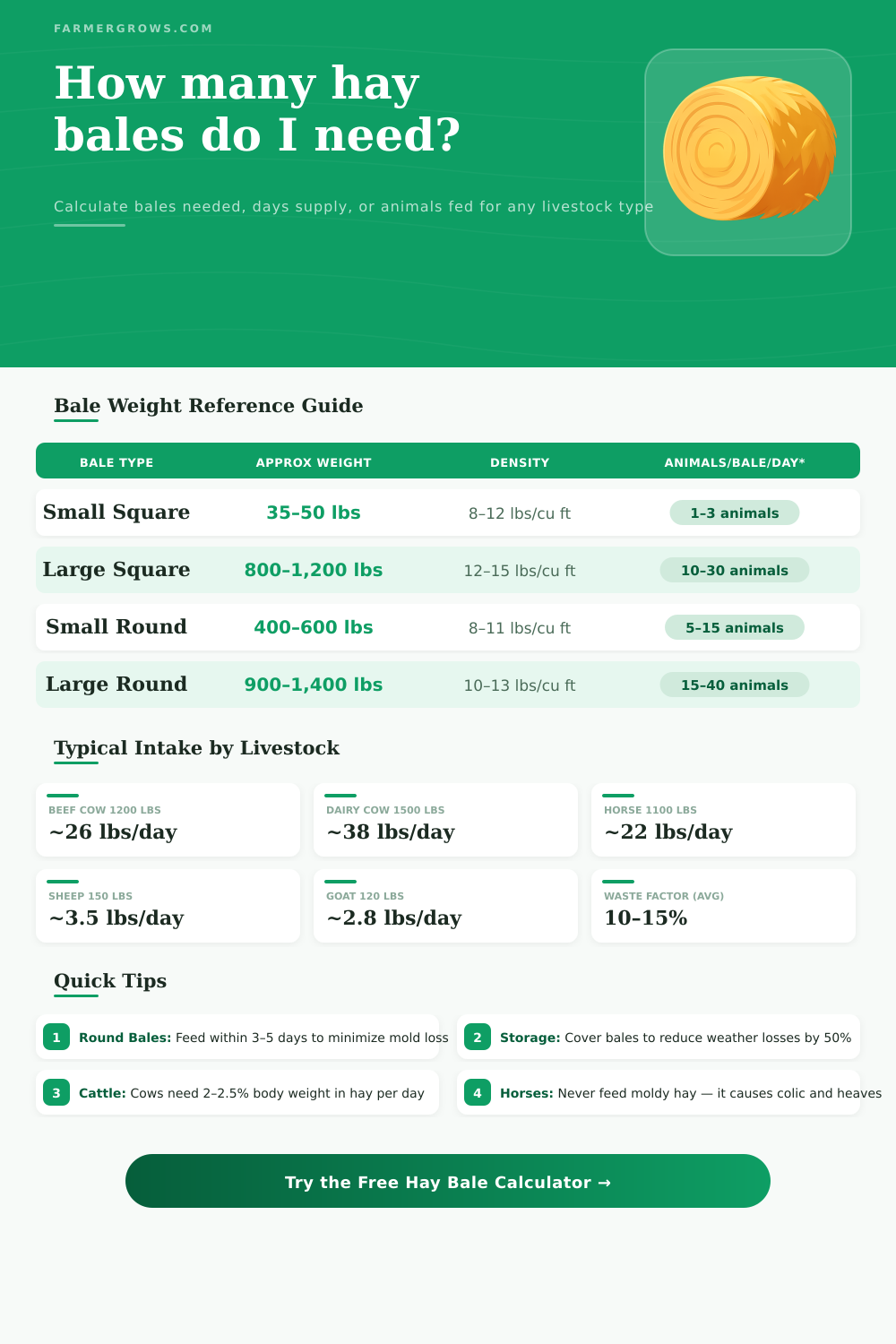
| Bale Type | Approx Weight | Density | Animals/Bale/Day* |
|---|---|---|---|
| Small Square | 35–50 lbs | 8–12 lbs/cu ft | 1–3 animals |
| Large Square | 800–1,200 lbs | 12–15 lbs/cu ft | 10–30 animals |
| Small Round | 400–600 lbs | 8–11 lbs/cu ft | 5–15 animals |
| Large Round | 900–1,400 lbs | 10–13 lbs/cu ft | 15–40 animals |
| Animal | Avg Weight | % BW Hay | Lbs/Day | Notes |
|---|---|---|---|---|
| Beef Cow | 1,200 lbs | 2.0–2.5% | 24–30 lbs | Increases in cold |
| Dairy Cow | 1,500 lbs | 2.0–2.5% | 30–38 lbs | Plus grain for milk |
| Horse | 1,100 lbs | 1.5–2.5% | 17–28 lbs | Light to hard work |
| Sheep (ewe) | 150 lbs | 2.0–4.5% | 3–7 lbs | Stage-dependent |
| Goat (doe) | 120 lbs | 2.0–4.0% | 2.5–5 lbs | Stage-dependent |
| Bale Type | Sq Ft per Bale | Bales per 1,000 sq ft | Stack Height |
|---|---|---|---|
| Small Square (single layer) | 4.5 sq ft | ~220 bales | Up to 5 layers |
| Large Square | 32 sq ft | ~30 bales | 2–3 layers |
| Small Round | 12–16 sq ft | 60–80 bales | 2 layers max |
| Large Round | 25–35 sq ft | 28–40 bales | 2 layers max |
The weight of hay bales depends on several things, like size, kind of grass, moisture and how tightly it is packed. Small square bales usually weigh 40 to 75 pounds but big squares or round can go from 500 to more than 1,500 pounds. Machines bind and pack the hay in set measures, and according to size and density the weight changes
Most farmers that make average square bales want 40-pound ones. Drying conditions can alter the weight, making it less or much more. Bad dried hay cause packages a lot heavier than you expect.
How Much Do Hay Bales Weigh and What Affects Their Weight
Two-string packages from grass hay most commonly weigh 45 to 55 pounds. Also the pressure during packing and the age of the machine affects it. New baler models press more strongly than old ones that only used spring tension.
Alfalfa hay weighs more and is denser than grass species, for instance timothy or bermudagrass. Package from timothy are around 15 % more light than from alfalfa. Water forms big part of the weight.
Hay baled with high humidity weighes more, but too much water can bring molds or decay.
Most little balers give full-sized packages around 4 feet wide and 5 feet diameter. The biggest machines produce 8 feet wide and 6 feet diameter. Weights go from 500 to 2,500 pounds for well prepared hay.
4×5-package has usually 600 to 770 pounds according to grass kind and humidity. 4×6-package weighs about 1,250 pounds, while well packed 5×6-package reaches around 1,500 pounds.
In big formats the difference shows more clearly. Round bale of 5 feet by 6 feet from alfalfa can have 1,500 pounds, while grass version only 1,200 pounds. Mixed hay falls between pure grass and pure alfalfa.
Loosely packed packages have 9 pounds each cubic foot, which matches 880 pounds of dry feed. Tightly packed in 12 pounds each cubic foot almost reach 1,200 pounds of dry feed. Dimensions, density and weight of packages seriously affects nutrition, price for purchase and sale, costs for livestock and ease of transportation and storage.
Bale weight also affects how much time goes for feeding and how often you put out hay. Cow of 1,300 pounds, eating 2.5 percent of its body, consumes 32.5 pounds of hay a day. For you that want precise weight, best weigh on a registered scale, because too many sizes exist so that simply estimating doesnot work.