
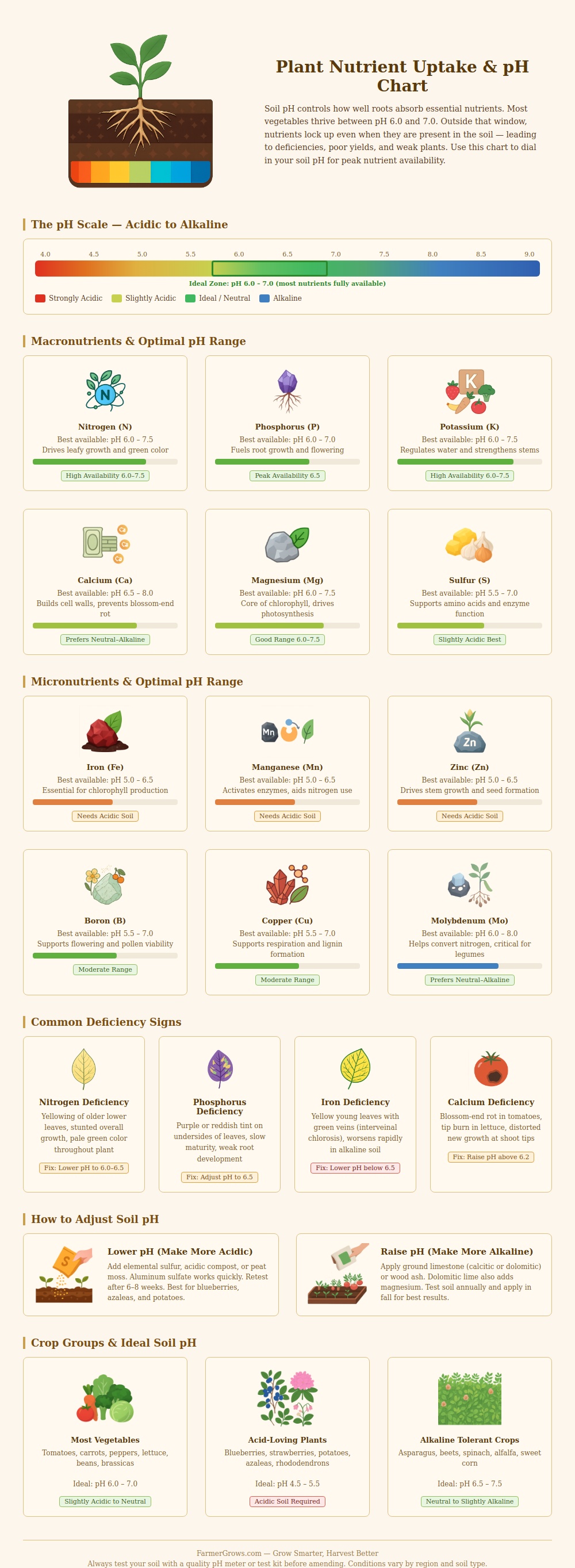
The soil pH seriously affects how plants absorb nutrients. The pH scale goes from 0 to 14, where values under 7 are acidic 7 neutral and higher values alkaline. At certain pH ranges nutrients become more available for plants, because soil pH alters the chemical forms and solubility of those nutrients.
For crop nutrition you must start with pH control, because it affects the access of all nutrients.
How Soil pH Affects Plant Nutrients
The pH of substrate directly acts on nutrient access in the rhizosphere and on absorption of plants. Macronutrients like nitrogen, potassium, calcium, magnesium and sulfur are available in pH 6.0 until 6.5, but micronutrients are then less available. You usually estimate pH 6.5 as optimum for nutrient access.
Nutrients for plants are best available between pH 5.2 and 6.2. Most plants like soil between pH 6 and 7, because here nutrients are best available.
Low pH increases the solubility of aluminum, manganese and iron, that poisons plants in excessive amount. In strongly acidic soil aluminum and manganese become more available and dangerous, while calcium, phosphorus and magnesium are less available. Under pH 5.0 those nutrients can be too available, which leads to toxicity.
Rather, in strongly alkaline soils nutrients are less available. Iron, manganese and zinc hardly reach plants in pH above 7.5, which causes chlorosis and stunted growth. High pH commonly causes iron deficiency with chlorosis, where leaves turn yellow but veins stay green.
Low pH can cause phosphorus deficiency with weak stems and yellowing of old leaves.
Boron is an exception. PH has little impact on its sorption, because uncharged molecules of boric acid are those that roots absorb. Its absorption does not depend on charge and is proportional to the amount of uncharged boric acid molecules.
Interestingly, higher soil pH reduces nitrogen, phosphorus and potassium absorption in rice, but those elements are better absorbed in wheat, corn and beans. Every plant requires nutrients differently, and even one species requires differently according to life stage. Strategy I plants activate H+-ATPase, that pumps protons in rhizosphere, sours it and makes ferric iron more accessible.
Ammonium ions absorb much more quickly than nitrates, which causes acidic pH build up in substrate. Plants absorbing anions and cations can strongly move pH in the growing system. You must alter soil pH to ensure that plants receive elements for healthy growth.