🔧 Hydraulic Hose Size Calculator
Find the correct hose inner diameter based on flow rate, line type & velocity limits
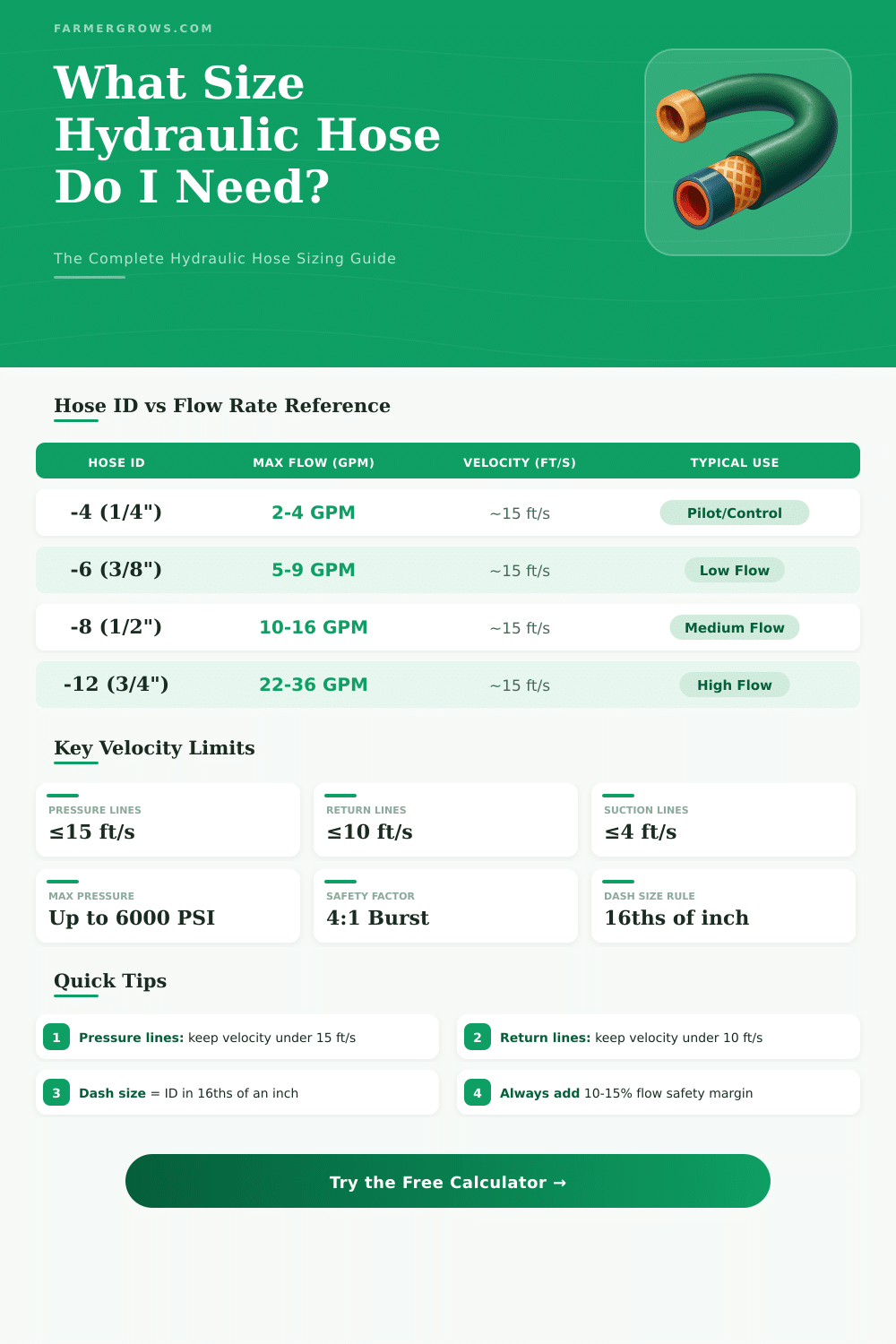
| Dash Size | ID (inches) | Pressure Line Max (GPM) | Return Line Max (GPM) | Suction Line Max (GPM) |
|---|---|---|---|---|
| -4 | 1/4" | 4 | 2.5 | 0.7 |
| -5 | 5/16" | 6 | 4 | 1.1 |
| -6 | 3/8" | 9 | 6 | 1.6 |
| -8 | 1/2" | 16 | 10 | 2.8 |
| -10 | 5/8" | 25 | 16 | 4.4 |
| -12 | 3/4" | 36 | 23 | 6.3 |
| -16 | 1" | 64 | 41 | 11.2 |
| -20 | 1-1/4" | 100 | 64 | 17.5 |
| -24 | 1-1/2" | 144 | 92 | 25.2 |
| -32 | 2" | 256 | 164 | 44.8 |
| Series | Construction | Working Pressure (PSI) | Burst Pressure (PSI) | Typical Application |
|---|---|---|---|---|
| 1SN / R1 | Single wire braid | 3,000 | 12,000 | Low-medium pressure |
| 2SN / R2 | Double wire braid | 4,000 | 16,000 | General hydraulics |
| R1T | Single textile braid | 3,625 | 14,500 | Low contamination systems |
| R2T | Double textile braid | 5,800 | 23,200 | High-flex applications |
| 4SP | 4-spiral wire | 5,000 | 20,000 | Mobile equipment |
| 4SH | 4-spiral high pressure | 6,000 | 24,000 | High-pressure systems |
| R7 | Thermoplastic | 4,350 | 17,400 | Lightweight / compact |
| R12 | Multi-spiral | 6,000 | 24,000 | Extreme pressure |
| Hose ID (mm) | Pressure Max (L/min) | Return Max (L/min) | Suction Max (L/min) | Cross-Section (mm²) |
|---|---|---|---|---|
| 6.3 mm | 15 | 9 | 2.5 | 31.2 |
| 8.0 mm | 23 | 15 | 4 | 50.3 |
| 10.0 mm | 36 | 23 | 6.3 | 78.5 |
| 12.5 mm | 56 | 36 | 9.8 | 122.7 |
| 16.0 mm | 91 | 58 | 16 | 201.1 |
| 19.0 mm | 129 | 82 | 22.5 | 283.5 |
| 25.0 mm | 223 | 142 | 39 | 490.9 |
| 32.0 mm | 366 | 234 | 64 | 804.2 |
Choosing the right size of hydraulic hoses is important when you work with tractors, loaders, tillers and other farm machines. Wrong choice can cause leaks, loss of pressure and early failure of the gear. So knowing how to measure and choose the right hose genuinely helps you that use hydraulics on the farm
The sizing of hydraulic hoses is made up of calculating the right measures so that it works in the system. This includes the internal and external diameter of the hose, and understanding the dash size that goes with them. ID and OD sizes are very important because they must not be too small nor too big.
How to Choose the Right Hydraulic Hose Size for Tractors and Farm Machines
Dash sizes are the standard method in the hydraulic industry for measuring hoses and coupling threads. The dash number shows the internal diameter in sixteenths of inch. For instance, dash 8 means 8/16, so half of inch.
Commonly you find on tractors sizes as -04, -06, -08, -10, -12 and -16. Hydraulic hoses use the size according to internal diameter, so a half-inch hose is 0.5 inches decmial.
For applications with high pressure, the two main sizes are 1/4 inch and 3/8 inch. Many farm machines, as back blades and loader cylinders, use 3/8 inch hoses. Even 4-inch cylinders on a blade can get fluid by means of 3/8 inch.
For systems as those of Allis Chalmers, 3/8 inch commonly works well.
Hydraulic pressure works like this, that even a small hose delivers quite a lot to the working end like a bucket or boom. But the speed of the machines depends on the flow and its haste. So a big internal diameter chosen right is a smart notion.
Some folks like to upgrade hoses of same size for refill.
Also the length of hydraulic hose matters. Too short a hose causes tension and restriction of motion in the system. Not everything is one-size-fits-all.
For instance, a replacement hose from a valve to oil lines of a loader can be 3/8 inch in 36 inches. Other typical hoses on tractors have around 48 inches with half-inch thread fittings. Local stores as Tractor Supply or Farm and Fleet usually have such hoses.
Right fittings will stop leaks, loss of pressure and early failure of gear. Choosing the right line size for a hydraulic system is key for best performance and long life of the parts. A nomograph is a simple and effective tool for finding the ideal dash size from easy indications.
Store common sizes, as half-inch spool and fewer 1/4, 3/8 and 3/4 inch hoses together with typical fittings, save money for repairs compared to buying premade hoses at stores.