🌺 Camellia Spacing Calculator
Calculate exactly how much space your camellias need based on species, planting style, and garden size
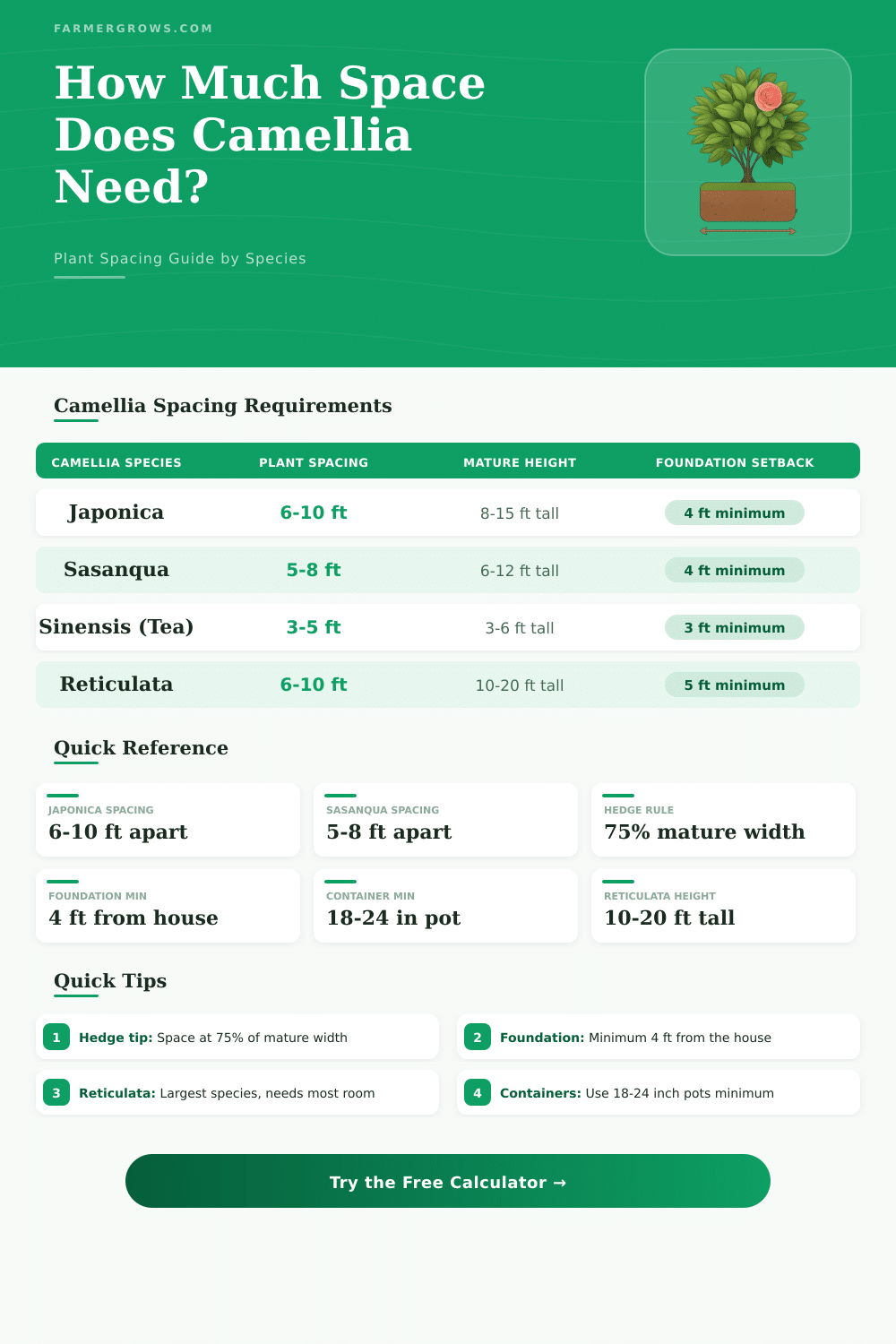
| Camellia Species | Plant Spacing | Mature Width | Mature Height | Foundation Setback |
|---|---|---|---|---|
| Japonica | 6–10 ft (180–300 cm) | 6–10 ft (180–300 cm) | 8–15 ft | 4 ft min |
| Sasanqua | 5–8 ft (150–240 cm) | 5–8 ft (150–240 cm) | 6–12 ft | 4 ft min |
| Sinensis (Tea) | 3–5 ft (90–150 cm) | 3–5 ft (90–150 cm) | 3–6 ft | 3 ft min |
| Reticulata | 6–10 ft (180–300 cm) | 6–10 ft (180–300 cm) | 10–20 ft | 5 ft min |
| Hybrid | 5–8 ft (150–240 cm) | 5–8 ft (150–240 cm) | 6–12 ft | 4 ft min |
| Camellia Species | Growth Rate | Years to Mature | Spread at Maturity | Best For |
|---|---|---|---|---|
| Japonica | Slow to moderate | 5–10 years | 6–10 ft diameter | Specimen, foundation, espalier |
| Sasanqua | Moderate to fast | 4–7 years | 5–8 ft diameter | Hedge, screen, espalier |
| Sinensis (Tea) | Moderate | 3–5 years | 3–5 ft diameter | Hedge, container, edible garden |
| Reticulata | Moderate | 6–12 years | 6–10 ft diameter | Specimen, large gardens |
| Hybrid | Moderate | 4–8 years | 5–8 ft diameter | Hedge, screen, specimen |
| Camellia Species | Hedge Spacing | Plants Per 10 ft | Fill-In Time |
|---|---|---|---|
| Japonica | 4.5–7.5 ft (75% of width) | 1–2 plants | 4–6 years |
| Sasanqua | 3.75–6 ft (75% of width) | 2–3 plants | 3–4 years |
| Sinensis (Tea) | 2.25–3.75 ft (75% of width) | 3–4 plants | 2–3 years |
| Reticulata | 4.5–7.5 ft (75% of width) | 1–2 plants | 5–7 years |
| Hybrid | 3.75–6 ft (75% of width) | 2–3 plants | 3–5 years |
| Garden Size | Specimen Plants | Hedge Row Plants | Screen Planting |
|---|---|---|---|
| 6 × 6 ft (1.8 × 1.8 m) | 1 (small species) | N/A | 1 |
| 10 × 10 ft (3 × 3 m) | 1–2 | 2–3 | 2–3 |
| 20 × 10 ft (6 × 3 m) | 2–3 | 3–5 | 4–6 |
| 30 × 6 ft (9 × 1.8 m) | 3–4 | 4–7 (hedge line) | 5–8 |
| 20 × 20 ft (6 × 6 m) | 3–4 | 4–6 | 6–10 |
| 50 × 20 ft (15 × 6 m) | 5–8 | 8–12 | 12–25 |
Get the right spacing for Camellia plants matters a lot. That helps the plants grow well and receive enough water and food from the ground. One usually advises to leave at least five feet between them and more Space is even more helpful.
The spacing of plants must be based on their size when they mature and on the speed of their growth.
How Far to Space Camellia Plants
For fences the situation changes a bit. Three feet between plants works well for forming a Camellia fence. Some gardeners lay Camellia plants along the line of fence to create a thick screen for privacy.
A fence six feet in height commonly works to hide the sight of the way. Some species can reach five metres of height if one does not trim them, so if the place is narrow, cutting for shape and height after flowering is a wise step.
The spacing depends also on the kind of Camellia that one plants. It really relates to the exact variety. For instance, if a Camellia reaches six feet of width, leave four feet between them, measuring from centre to centre, works well.
That means estimating from the centre of one plant to the centre of the naxt. Always worth checking the label of the plant about the mature width before making a decision about the distance.
Sasanqua Camellia plants grow quickly and can reach six to fourteen feet of height and five to seven feet of width. Their flowers reach up to three inches across and last during four to six weeks. Because Sasanqua plants tend to stay more small and more tolerant in heat and sun than Japanese Camellia plants, they work for spots wear the Space lacks.
Small varieties like the red Chansonette Camellia work well for pots.
Camellia plants should be planted in partial shade or filtered sunshine. The ideal place is protected against cold winds and early morning sun. Leave three to five metres between plants to give each one enough Space.
Plant Camellia at least six feet away from a building is good usual advice, and slightly sour soil works best.
Regular watering is also important. Covering the root zone with organic mulch helps to keep the ground quite moist. Adding and keeping two to three inches of mulch is helpful.
If one plants Camellia in autumn, the new roots give a good base for growth when the spring arrives.
Camellia plants are usually grown as single copies, but they also work well for fences or even under other plants. For instance, the Japanese Camellia can fill Space well and one can plant under it. Some varieties do not need cutting to help flowering, whichmakes the task quite simple.